YouTube Shorts vs Long-Form Video: Which Content Format Grows Your Channel Faster

You have 10 hours this week to create YouTube content. Do you spend it filming one polished 15-minute video, or do you pump out 20 quick Shorts? The answer determines whether your channel grows or stagnishes.
The data tells a story that most creators miss. According to Neal Schaffer, YouTube Shorts now averages 200 billion views daily as of June 2025, nearly tripling from 70 billion just a year ago. Meanwhile, long-form videos still dominate watch time and ad revenue. The format war is not about picking a winner. It is about understanding what each format actually delivers.
This comparison breaks down the growth mechanics of both formats using real channel data and platform statistics. You will see which format builds subscribers faster, which keeps them watching longer, and how the smartest creators use both to compound their growth.
The Raw Numbers: How Each Format Performs
YouTube Shorts exploded in visibility over the past year. The jump from 70 billion to 200 billion daily views represents a fundamental shift in how people consume video content. But views do not equal growth.
AM World Group found that creators who post 3 to 5 Shorts weekly alongside 1 to 2 long-form videos see subscriber growth rates increase by 67% compared to single-format channels. This hybrid approach outperforms channels that commit entirely to one format.
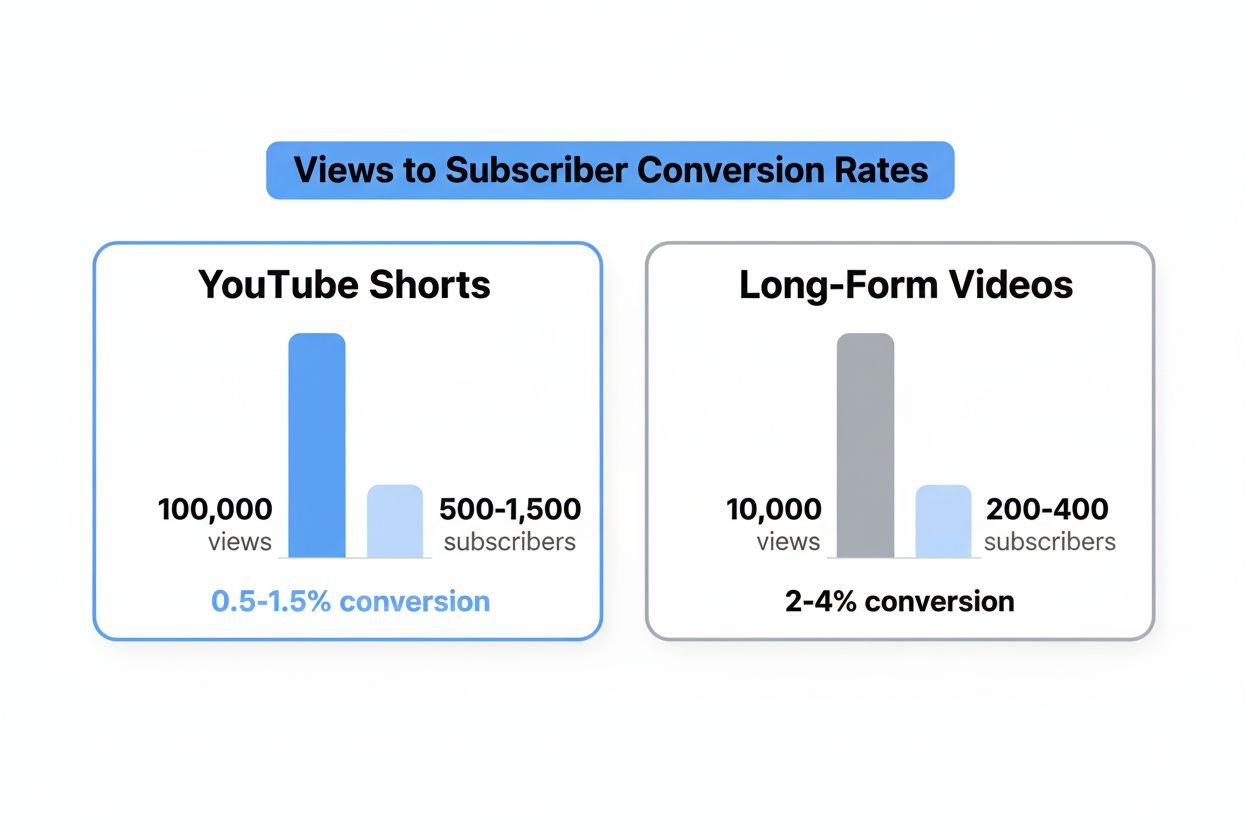
The subscriber conversion rate differs dramatically between formats. Long-form videos convert viewers to subscribers at roughly 2-4% when the content delivers on its promise. Shorts convert at 0.5-1.5% because viewers scroll through dozens in a session without forming channel attachment.
Here is what that means in practice: A long-form video with 10,000 views might bring 200-400 new subscribers. A Short with 100,000 views might bring 500-1,500 subscribers. The Short reaches 10x more people but converts at one-third the rate.
Watch time matters more than raw views for channel authority. YouTube's algorithm weighs watch time heavily when recommending content. A 12-minute video that keeps viewers for 8 minutes signals quality. A 45-second Short that viewers watch completely signals engagement but accumulates less total watch time per view.
According to AIR Media-Tech, long-form content holds an advantage for building lasting subscriber count. The extended viewing session creates familiarity. Viewers who spend 10 minutes with your content feel like they know you. Viewers who watch a 30-second Short barely register your channel name.
Algorithm Behavior: What YouTube Actually Rewards
YouTube's recommendation system changed substantially in 2024-2025. AM World Group reports that YouTube's algorithm now analyzes over 1,000 different signals to determine content visibility, compared to approximately 200 signals in previous years.
This complexity means the platform evaluates content across multiple dimensions simultaneously. For Shorts, the algorithm prioritizes:
- Completion rate (did viewers watch to the end)
- Rewatch rate (did they loop it)
- Share rate (did they send it to others)
- Swipe-away speed (how fast did they move to the next Short)
For long-form videos, the algorithm weighs:
- Average view duration (how long viewers stayed)
- Click-through rate from thumbnails
- Session start rate (does your video begin viewing sessions)
- Repeat viewers (do people come back to your channel)
The algorithm treats these formats as separate ecosystems. A viral Short does not automatically boost your long-form videos. A successful long-form video does not push your Shorts to more viewers. They operate in parallel recommendation streams.
This separation creates an opportunity. Channels can build two distinct audiences: Short-form scrollers who want quick entertainment, and long-form viewers who want depth. The challenge is converting the first group into the second.
Production Time vs Output: The Efficiency Question
Time investment differs wildly between formats. A quality 10-minute long-form video typically requires:
- 2-3 hours of research and scripting
- 1-2 hours of filming
- 3-5 hours of editing
- 30 minutes for thumbnail creation
- Total: 7-11 hours
Five YouTube Shorts typically require:
- 30 minutes of concept development
- 1-2 hours of filming (batch recording)
- 2-3 hours of editing (5 videos)
- Total: 4-6 hours
The Shorts deliver more content pieces per hour invested. But each piece carries less individual weight. A strong long-form video can drive traffic for months through search and suggested videos. Most Shorts peak within 48 hours and then fade.
YouTube Shorts now supports videos up to 3 minutes long, according to AIR Media-Tech. This extension blurs the line between formats. A 3-minute Short can deliver substantial value while remaining in the high-velocity Shorts feed.
Creators who batch-produce Shorts maintain consistency more easily. Filming 10 Shorts in one session and releasing them over two weeks creates a steady content flow. Long-form videos demand more per-video investment, making weekly uploads harder to sustain.

Audience Retention: Who Stays and Who Leaves
Subscriber quality differs between formats. AM World Group found that creators who balance short-form content with long-form videos maintain 40% higher audience retention rates.
This retention gap exists because long-form viewers make a conscious choice to subscribe. They invested time in your content and want more. Shorts subscribers often click subscribe during a dopamine spike from a viral video, then forget about your channel.
The notification behavior reflects this difference. Long-form subscribers turn on notifications at higher rates. They anticipate your next upload. Shorts subscribers rarely enable notifications because they discovered you through algorithmic recommendation, not intentional search.
Channel loyalty builds through repeated exposure. A viewer who watches five of your 10-minute videos has spent 50 minutes with your content. A viewer who watches 50 of your Shorts has spent 25 minutes with your content. The first viewer feels invested. The second viewer barely remembers you.
This creates a retention problem for Shorts-only channels. They accumulate subscribers who never return. The subscriber count rises but view counts stagnate. The channel looks successful on paper but lacks an engaged audience.
Long-form channels face the opposite problem. They build loyal audiences but struggle to reach new viewers. The algorithm favors content that starts viewing sessions, and long-form videos compete with every other video on the platform for that initial click.
Monetization Reality: Where the Money Actually Comes From
Revenue models differ fundamentally between formats. Long-form videos generate income through:
- Mid-roll ads (for videos over 8 minutes)
- Pre-roll and post-roll ads
- Sponsorship integration
- Affiliate links in descriptions
- Channel memberships from loyal viewers
YouTube Shorts generate income through:
- Shorts Fund (being phased out)
- Ad revenue sharing from the Shorts feed (lower CPM than long-form)
- Driving traffic to monetized long-form content
The CPM (cost per thousand views) for Shorts sits substantially lower than long-form content. A long-form video might earn $3-8 per 1,000 views depending on niche and audience location. Shorts typically earn $0.05-0.10 per 1,000 views.
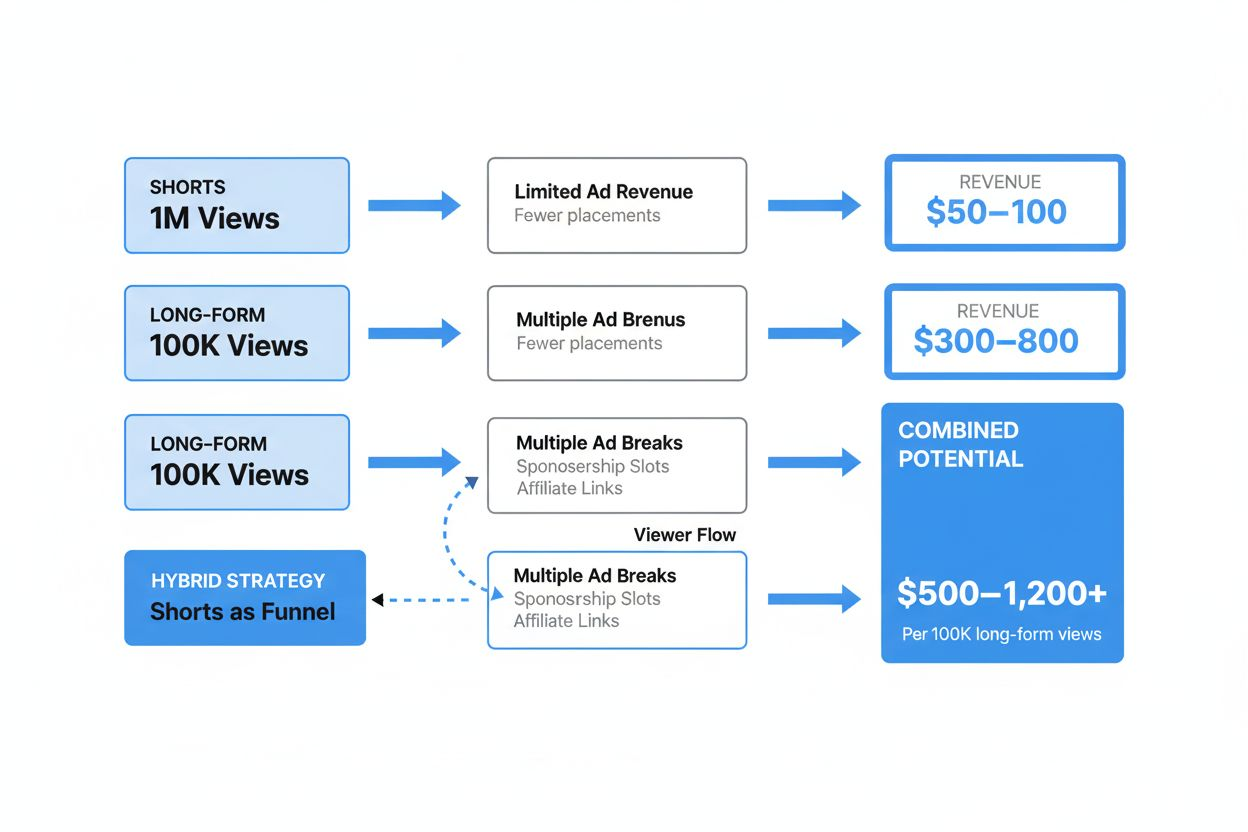
This means a Short with 1 million views might generate $50-100. A long-form video with 100,000 views might generate $300-800. The Short reaches 10x more people but earns a fraction of the revenue.
Sponsorships favor long-form content. Brands pay for integration that feels natural and gives them 60-90 seconds of attention. A 30-second Short cannot accommodate meaningful sponsorship without feeling like a pure ad.
The hybrid approach solves this monetization gap. Shorts attract new viewers at scale. Long-form videos convert those viewers into revenue. AIR Media-Tech notes that using Shorts to tease longer videos and integrating playlists can increase overall channel watch time.
The Hybrid Strategy: How Top Creators Use Both Formats
The 67% growth advantage for hybrid channels is not random. It reflects a deliberate content strategy that leverages the strengths of each format.
Successful creators use Shorts as a discovery engine. They create Shorts that:
- Extract the most compelling 30-60 seconds from long-form videos
- Answer single questions that lead to deeper topics
- Showcase personality and presentation style
- Include clear calls to action pointing to long-form content
The Shorts feed becomes a perpetual audition. Thousands of potential subscribers see your content daily. The ones who resonate click through to your channel and find the long-form videos that convert them into loyal viewers.
This approach requires intentional design. The Short cannot just be a random clip. It needs to create curiosity or leave a question unanswered. A Short that fully resolves its topic gives viewers no reason to watch more.
Effective Shorts-to-long-form bridges include:
- "I explain the full method in the link in my bio"
- "Watch the full video to see what happened next"
- "This is step 1 of 5 - full tutorial on my channel"
- Ending on a cliffhanger or unexpected result
The playlist strategy amplifies this effect. Creators organize long-form videos into themed playlists, then reference these playlists in Shorts. A viewer who clicks through lands in an autoplay sequence that keeps them watching for 30-60 minutes.
Posting frequency matters for the hybrid approach. The AM World Group data shows that 3-5 Shorts per week alongside 1-2 long-form videos hits the optimal balance. More Shorts than that dilutes quality. Fewer Shorts misses the discovery opportunity.
This schedule also matches production capacity for most creators. Two long-form videos per week (14-22 hours of work) plus five Shorts (4-6 hours of work) totals 18-28 hours. That is a sustainable full-time creator workload.
Channel Size and Format Choice: What Works at Different Stages
Your current subscriber count changes which format delivers better returns.
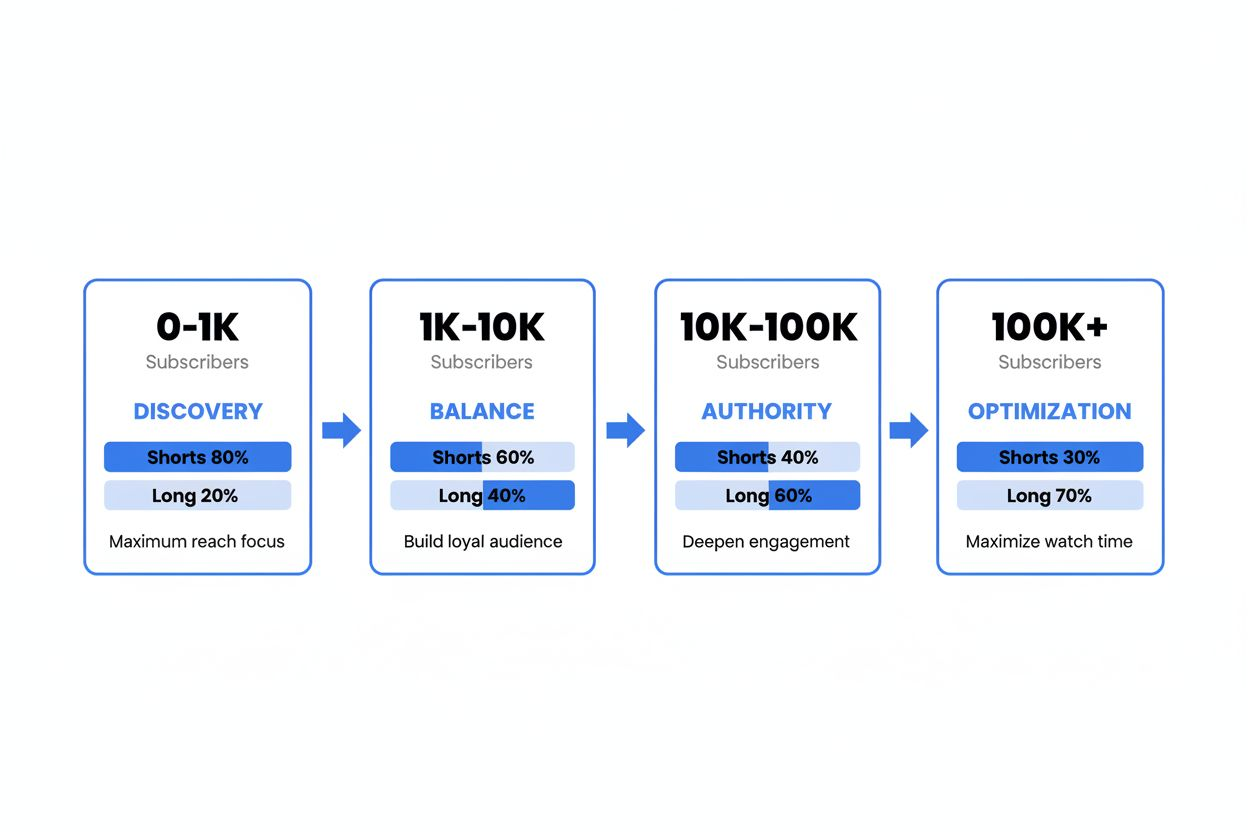
Channels under 1,000 subscribers benefit more from Shorts. The barrier to entry is lower. A single viral Short can jump a channel from 200 to 5,000 subscribers overnight. Long-form videos at this stage struggle to reach anyone because the channel lacks authority in YouTube's algorithm.
According to Neal Schaffer, only 618,955 channels have 100,000+ subscribers, representing less than 1% of all YouTube channels. The vast majority of creators sit below 10,000 subscribers, where discovery is the primary challenge.
Shorts solve the discovery problem through algorithmic distribution. YouTube pushes Shorts to viewers who have never heard of your channel. Long-form videos rely more heavily on search, suggested videos, and existing subscribers.
Channels between 1,000 and 10,000 subscribers should split focus evenly. Use Shorts to maintain growth momentum while building a long-form library that establishes topical authority. This stage is about proving you can sustain quality across both formats.
Channels above 10,000 subscribers can lean more heavily into long-form content. They have enough algorithmic authority that their long-form videos reach new viewers through suggested videos and search. Shorts become a supplementary growth tool rather than the primary engine.
Channels above 100,000 subscribers often reduce Shorts frequency. Their brand recognition and loyal audience make long-form content more efficient. They use Shorts strategically for specific campaigns or to maintain feed presence, but the core content strategy centers on long-form videos.
Content Types That Favor Each Format
Certain content naturally fits one format better than the other.
Shorts excel at:
- Quick tips and hacks
- Before-and-after reveals
- Reaction content
- Trending audio challenges
- Myth-busting single facts
- Personality-driven humor
- Product demonstrations under 60 seconds
Long-form videos excel at:
- Tutorials with multiple steps
- In-depth analysis and commentary
- Storytelling with narrative arcs
- Interviews and conversations
- Product reviews with context
- Educational content requiring explanation
- Vlogs documenting experiences
Some content works in both formats with different approaches. A recipe can be a 30-second Short showing the final result and key steps, or a 10-minute long-form video explaining techniques and variations. The Short attracts viewers who want quick inspiration. The long-form video serves viewers who want to actually cook the dish.
Educational creators face a specific challenge. Complex topics require time to explain properly. A Short can introduce a concept but cannot teach it completely. This creates a natural funnel: Shorts introduce ideas, long-form videos teach the complete skill.
Entertainment creators have more flexibility. A comedian can deliver complete jokes in Shorts or build longer narrative sketches in long-form videos. Both formats work independently. The choice depends on the specific joke structure and punchline timing.
Search and Discovery: How Viewers Find Each Format
Long-form videos dominate YouTube search results. When someone searches "how to change a tire," they want a complete tutorial, not a 30-second clip. Search intent favors depth.
Shorts appear in a separate feed that users access by clicking the Shorts icon or swiping up from a Short. This feed operates like TikTok or Instagram Reels - an endless scroll of algorithmically selected videos. Users do not search for Shorts. The algorithm delivers them.
This discovery difference affects content strategy. Long-form videos should target specific search terms and questions. Titles and descriptions need SEO optimization. Thumbnails need to stand out in search results and suggested video sidebars.
Shorts need hooks that stop the scroll. The first frame and first second determine whether a viewer keeps watching or swipes away. Titles matter less because most viewers never read them. The visual and audio hook carries the entire burden.
Evergreen content favors long-form videos. A tutorial on "how to build a website" remains relevant for years and accumulates views through search. A Short about a trending audio clip peaks quickly and then dies.
Trending content favors Shorts. Reacting to current events or viral moments works better in a format that distributes quickly and widely. Long-form videos take longer to produce, and by the time they publish, the trend may have passed.
The Algorithm's Dual Recommendation System
YouTube operates two separate recommendation engines. Understanding this split clarifies why the hybrid approach works.
The long-form recommendation engine prioritizes:
- Videos that keep viewers on YouTube for extended sessions
- Content similar to what the viewer previously watched
- Videos from channels the viewer subscribes to
- Content that other viewers with similar interests watched
The Shorts recommendation engine prioritizes:
- Videos that viewers watch completely
- Content that generates immediate engagement (likes, comments, shares)
- Shorts from creators the viewer does not already follow (to maximize discovery)
- Videos that match trending audio or topics
These engines do not cross-pollinate automatically. A viewer who watches your Shorts will not automatically see your long-form videos in their home feed. You must explicitly direct them to your long-form content.
This separation explains why some channels have millions of views on Shorts but low view counts on long-form videos. The Shorts audience never migrated to the long-form content because the creator did not build a bridge.
The most effective bridge is the channel page itself. When a Short performs well, a percentage of viewers click through to your channel. If your channel page clearly showcases your best long-form videos with compelling thumbnails, those viewers convert. If your channel page is disorganized or unclear, they leave.
Practical Implementation: Building Your Content Calendar
A realistic content calendar for the hybrid approach looks like this:
Monday: Film long-form video (2 hours) Tuesday: Edit long-form video (4 hours) Wednesday: Film 5 Shorts in batch session (1.5 hours) Thursday: Edit and schedule Shorts (2.5 hours) Friday: Publish long-form video, publish Short #1 Saturday: Publish Short #2 Sunday: Publish Short #3 Monday: Publish Short #4 Tuesday: Publish Short #5
This schedule produces 1 long-form video and 5 Shorts per week with about 10 hours of production time. It is sustainable for a part-time creator and leaves room for strategy, community engagement, and analytics review.
Batch production is critical for Shorts. Setting up once and filming multiple Shorts in sequence saves setup time and maintains creative momentum. Trying to film one Short per day fragments your schedule and reduces efficiency.
Long-form videos benefit from a consistent publishing schedule. Viewers and the algorithm both reward predictability. Publishing every Friday at 3 PM trains your audience to expect new content and signals to YouTube that your channel is active and reliable.
The content relationship between Shorts and long-form videos should be intentional. Options include:
- Shorts as teasers: Extract compelling moments from upcoming long-form videos
- Shorts as extensions: Create additional content that expands on long-form topics
- Shorts as standalone: Produce independent content that showcases your personality and drives channel discovery
The teaser approach creates anticipation. The extension approach maximizes value from research and filming. The standalone approach builds a separate content library that attracts different audience segments.
Analytics: What to Actually Measure
Different metrics matter for each format.
For Shorts, track:
- View count (raw reach)
- Average view duration as percentage (completion rate)
- Likes per view (engagement rate)
- Shares per view (virality indicator)
- Profile visits from Shorts (discovery effectiveness)
For long-form videos, track:
- Average view duration in minutes (engagement depth)
- Click-through rate from impressions (thumbnail and title effectiveness)
- Subscriber conversion rate (audience building)
- Watch time contribution (monetization and algorithm weight)
- Returning viewer percentage (loyalty)
The hybrid strategy adds one critical metric: cross-format conversion rate. What percentage of viewers who discover you through Shorts eventually watch a long-form video? This number indicates whether your bridge strategy works.
You can estimate cross-format conversion by comparing:
- New subscribers from Shorts week (visible in analytics)
- Long-form video views from non-subscribers in the following week
- Channel page visits from Shorts (visible in traffic sources)
If Shorts bring 1,000 new subscribers but your long-form videos show no increase in views from non-subscribers, your conversion strategy failed. If Shorts bring 1,000 new subscribers and your next long-form video gets 300 views from non-subscribers, your strategy works.
According to Neal Schaffer, there are 65.3 million YouTube creators as of June 2025. In this crowded landscape, data-driven decisions separate growing channels from stagnant ones. Track what matters, ignore vanity metrics, and adjust based on results.
The Verdict: Which Format Grows Channels Faster
Neither format wins universally. The answer depends on your current position and goals.
For raw subscriber acquisition speed in the first 1,000 subscribers: Shorts win. They reach more people faster and can trigger explosive growth from a single viral video.
For building an engaged, loyal audience that watches regularly: Long-form wins. The time investment from viewers creates stronger channel attachment and higher retention rates.
For sustainable long-term growth and monetization: The hybrid approach wins by 67%, according to AM World Group. Creators who post 3-5 Shorts weekly alongside 1-2 long-form videos see subscriber growth rates increase by 67% compared to single-format channels.
The hybrid strategy compounds advantages. Shorts provide the discovery and reach that new channels desperately need. Long-form videos provide the depth and watch time that the algorithm rewards and that sponsors pay for. Together, they create a growth engine that neither format can match alone.
The creators who balance short-form content with long-form videos maintain 40% higher audience retention rates, according to AM World Group. This retention advantage translates to stable view counts, predictable revenue, and sustainable channel growth.
Your production time should reflect your channel stage. Early-stage creators should invest 60-70% of production time in Shorts to solve the discovery problem. Mid-stage creators should split time evenly to build both reach and depth. Established creators should invest 70-80% of production time in long-form content to maximize revenue and audience loyalty while using Shorts strategically for specific growth campaigns.
The format war is a false choice. The real question is not which format grows channels faster, but how to use both formats strategically to compound your growth. The data shows that creators who understand this distinction build channels that reach more people, keep them watching longer, and generate more revenue than creators who commit to a single format.