Channel Attribution Models Decoded for YouTubers: Which One Actually Credits Your Video Content Fairly
You spent 40 hours scripting, filming, and editing a video explaining how your product solves a specific problem. A viewer watches it, searches your brand name three days later, clicks a Google ad, and buys. Your analytics credit the sale to "paid search." The video gets zero recognition.
This happens thousands of times per day to content creators who don't understand channel attribution. The models that businesses use to track which marketing efforts drive conversions systematically ignore or undervalue video content. If you create videos as part of a business strategy, you need to know how attribution works and why the default settings are rigged against you.
What Channel Attribution Actually Measures
Channel attribution assigns credit for a conversion (a sale, signup, download, or other goal action) to the marketing touchpoints that led to it. When someone converts, they rarely do it on their first interaction with your brand. They might watch a YouTube video, see a social post, click an email, search your brand name, and then finally purchase. Attribution models decide which of those steps gets credit.
The model you use determines which channels look successful and which look like they are wasting money. Choose the wrong model, and you will cut budgets from the exact content that is driving your growth.
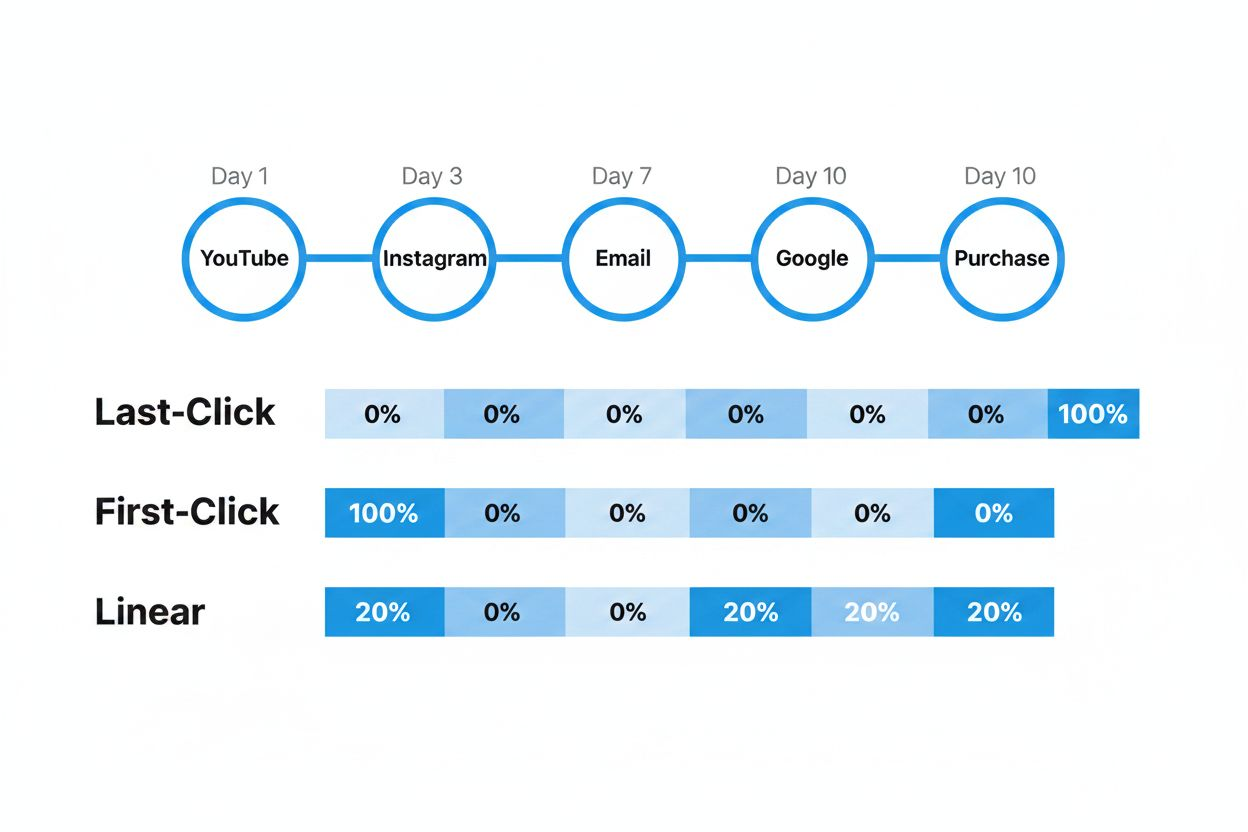
Most platforms default to last-click attribution. This model gives 100% of the credit to the final touchpoint before conversion. For video creators, this is a disaster. Video content typically works at the top of the funnel, introducing people to your brand or product. By the time they convert, they have interacted with other channels. Last-click erases your contribution entirely.
Why Last-Click Attribution Systematically Undervalues Video
According to Twilio, last-touch attribution can sway results in favor of platforms like Google Ads and lead to incorrect optimization decisions. Here is how this plays out for video creators.
Someone discovers your brand through a YouTube video where you demonstrate your product. They are interested but not ready to buy. Three days later, they remember your brand name and search for it on Google. They click your ad (because competitors are bidding on your brand terms) and purchase. Last-click gives 100% credit to the Google ad. The video that created the initial demand gets nothing.
Twilio describes this exact scenario: in a YouTube pre-roll plus paid search situation, last-touch only credits the search click, ignoring the video ad that initiated the purchase intent. The same logic applies whether you are running video ads or creating organic content.
The problem compounds when you look at aggregate data. Your analytics show that paid search has a great return on ad spend while video has almost none. You increase your search budget and cut video production. But search was only converting people who already knew about you from video. When video stops creating awareness, search conversions drop too. You have optimized yourself into a worse position.
How Different Attribution Models Treat Your Video Content
Last-Click Attribution
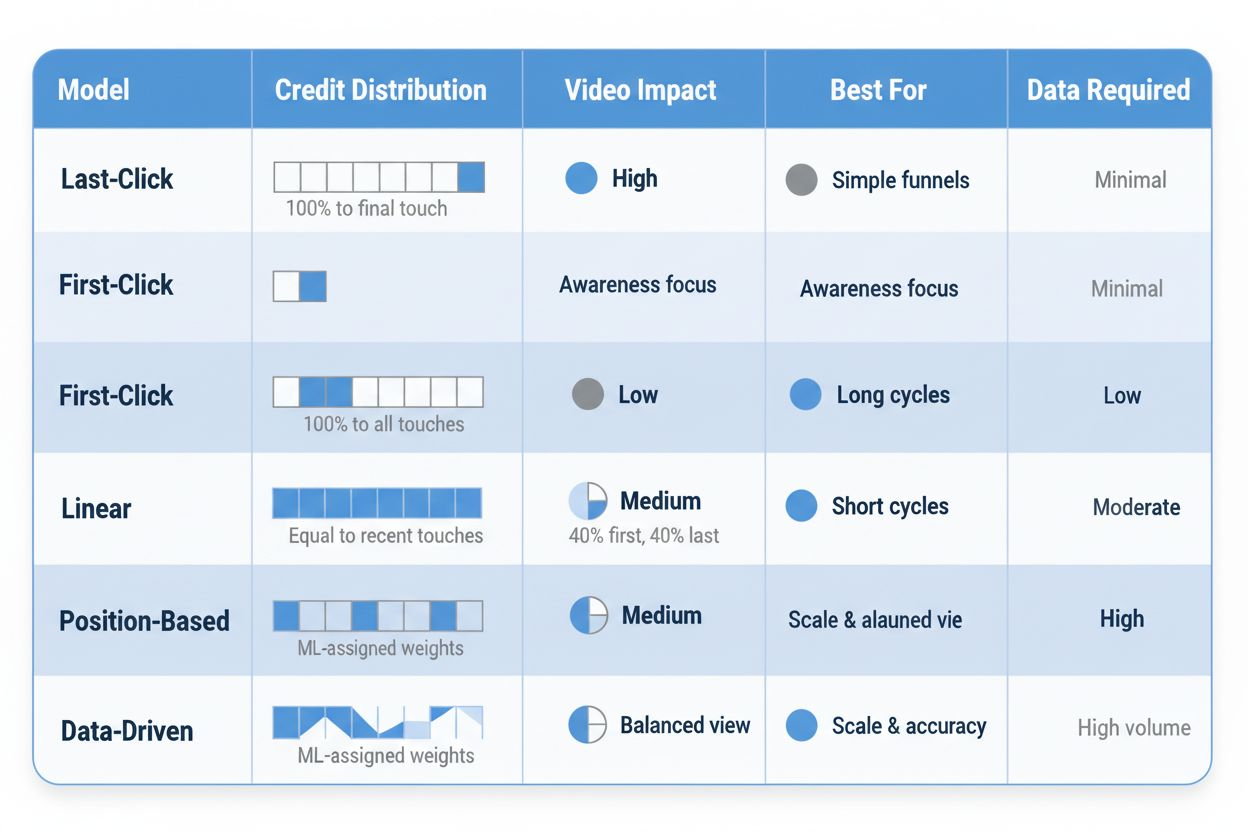
Gives all credit to the final interaction before conversion. Video almost never wins here unless someone watches a video and immediately converts without any other touchpoints. This model makes bottom-funnel tactics (retargeting, branded search, email) look incredibly effective while making top-funnel content (educational videos, how-to guides) look worthless.
First-Click Attribution
Gives all credit to the first interaction. This swings too far in the opposite direction. According to Twilio, first-touch attribution would overemphasize the YouTube ad while ignoring the paid search ad's role in closing the conversion. Your video gets credit even when other channels did the heavy lifting of converting awareness into action.
Linear Attribution
Distributes credit equally across all touchpoints. If someone had five interactions before converting, each gets 20% credit. This is fairer to video but still imperfect. It assumes every touchpoint contributed equally, which is rarely true. The video that introduced the product and the retargeting ad that reminded them to complete checkout did not have the same impact.
Time-Decay Attribution
Gives more credit to touchpoints closer to the conversion. A video watched 20 days ago gets less credit than an email clicked yesterday. This model acknowledges that recent interactions matter more but still undervalues the initial awareness that video often creates.
Position-Based (U-Shaped) Attribution
Assigns 40% credit to the first touchpoint, 40% to the last, and splits the remaining 20% among middle interactions. This recognizes that both creating awareness and closing the sale matter. Video content benefits here if it is the first touchpoint, but middle-funnel videos still get minimal credit.
Data-Driven Attribution
Uses machine learning to analyze actual conversion paths and assign credit based on which touchpoints statistically increase conversion likelihood. According to SEO Premier, Data-Driven Attribution (DDA) uses machine learning to analyze all conversion paths and requires sufficient conversion volume to work. This is the most accurate model but requires significant data. If you are a smaller creator or business, you won't have enough conversions for the algorithm to learn effectively.
The Specific Problem with YouTube and Organic Video
If you run YouTube ads, you at least get some tracking data. SEO Premier notes that YouTube's default click-through conversion window is 30 days but can be customized per campaign. You can also track view-through conversions.
View-through conversions occur when a user sees an ad but doesn't click, yet converts later. According to SEO Premier, this metric is especially relevant on YouTube where many users skip ads. Someone might watch 10 seconds of your ad, skip it, remember your brand, and convert later. Without view-through tracking, that conversion gets attributed elsewhere.
But organic YouTube videos face a worse problem. SEO Premier points out that organic YouTube videos lack built-in attribution tracking unless creators use UTM parameters or GA4 event tagging. If you don't manually add tracking to every link in your video descriptions, you have no way to connect video views to conversions.
Even when you do add UTM parameters, you only track people who click links in your description. Most viewers don't click. They watch, remember your brand, and find you later through search or by typing your URL directly. Those conversions show up as "direct traffic" or "organic search" in your analytics, not as YouTube referrals.
Why Video Shows Up as an Assist Instead of a Closer
AI Digital explains that video, CTV, creator, and podcast content often appear only as "assists" in attribution reports, not closers, even when doing the hard work of creating demand. An assist means the channel was part of the conversion path but didn't get the final click.
This happens because of how people consume video content versus how they make purchase decisions. Video is a lean-back medium. People watch to learn, be entertained, or solve a problem. They are not in buying mode. Even if your video convinces them to purchase, they typically don't buy immediately. They finish the video, close YouTube, and come back later through a different channel when they are ready to transact.
The channel they use to come back (search, direct, email) gets the conversion credit. Your video gets listed as an assist, if it shows up at all.
In multi-touch attribution reports, assists are treated as less valuable than conversions. A channel with 1,000 conversions and 500 assists looks better than one with 500 conversions and 1,000 assists, even though the second channel might be creating more total value by influencing purchases that other channels close.
The Growing Complexity of Customer Journeys
Attribution is getting harder, not easier. AI Digital cites McKinsey research showing that B2B customers use an average of 10 interaction channels in their buying journey, up from 5 in 2016. Consumer journeys are similarly complex.
Someone might see your TikTok, watch a YouTube video, read a blog post, see a Facebook ad, get an email, click an Instagram story, search your brand, and then purchase. Which of those eight touchpoints deserves credit? All of them contributed, but in different ways.
Simple attribution models can't handle this complexity. Last-click gives everything to the Google search. First-click gives everything to TikTok. Linear gives each touchpoint 12.5% credit, which undervalues the video that actually explained the product compared to the Instagram story that was just a reminder.

What Data-Driven Attribution Reveals About Video
When businesses switch from last-click to data-driven attribution, video performance typically improves significantly. The algorithm identifies that people who watched videos convert at higher rates than those who didn't, even if the video wasn't the last touchpoint.
But there is a catch. According to SEO Premier, Data-Driven Attribution requires sufficient conversion volume to work. Google recommends at least 400 conversions per month for the model to generate reliable insights. Most individual creators and small businesses don't hit that threshold.
Without enough data, the algorithm can't distinguish between correlation and causation. It might see that people who watched videos also converted, but it can't tell whether the video caused the conversion or whether high-intent users just happened to watch videos as part of their research.
How to Track Video Impact When Attribution Models Fail You
If you can't rely on attribution models to fairly credit your video content, you need alternative measurement approaches.
Use UTM Parameters Consistently
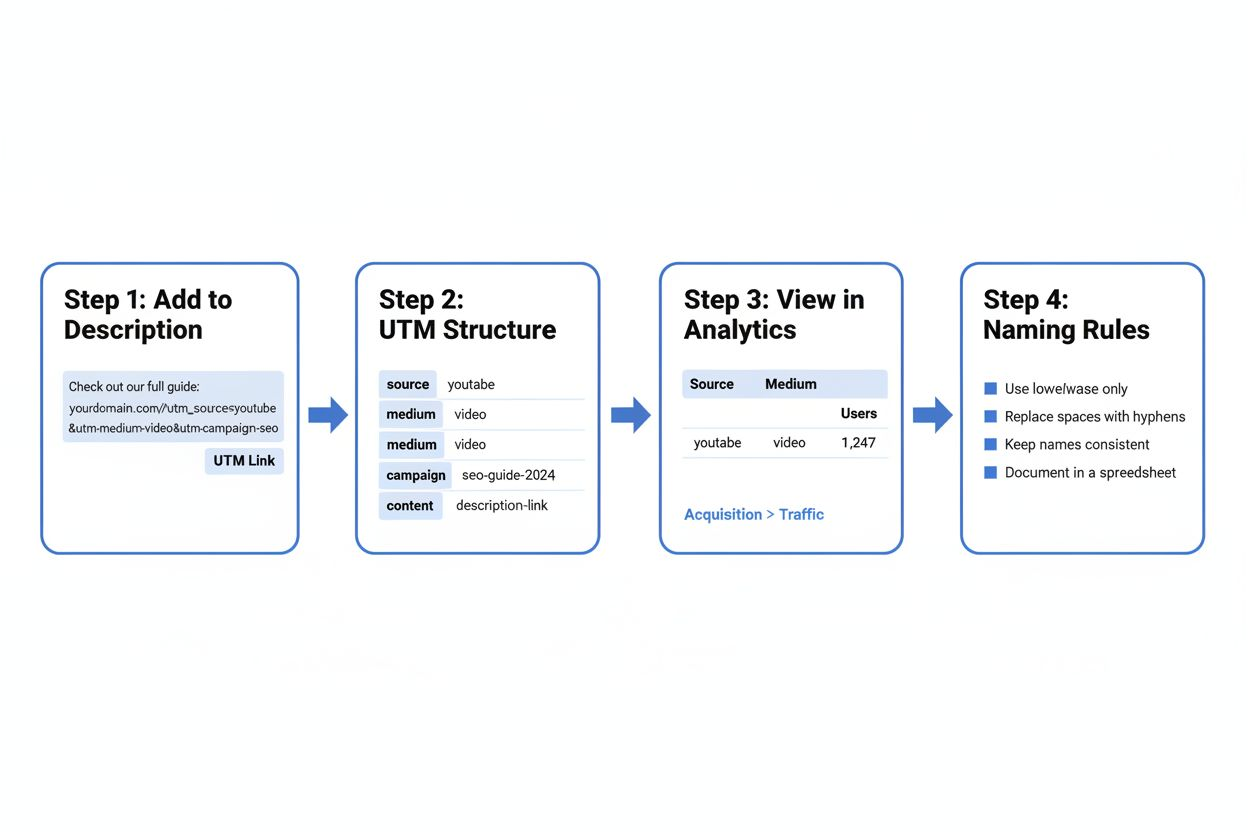
Add UTM parameters to every link in your video descriptions. Use a consistent naming convention: utm_source=youtube, utm_medium=video, utm_campaign=specific-video-title. This at least captures click-through traffic, even if it misses viewers who don't click.
Set Up GA4 Event Tagging
Google Analytics 4 allows custom event tracking. You can set up events for video plays, completion rates, and engagement milestones. While this doesn't directly connect video views to conversions, it shows which videos get the most engaged viewing, which often correlates with conversion influence.
Track Brand Search Volume
Monitor branded search volume in Google Search Console. When you publish a successful video, you should see an increase in people searching your brand name. This is an indirect measure of awareness creation that attribution models miss entirely.
Survey Your Customers
Add a "How did you hear about us?" field to your checkout or signup process. Include "YouTube video" as an option. Self-reported attribution is imperfect (people forget or misremember), but it captures awareness that analytics miss.
Compare Conversion Rates by Traffic Source
Look at conversion rates, not just conversion volume. If YouTube traffic converts at 5% while paid search converts at 8%, that doesn't mean search is better. Search is capturing people who already know what they want. YouTube is introducing your brand to cold audiences. A 5% conversion rate from cold traffic is often more valuable than 8% from warm traffic because it represents new customer acquisition.
Analyze Time-Lagged Correlations
Track whether spikes in video views correlate with conversion increases 3-7 days later. This requires manual analysis but can reveal video's influence even when attribution models don't capture it.
The Retargeting Trap: When Last-Click Makes You Think You Found Gold
AI Digital notes that last-click tends to over-credit branded search and retargeting while undercounting upper-funnel video influence. Retargeting is particularly deceptive under last-click attribution.
Retargeting shows ads to people who already visited your site. By definition, something else brought them there first. Often, that something is a video. They watched your content, visited your site, didn't convert, and left. Now retargeting brings them back and gets credit for the conversion.
Under last-click, retargeting looks incredibly efficient. High conversion rates, low cost per acquisition. You increase retargeting spend and cut video production. But retargeting only works if you have traffic to retarget. When you stop creating videos that drive initial site visits, your retargeting pool shrinks. Performance drops.
This is the attribution death spiral: last-click makes bottom-funnel tactics look great, you shift budget toward them, top-funnel performance suffers, and overall conversions decline even though your "efficient" channels are still performing well on paper.
Which Attribution Model Should You Actually Use
For most video creators and small businesses, the honest answer is that no single attribution model will give you perfect data. Each one is wrong in different ways.
If you have to choose one model in your analytics platform, position-based (U-shaped) attribution is usually the best compromise. It gives meaningful credit to both the first touchpoint (often video) and the last touchpoint (often search or direct), while acknowledging that middle interactions matter too.
If you have enough conversion volume (400+ per month), switch to data-driven attribution. Let the algorithm figure out what actually drives conversions instead of relying on arbitrary rules.
But the real solution is to stop relying on a single attribution model. Look at your data through multiple lenses:
- Check last-click to see what is closing conversions
- Check first-click to see what is creating awareness
- Check position-based to see the full picture
- Look at assisted conversions to see what is influencing purchases even when it doesn't get final credit
- Track brand search volume as a proxy for awareness creation
- Survey customers to capture what analytics miss
When all these signals point in the same direction, you can trust the data. When they conflict, you need to dig deeper.
The Future of Attribution for Video Creators
Attribution is getting harder because of privacy changes. Cookie deprecation, iOS tracking restrictions, and privacy regulations limit the data available for cross-channel tracking. This hurts video creators more than most because video influence often happens across devices and platforms.
Someone watches your video on their phone during lunch. They research on their laptop that evening. They purchase on their tablet the next day. Without cross-device tracking, these look like three different people, and the video gets no credit for the eventual purchase.
Server-side tracking and first-party data collection are becoming essential. If you can get people to create accounts or join your email list, you can track their journey more accurately than relying on cookies and device IDs.
But the fundamental problem remains: attribution models are designed for direct-response marketing, not content marketing. They measure clicks and conversions, not awareness and consideration. Video excels at awareness and consideration, which makes it inherently difficult to measure with tools built for a different purpose.

Making the Case for Video When the Data Doesn't Help
If you create video content for a business (your own or a client's), you will eventually face someone who wants to cut the video budget because "the ROI isn't there." They are looking at last-click attribution data that systematically undervalues what you do.
Here is how to make the case without relying on attribution models:
Show the Correlation Between Video and Overall Growth
Plot video output (views, watch time, or number of videos published) against total conversions over time. If they move together, video is contributing even if attribution doesn't capture it.
Demonstrate Brand Search Lift
Show that branded search volume increases after video campaigns. This proves you are creating awareness that leads to direct and search conversions.
Compare New vs. Returning Customer Acquisition
Video should over-index for new customer acquisition compared to channels like email and retargeting. If it does, it is doing its job even if it doesn't get last-click credit.
Calculate Lifetime Value by Acquisition Channel
Customers acquired through video content might have higher lifetime value than those acquired through paid search, even if the initial conversion rate is lower. This suggests video attracts better-quality customers.
Run Holdout Tests
Stop producing video for a defined period and measure what happens to overall conversions, brand search, and traffic. If they decline, video was contributing more than attribution suggested.
The goal is not to prove that video deserves 100% credit. It is to prove that video creates value that attribution models systematically miss, and that cutting video budget will hurt overall performance even if the attribution data says otherwise.
Understanding Attribution as a Creator Changes Your Strategy
Once you understand how attribution works, you can make smarter decisions about content strategy, platform choice, and how you measure success.
You will stop obsessing over immediate conversions from video traffic. A video with 10,000 views and 10 direct conversions might be failing, or it might be creating awareness that leads to 500 conversions through other channels. The view count and engagement metrics tell you more than the conversion count.
You will invest more in brand building and less in direct calls-to-action. If most video viewers won't convert immediately anyway, you might as well focus on creating memorable content that sticks in their mind for when they are ready to buy.
You will use different success metrics. Watch time, completion rate, comment quality, brand search lift, and survey responses become more important than click-through rate and immediate conversions.
You will also get better at explaining your value to stakeholders. Instead of saying "my videos drive conversions" (which the data will contradict), you can say "my videos create awareness and consideration that leads to conversions through other channels, which is why we see brand search increase by 40% in the week after a video launch."
Attribution models are tools, not truth. They measure what is easy to measure, not what matters most. Video creates value that is hard to measure but easy to see when you know where to look.