How YouTubers and Video Bloggers Can Monetize Their Audience With Customer Referral Marketing Before 1,000 Subscribers
You have 300 subscribers. Your last video got 87 views. YouTube's Partner Program is still months away, and AdSense revenue feels like a distant dream.
But here's what most small creators miss: you don't need 1,000 subscribers to make money from your audience. Customer referral marketing and affiliate programs work differently than ad revenue. They pay based on conversions, not views. A single video recommending the right product can generate income that exceeds what many creators earn from months of AdSense.
According to Kan Do Creators Community, affiliate income is not based on views or subscribers. One well-placed recommendation to an engaged audience of 200 can outperform a viral video seen by 50,000 uninterested viewers.
This guide shows you how to start earning through customer referral programs right now, regardless of your subscriber count.
Why Referral Marketing Works for Small Channels
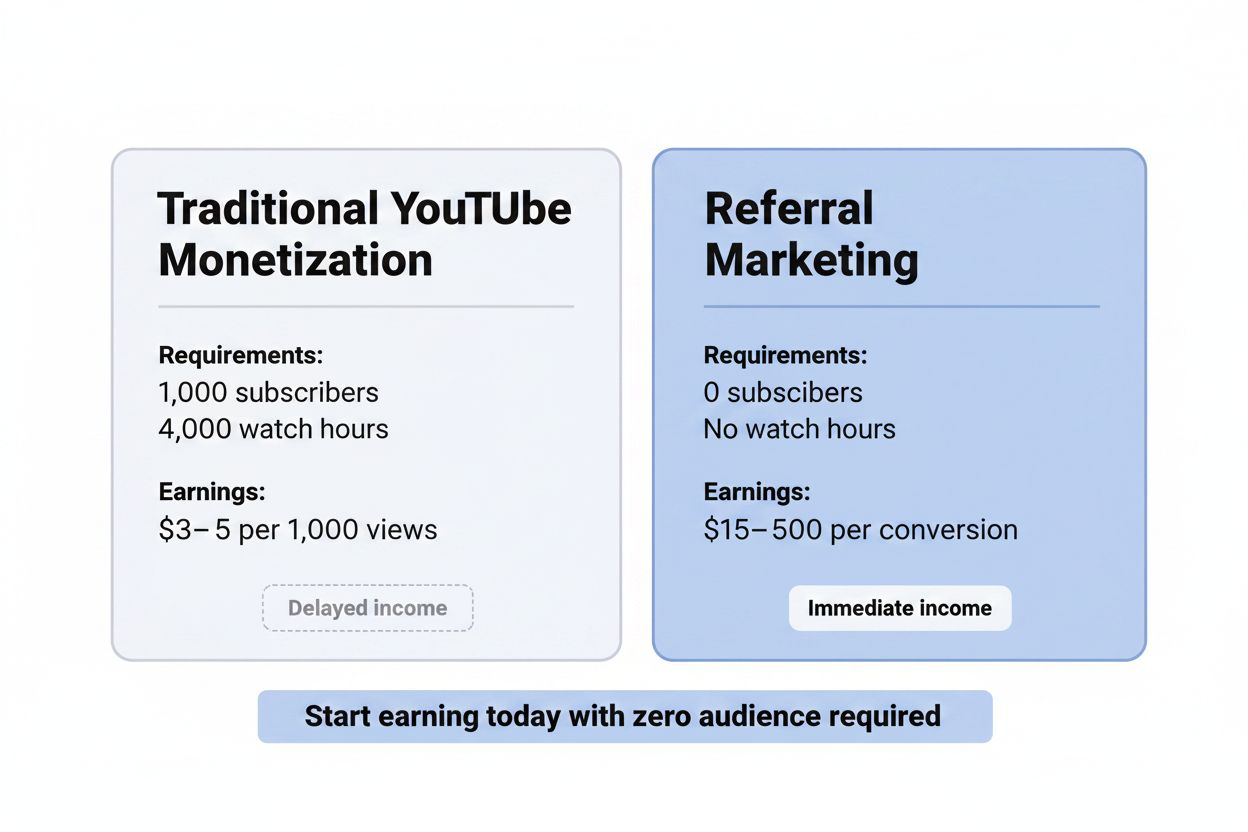
Traditional YouTube monetization requires meeting specific thresholds. You need 1,000 subscribers and 4,000 watch hours in the past 12 months before you can join the Partner Program and run ads.
Referral programs have no such gates. Most are free to join with zero subscriber requirements. You can sign up today, get your unique referral link, and start earning as soon as someone clicks through and makes a purchase.
The math works in your favor as a small creator. If you have 500 subscribers and 10% of them trust your recommendations enough to try a product, that's 50 potential conversions. At $50 per conversion, you've made $2,500. Compare that to ad revenue: 500 subscribers might generate 2,000-3,000 views per video, earning you $6-15 in AdSense.
Small audiences are often more engaged than large ones. Your 400 subscribers likely watch most of your videos and trust your opinion. That trust converts.
Understanding the Difference Between Affiliate Programs and Referral Programs
The terms get used interchangeably, but there's a technical distinction worth knowing.
Affiliate programs typically pay a percentage commission on sales. You promote a product, someone buys it through your link, and you earn a cut. These work well for physical products, software subscriptions, and services.
Referral programs usually offer fixed rewards. You refer a friend, they sign up or make a purchase, and you both get something (cash, credits, or free months of service). These tend to be simpler and more transparent.
For creators, both models work the same way: you share a unique link, track conversions, and get paid. The key is matching the right programs to your content and audience.
How to Choose Referral Programs That Match Your Content
Don't promote everything. Your audience trusts you because you're selective. Pick programs that align with what you already talk about.
Ask yourself three questions:
- Do I actually use this product or service?
- Would I recommend it to a friend without getting paid?
- Does it solve a problem my audience has?
If you answer no to any of these, skip it. Authenticity matters more than commission rates.
Look at your last 10 videos. What tools, services, or products did you mention? Those are your starting points. If you edit videos, look at editing software affiliate programs. If you talk about productivity, find apps your audience would use. If you review tech, electronics retailers have affiliate programs.
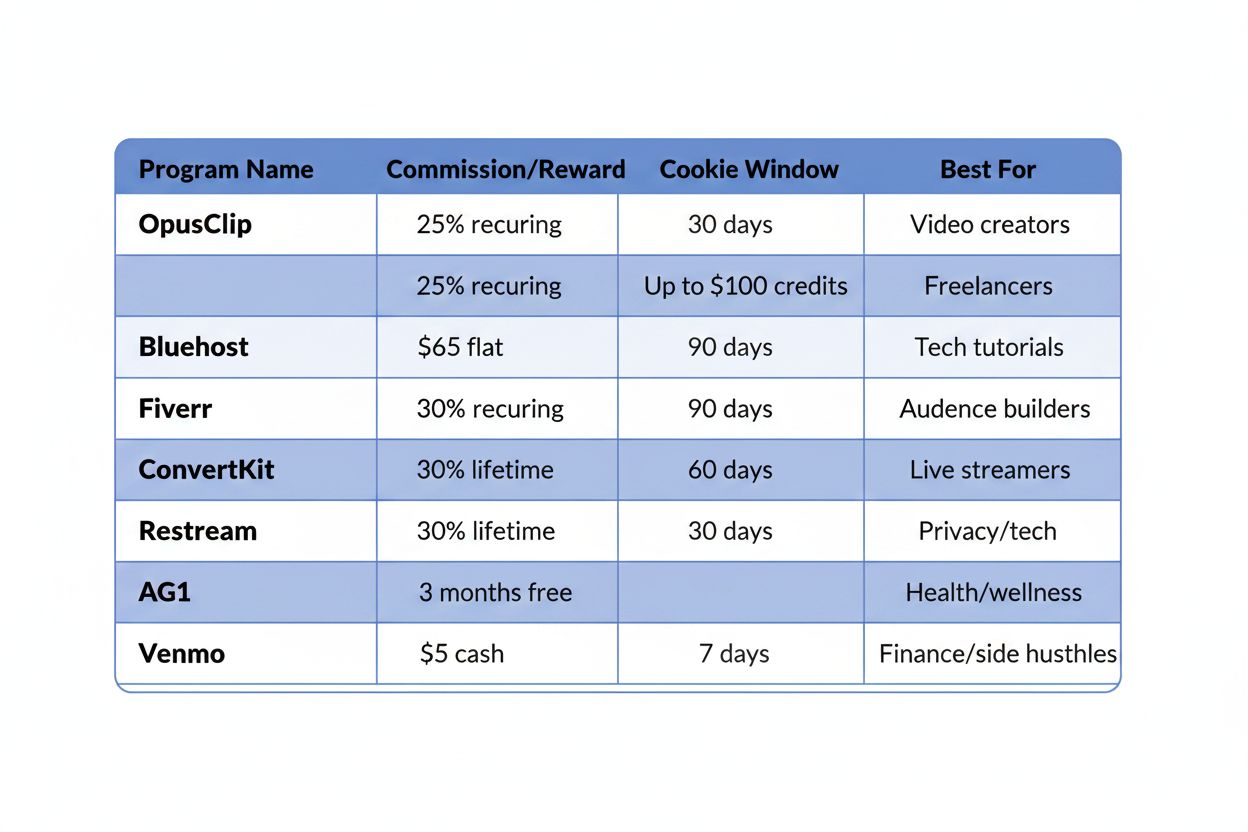
According to Zubtitle, ConvertKit pays 30% recurring commission for every referral who signs up through a creator's link. If you make content about email marketing, newsletters, or building an audience, that's a natural fit. If you make cooking videos, it's not.
Match matters more than payout.
High-Value Referral Programs You Can Join Today
Here are specific programs that pay well and accept creators at any size.
Software and Tools
OpusClip pays 25% recurring commission. According to Kan Do Creators Community, 5 referrals from one video can generate $217.50 per year in recurring income. The tool repurposes long videos into short clips, making it relevant for any creator who posts to multiple platforms.
Restream pays up to 30% commission on all sales for the lifetime of referred accounts. If you stream or talk about live content, this is a fit. The recurring nature means you earn as long as your referrals stay subscribed.
ConvertKit's 30% recurring commission applies to a tool many creators need: email marketing. If you talk about building an audience or monetizing content, this works.
Services and Hosting
Bluehost pays $65 per qualified hosting purchase. If you create tutorials about starting a blog, website, or online business, web hosting is a logical recommendation.
WP Engine and HubSpot offer 180-day cookie windows, according to Kan Do Creators Community. This matters for high-ticket items. Someone might watch your video in January, research options for weeks, and finally purchase in March. With a 180-day window, you still get credit. Compare that to Amazon Associates' 24-hour window.
Consumer Products and Services
Fiverr's referral program pays up to $500 in Fiverr credits, with up to $100 per referral. If you outsource thumbnails, editing, or voiceovers, you're already using Fiverr. Share your experience.
AG1 pays $15 in credits per successful referral, and referred users get a free year's supply of Vitamin D3+K2. Health and wellness creators can integrate this naturally.
Surfshark VPN pays up to 3 months free per successful referral. VPNs are relevant to any creator with an online audience concerned about privacy or accessing region-locked content.
Cash Rewards
Venmo's referral program pays $5 cash per referral who signs up and completes a transaction. The payout is small, but the barrier is low. If you talk about side hustles, freelancing, or getting paid online, Venmo is already part of the conversation.
How to Integrate Referral Links Without Sounding Like a Commercial
The worst thing you can do is interrupt your content with an awkward sales pitch. Your audience came for information or entertainment, not an ad read.
Integrate referrals into the natural flow of your content. If you're showing how you edit a video, mention the software you use and drop the link in the description. If you're explaining how you built your website, talk about your hosting choice and why it works for you.
The formula: use it, explain why, offer the link as a resource.
Example: "I edit in DaVinci Resolve, but for quick social clips I use OpusClip because it auto-generates captions and finds the best moments. Link's in the description if you want to try it."
That's not a sales pitch. That's useful information with an option to learn more.
Place your referral links in three spots:
- Video description (pinned comment if the link is especially relevant to that video)
- A dedicated "Tools I Use" page on your website or in your YouTube About section
- Mentioned verbally in the video when contextually appropriate
Don't apologize for using referral links. You're providing value by sharing tools that work. Getting compensated for that recommendation is fair.
Creating Content That Converts Without Chasing Virality
You don't need millions of views to make referral income work. You need the right viewers.
A video titled "5 Tools I Use to Edit Faster" will attract people actively looking for editing solutions. Those viewers are ready to try something new. A video titled "My Morning Routine" might get more views, but those viewers aren't in buying mode.
Create content that solves specific problems. How-to videos, tool comparisons, and tutorials naturally lead to conversions because the viewer is already looking for a solution.
According to Kan Do Creators Community, most affiliate and referral programs are free to join with no subscriber minimum. This means you can test different programs across different videos and see what resonates.
Make dedicated gear/tools videos twice a year. Walk through everything you use to create content: camera, mic, lights, software, apps, services. These videos have long shelf lives. Someone discovering your channel in 2027 will still find value in a 2025 tools video if the recommendations hold up.
Update your descriptions. If you mentioned a tool in a video from six months ago but didn't have a referral link then, add it now. Old videos can generate new income.
Tracking What Works and Doubling Down
Most referral programs provide dashboards showing clicks, conversions, and earnings. Check them weekly.
Look for patterns. Which videos drive the most clicks? Which programs convert best? Which links get clicked but don't convert (suggesting the product isn't a good fit or the audience isn't ready to buy)?
If one video generates 50% of your referral income, make more content like it. If a specific program converts at 10% while others sit at 2%, prioritize that program in future videos.
Don't spread yourself thin. It's better to promote 3-5 programs well than 20 programs poorly. Focus on what converts.
Test different placements. Try mentioning a link at the start of a video versus the end. Try pinned comments versus description-only links. Small changes can double conversion rates.

Building a Tools Page That Works While You Sleep
Create a single page listing every tool, service, and product you recommend. This becomes your referral hub.
Structure it by category: video editing, audio, hosting, productivity, gear, learning resources. Under each item, write 2-3 sentences explaining what it does and why you use it. Include your referral link.
Put this page in your YouTube About section, your video descriptions, and your pinned comment template. Every video you publish funnels people to this page, and every product on that page has the potential to generate income.
Update it quarterly. Remove products you no longer use. Add new discoveries. Keep it current.
This page compounds over time. A viewer might watch 10 of your videos over three months, finally decide to upgrade their setup, and visit your tools page to see all your recommendations in one place. One visit can generate multiple conversions.
What to Disclose and How to Stay Compliant
You must disclose affiliate and referral relationships. This is both an ethical requirement and a legal one (FTC guidelines in the US, similar rules elsewhere).
The disclosure should be clear and prominent. Don't bury it in a wall of text.
Good disclosure examples:
- "Links in the description are affiliate links, which means I may earn a commission if you make a purchase. This doesn't cost you anything extra."
- "I'm a ConvertKit affiliate, so I earn a commission if you sign up through my link. I only recommend tools I actually use."
Place the disclosure at the top of your video description, before the links. Mention it verbally in the video if the product is a major focus.
Honesty builds trust. Viewers understand that creators need to make money. They don't mind affiliate links as long as you're transparent and genuinely helpful.
Common Mistakes That Kill Conversions
Promoting too many things at once. If every video has 15 different affiliate links, none of them stand out. Pick one or two per video.
Recommending products you don't use. Viewers can tell when you're reading from a script versus speaking from experience. Authenticity converts. Generic praise doesn't.
Ignoring cookie windows. According to Kan Do Creators Community, Amazon Associates has a 24-hour cookie window while WP Engine and HubSpot offer 180-day windows. For expensive purchases that require research, longer windows matter. Don't waste time promoting high-ticket items through programs with short windows.
Forgetting to update old videos. If you published 50 videos before discovering referral programs, go back and add links to relevant descriptions. That back catalog can generate passive income.
Giving up too early. Referral income builds slowly. Your first month might generate $20. Your sixth month might generate $400. Consistency compounds.
Scaling Beyond Your First Dollar
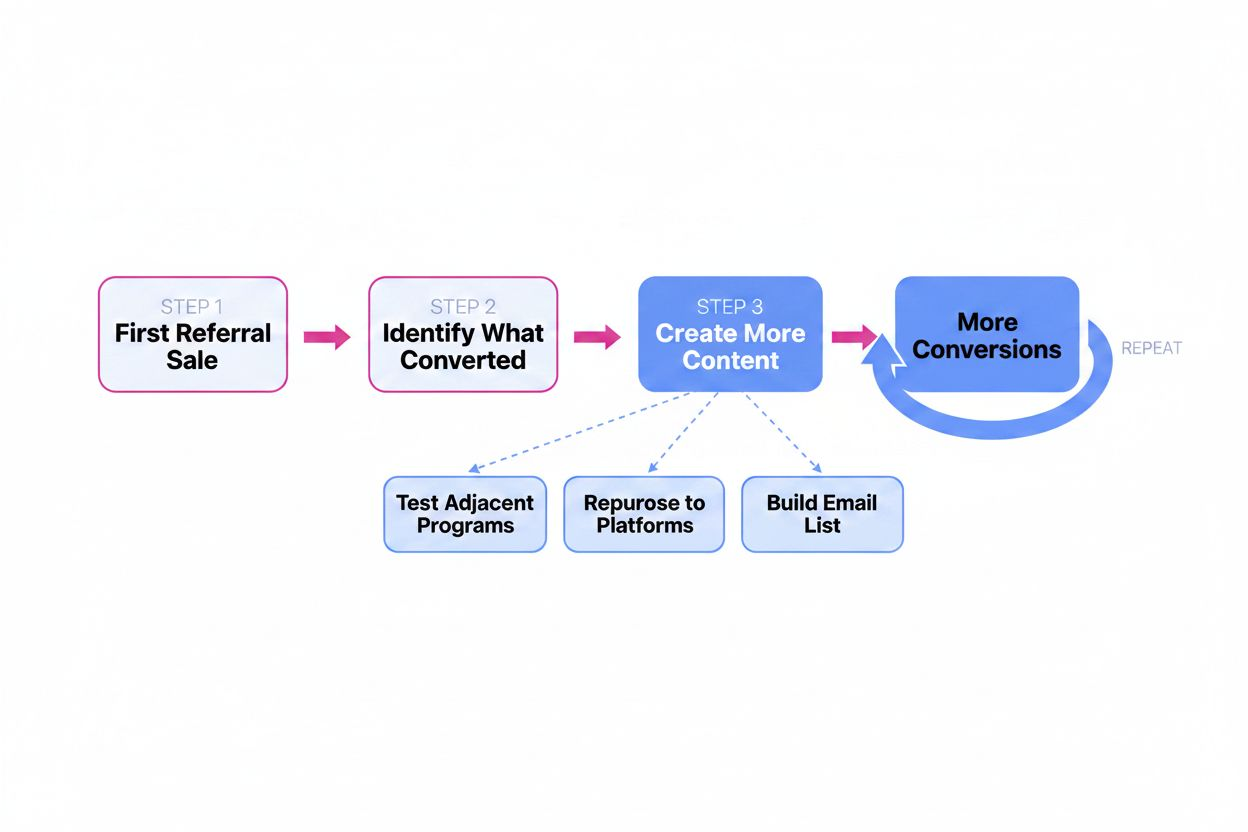
Once you've made your first referral sale, you have proof of concept. Your audience trusts you enough to act on your recommendations.
Now scale strategically.
Create more content around high-converting topics. If your video about email marketing tools drove 10 conversions, make a follow-up about email marketing strategies, list-building tactics, or automation workflows. Each video reinforces the others and drives more traffic to your referral links.
Expand to adjacent programs. If Bluehost converts well, try other hosting providers or domain registrars. If OpusClip works, explore other video tools.
Repurpose your content. Turn your YouTube video into a blog post, a Twitter thread, or an Instagram carousel. Each format reaches different people and creates new opportunities for conversions.
Build an email list. Collect emails through a simple lead magnet (a PDF checklist, a resource guide, a mini-course). Email subscribers convert at higher rates than YouTube viewers because they've opted in to hear from you. Send them your tools page, new recommendations, and updates when programs run special promotions.
When to Diversify and When to Focus
Early on, focus. Pick 3-5 programs that fit your content and promote them consistently for three months. Learn what works before expanding.
Once you have reliable income from those core programs (let's say $200-500/month), you can experiment. Test new programs one at a time. If a new program outperforms an old one, swap it in. If it underperforms, drop it.
Diversification protects you from program changes. Companies can reduce commission rates, shut down affiliate programs, or change terms. If 100% of your referral income comes from one program, you're vulnerable. Spreading income across 5-7 programs reduces that risk.
But diversification for its own sake dilutes your message. Don't promote 30 different products just to have options. Promote what you use, what converts, and what serves your audience.
Turning Referral Income Into Sustainable Revenue
Referral marketing is not a get-rich-quick scheme. It's a sustainable income stream that grows with your channel.
According to Epidemic Sound, their program offers a free month per new paying subscriber referred, with no cap on earnings. Recurring commission programs like this create predictable income. Five referrals this month might generate $50. But if those five people stay subscribed for two years, that's $1,200 from one video.
The compound effect is real. Your first year might generate $2,000 in referral income. Your second year might generate $8,000 because you have more content, more links, and more experience knowing what converts.
Reinvest early earnings into your channel. Better audio quality, improved lighting, or a second monitor can help you create better content faster. Better content attracts more viewers. More viewers generate more conversions.
Track your income monthly. Celebrate small wins. $50 in your first month is proof that this works. $200 in month three means you're learning. $500 in month six means you've built a system.
What Happens After You Hit 1,000 Subscribers
Reaching the YouTube Partner Program doesn't mean you abandon referral marketing. The two income streams work together.
AdSense pays based on views. Referral programs pay based on conversions. A video with 5,000 views might generate $15 in AdSense and $300 in referral income if it's promoting the right product to the right audience.
Many successful creators earn more from referrals and sponsorships than from ad revenue. AdSense is passive but limited. Referral income scales with trust and relevance.
Keep doing what works. If referral marketing generated income before 1,000 subscribers, it will generate more income after. Your larger audience means more potential conversions.
Add sponsorships carefully. Direct brand deals pay more than affiliate commissions, but they come with creative restrictions. A sponsor might require specific talking points or limit what else you can promote. Referral programs give you full creative control.
Balance all three: AdSense for passive income, referral programs for scalable income, and sponsorships for high-value one-time payments.

Starting Today With Zero Subscribers
You don't need permission to start. You don't need a minimum subscriber count. You need a plan and the willingness to try.
Here's what to do in the next 24 hours:
- List the tools and services you already use to create content
- Search "[tool name] affiliate program" or "[service name] referral program"
- Sign up for 3-5 programs that fit your content
- Add your referral links to your existing video descriptions
- Plan your next video around a tool or service you genuinely recommend
Your first conversion might come from a video you published last month. It might come from your next upload. It might take three weeks or three months.
But it won't come at all if you don't start.
Most creators wait until they're "big enough" to monetize. They assume income requires scale. They're wrong. According to Kan Do Creators Community, a single video recommending the right product can earn more than months of AdSense revenue.
The creators who win are the ones who start small, test constantly, and build systems that compound over time. Subscriber count is a vanity metric. Revenue is a performance metric.
You have an audience. Even if it's 50 people, those 50 people chose to subscribe because they value what you create. That's enough to start.