How to Evaluate the ROI of Your Sponsorship Campaigns

The Problem with "Brand Awareness" as a Metric
Sponsorship budgets are rarely small. Whether you are backing a local sports team, a major industry conference, or a podcast with a loyal audience, the money involved demands accountability. Yet many organizations write the check, show up at the event, and then measure success by counting how many people walked past their banner.
That approach is not measurement. It is guesswork dressed up with a clipboard.
The difficulty with sponsorship ROI is that it sits somewhere between advertising (which has clear performance metrics) and public relations (which has always resisted clean quantification). Sponsorships generate brand exposure, yes, but they also drive leads, influence purchasing decisions, build relationships, and create content. Evaluating them properly means building a framework that captures all of those outputs, not just the ones that are easiest to count.
This article walks through how to do that, from setting objectives before you sign the contract to calculating a defensible return after the campaign ends.
Start Before the Sponsorship Begins
Most ROI failures happen before the event or campaign even launches. Organizations agree to sponsor something, then scramble afterward to figure out whether it was worth it. By then, it is too late to collect the data that would have made the evaluation meaningful.
Define What You Are Actually Trying to Achieve
Before signing anything, write down the specific business outcome you want from this sponsorship. Not "increase brand awareness." That phrase means nothing without context. Instead, ask:
- Do you want to generate a specific number of qualified leads?
- Are you trying to reach a new audience segment you do not currently serve?
- Is the goal to retain an existing client relationship by co-sponsoring something they care about?
- Do you want to drive traffic to a specific landing page or product?
- Are you trying to establish credibility in a new market?
Each of these goals requires different measurement approaches. A sponsorship designed to generate leads needs a lead-tracking mechanism. One designed to reach a new audience needs pre- and post-campaign audience data. Getting clear on the goal first determines everything else.
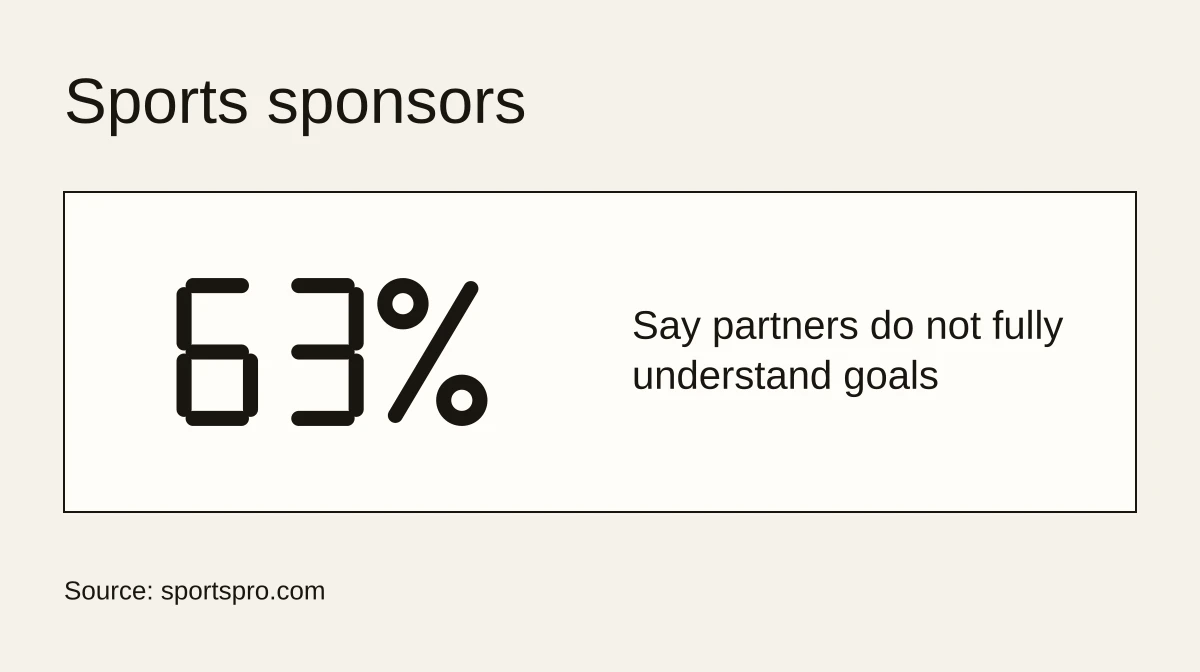
Source: www.sportspro.com
Set a Baseline
You cannot measure change if you do not know where you started. Before the campaign launches, record your current numbers for whatever metrics matter to your goal:
- Current website traffic (overall and from relevant segments)
- Current lead volume by channel
- Current brand awareness scores if you run surveys
- Current social media follower counts and engagement rates
- Current sales in the geographic or demographic area the sponsorship targets
These baseline numbers are the foundation of your ROI calculation. Without them, any post-campaign data is just a number floating in space.
Assign a Budget Number That Includes Everything
The "investment" side of ROI is often undercounted. Sponsorship fees are obvious, but the true cost includes:
- Staff time spent planning, attending, and following up
- Travel and accommodation for team members
- Branded materials, signage, and merchandise
- Any activation costs (demos, giveaways, hosted events within the event)
- Technology costs for tracking or lead capture
If you spend $20,000 on a conference sponsorship but another $15,000 in staff time and activation costs, your investment is $35,000, not $20,000. Using the lower number inflates your apparent ROI and leads to bad decisions.
Choosing the Right Metrics for Your Goals
Different sponsorship goals demand different measurement tools. Here is how to match them up.
Lead Generation
If your primary goal is leads, you need a clean tracking mechanism tied specifically to the sponsorship. Options include:
- A unique landing page URL used only in sponsorship materials
- A dedicated phone number or email address
- A promo code distributed exclusively at the event or through the sponsorship channel
- QR codes on physical materials that link to a tagged URL
After the campaign, count the leads generated through these channels. Then apply your standard lead-to-customer conversion rate and average deal value to estimate revenue generated. That gives you a revenue figure to compare against your investment.
Brand Awareness and Reach
Reach is the metric most sponsorship sellers will pitch to you: "This event reaches 50,000 attendees." But raw reach numbers are often inflated, and reach alone does not tell you whether anyone paid attention to your brand.
More useful metrics include:
- Estimated impressions with your brand visible (logo placements, mentions, signage)
- Social media mentions and tags during the event period
- Media coverage that includes your brand name
- Share of voice compared to other sponsors
If brand awareness is genuinely your goal, the most rigorous approach is running a short survey with a sample of the target audience before and after the campaign, asking about brand recognition and perception. This is more work, but it produces defensible data.
Audience Engagement
For sponsorships that include content (podcast sponsorships, newsletter sponsorships, sponsored sessions at conferences), engagement metrics matter more than raw reach:
- Click-through rates on sponsored content links
- Time spent on your landing page by traffic from the sponsorship
- Email open rates for sponsored newsletter placements
- Video view duration for sponsored video content
High reach with low engagement usually means your message is not resonating with that audience, which is important information for deciding whether to renew.
Relationship Value
Some sponsorships are primarily about relationships, keeping a key client happy, building goodwill with a community, or gaining access to decision-makers. These are harder to quantify but not impossible.
You can track:
- Number of meaningful conversations or meetings held during the event
- New contacts added to your CRM with notes on relationship quality
- Client retention rates for accounts where the sponsorship was a factor
Assigning a dollar value to relationship outcomes requires judgment, but you can use your average customer lifetime value as a reference point. If a sponsorship helped you retain a client worth $200,000 annually, that is a meaningful data point.
During the Campaign: Active Tracking
Setting up measurement systems before the campaign is only useful if someone actually runs them during the campaign. Assign clear ownership for data collection.
At Live Events
Designate someone whose job is specifically to capture data, not just to staff the booth or attend sessions. Their responsibilities should include:
- Logging every lead or contact made, with notes on the conversation
- Photographing brand placements for your records
- Monitoring social media in real time for mentions and tags
- Counting or estimating foot traffic to your activation area if relevant
Paper sign-up sheets still work at events, but a tablet with a simple form that feeds directly into your CRM is better. Every lead that gets transcribed manually is a lead that might get lost.
For Digital Sponsorships
Digital sponsorships (podcast ads, newsletter placements, sponsored social posts) generate data automatically, but you need to make sure your tracking is set up correctly before the campaign goes live. Check that:
- UTM parameters are correctly applied to all links
- Your analytics platform is recording sessions from those sources
- Any promo codes are active and working
- Conversion goals are set up in your analytics so you can see what happens after someone clicks through
Pull data weekly rather than waiting until the end. If something is not working (a broken link, a promo code that was never activated), you want to catch it early.
Calculating the Return
Once the campaign ends and you have collected your data, you can calculate ROI. The basic formula is straightforward:
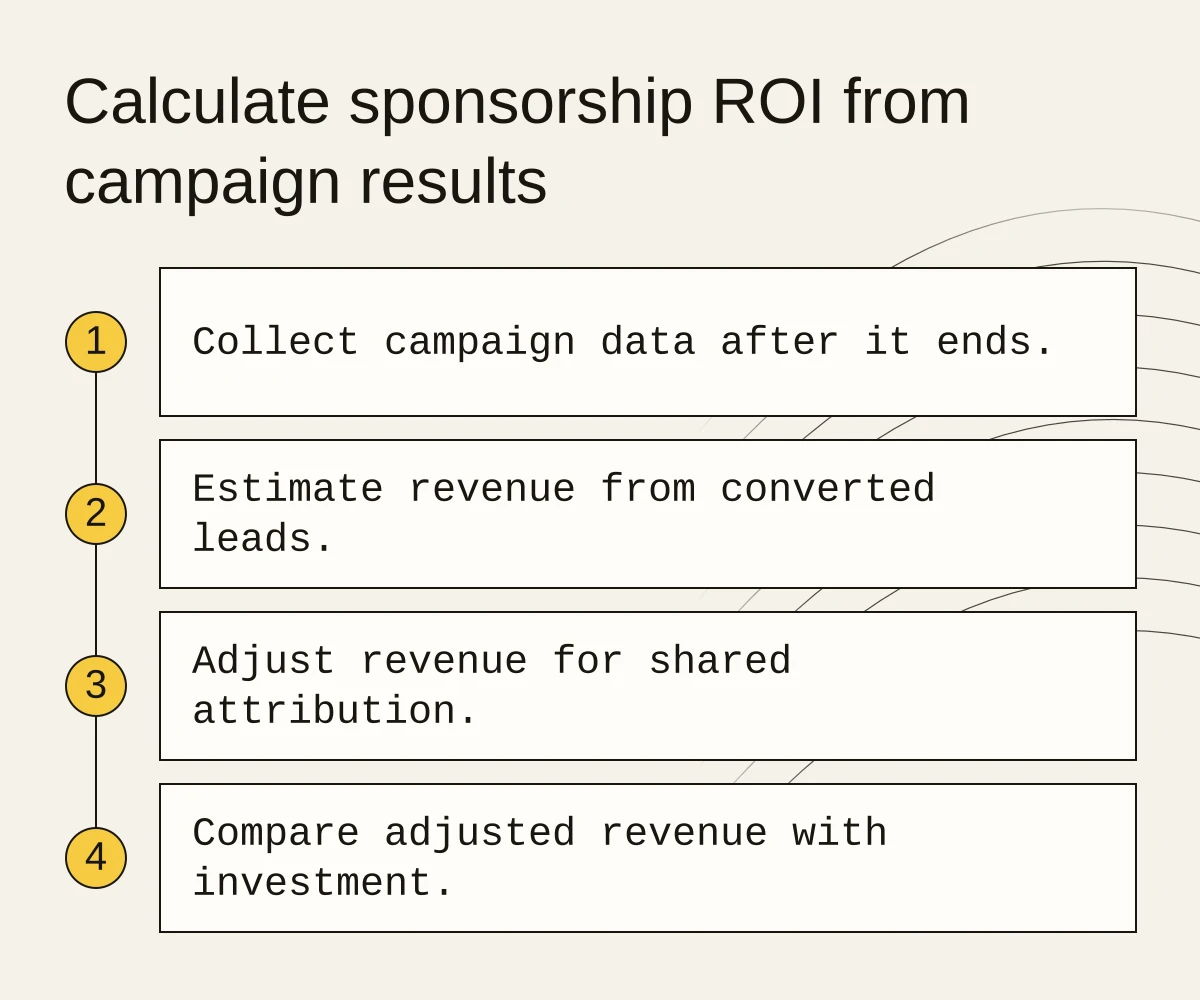
ROI = ((Revenue Generated - Total Investment) / Total Investment) x 100
So if a sponsorship cost $35,000 and generated $70,000 in revenue from new customers, the ROI is 100%.
But sponsorships rarely produce immediate, clean revenue figures. More often, you are working with a mix of direct and indirect outcomes. Here is how to handle that.
Attributing Revenue
For leads generated through the sponsorship, apply your standard conversion rate and average deal value to estimate revenue. If you generated 50 leads, your typical conversion rate is 20%, and your average deal value is $10,000, the estimated revenue is $100,000.
Be honest about attribution. If a lead came through the sponsorship but also received three months of email nurturing before converting, the sponsorship deserves partial credit, not full credit. Many organizations use a first-touch or last-touch attribution model, but a multi-touch model that distributes credit across all interactions is more accurate.
Assigning Value to Non-Revenue Outcomes
Not every sponsorship outcome converts directly to revenue. For outcomes that do not, you have two options:
Comparative value: What would it have cost to achieve the same outcome through another channel? If the sponsorship generated 200,000 impressions with your target audience, you can divide that against the cost per thousand advertising impressions you would pay through paid media to get a direct cost-efficiency benchmark.
Qualitative documentation: For relationship outcomes, document them clearly with notes on which accounts were strengthened, what conversations happened, and what the potential business value is. This does not give you a clean ROI number, but it builds a record that informs future decisions.
The Payback Period
For sponsorships that generate leads requiring a long sales cycle, the revenue may not materialize until months after the campaign ends. Build this into your evaluation timeline. A sponsorship that looks like a loss at 30 days might look very different at 12 months.
Set a reminder to revisit the data at 6 and 12 months post-campaign, tracking which leads from the sponsorship eventually converted and at what value.
Common Mistakes That Distort Your Results
Counting Outputs as Outcomes
Outputs are things you produced: 500 brochures distributed, 1,000 badge scans, 200 social media impressions. Outcomes are things that changed as a result: 40 qualified leads, 15 new conversations with target accounts, a 12% lift in website traffic from the target region.
Outputs feel good to report because the numbers are usually large. But they do not tell you whether the sponsorship moved the business forward.
Ignoring the Counterfactual
Would some of those leads have come in anyway through your other marketing channels? Would that client relationship have stayed strong without the sponsorship? Honest ROI evaluation requires asking what would have happened without the sponsorship, and adjusting your numbers accordingly.
This is genuinely difficult to answer, but even a rough estimate is better than assuming all results were caused by the sponsorship.
Evaluating Every Sponsorship the Same Way
A $5,000 local community sponsorship and a $500,000 national conference sponsorship should not be evaluated with the same level of rigor, but they should both be evaluated. Scale your measurement effort to the investment size. For smaller sponsorships, a simple lead count and a qualitative debrief may be enough. For larger ones, you need the full framework.
Forgetting to Debrief the Team
The people who staffed the event or managed the campaign have information that does not show up in any spreadsheet. What questions did prospects ask? What objections came up repeatedly? Which competitor was mentioned most often? What did the audience seem most interested in?
A 30-minute debrief with the team within a week of the campaign ending captures that knowledge before it fades. It also surfaces insights that improve your next sponsorship.
Building a Sponsorship Scorecard
If your organization runs multiple sponsorships, a standardized scorecard makes comparison and decision-making much easier. The scorecard should capture:
- Total investment (all costs)
- Leads generated
- Estimated revenue attributed
- Brand impressions (with a note on quality)
- Key relationships developed
- Qualitative notes on audience fit and activation quality
- Overall ROI percentage
Over time, this scorecard becomes a database that tells you which types of sponsorships consistently perform for your business and which ones consistently disappoint. That historical data is far more valuable than any single campaign evaluation.
Making the Decision to Renew or Walk Away
The final purpose of all this measurement is to make a better decision about whether to continue the sponsorship. That decision should weigh:
- The quantified ROI from the campaign
- The trend over multiple years if this is a recurring sponsorship
- The strategic fit with your current business goals
- The opportunity cost of the budget (what else could that money do?)
- Any qualitative factors that the numbers do not capture
A sponsorship with a modest ROI but strong strategic fit and relationship value might be worth continuing. One with a technically positive ROI but no alignment with your current target audience might be worth cutting.
The goal is not to hit a specific ROI threshold on every sponsorship. It is to make informed decisions with real data rather than gut feelings and sunk-cost reasoning. Organizations that build this discipline consistently get more value from their sponsorship budgets, not because they spend more, but because they stop spending on things that do not work.
Turning Measurement into a Competitive Advantage
Most of your competitors are not measuring their sponsorships carefully. They are renewing based on habit, cutting based on budget pressure, and generally flying blind. That creates an opening.
When you can walk into a sponsorship negotiation with data showing exactly what a similar sponsorship delivered, you negotiate from a position of knowledge. You can ask for specific assets, activation rights, or audience access because you know what drives results for your business. You can also walk away from bad deals without second-guessing yourself.
Sponsorship measurement is not a finance exercise. It is a strategic tool. Build the habit of measuring every campaign, document what you learn, and let the data shape your decisions. The organizations that do this consistently find that their sponsorship programs get sharper and more effective over time, not because the market changes, but because they do.