Expanding Sponsorship Opportunities with Live Streaming

The Gap Between Audiences and Ad Budgets
Brands have always followed audiences. When radio audiences grew, ad budgets followed. Television did the same. Digital display advertising tracked the shift to web browsing. The pattern is consistent, and right now, a significant portion of audience attention has moved to live streaming, while many sponsorship strategies have not caught up.
Live streaming has grown from a niche activity into a mainstream content format. Gaming, sports, fitness, cooking, music, news commentary, product launches, and corporate events all happen live online, often drawing audiences that rival or exceed traditional broadcast numbers for comparable content. Live streaming hours watched rose 12% in 2024, reaching 32.5 billion hours, yet the sponsorship models applied to these streams frequently borrow from formats that do not quite fit, either treating streams like static web pages covered in banner ads, or applying broadcast television logic to an environment that behaves very differently.
The brands and rights holders who understand what makes live streaming distinct are finding ways to build sponsorship packages that work better for everyone: more engaging for viewers, more measurable for sponsors, and more valuable for the creators and platforms hosting the content.
What Makes Live Streaming Different from Other Media
Before building a sponsorship strategy around live streaming, it helps to understand what separates it from the formats that came before.
The most obvious difference is real-time interaction. A viewer watching a recorded video is passive. A viewer watching a live stream can type a comment and see the host respond within seconds. This creates a fundamentally different relationship between content and audience. Viewers feel present rather than just watching, and that sense of presence changes how they respond to sponsorship messages.
Live content also carries a sense of urgency. Because it is happening now, viewers are less likely to walk away. They do not want to miss something. This is the same psychology that drives live sports ratings, and it applies equally to a live product reveal, a live Q&A session, or a live gaming tournament.
The third major difference is duration. YouTube video durations can range from a few seconds to several hours, but a live stream might run two hours, six hours, or in some cases much longer. This extended duration creates more natural opportunities for sponsorship integration without the content feeling overwhelmed by advertising. It also means viewers have more time to absorb a sponsor's message in context, rather than encountering it as an interruption.
Finally, live streams generate data in real time. Chat activity, viewer counts, peak moments, drop-off points, and audience reactions are all visible as the stream happens. Twitch, for example, surfaces Game Developer Analytics metrics including aggregate hours watched and the number of concurrent streamers, a level of immediate feedback that traditional broadcast sponsorship cannot match.
Types of Sponsorship That Work in Live Environments
Host-Read Integrations
The most effective sponsorship format in live streaming is also the simplest: the host talks about the sponsor. This is not new. Radio hosts have been doing it for decades. But in live streaming, it carries additional weight because the audience has often built a strong relationship with the host over many hours of live content.
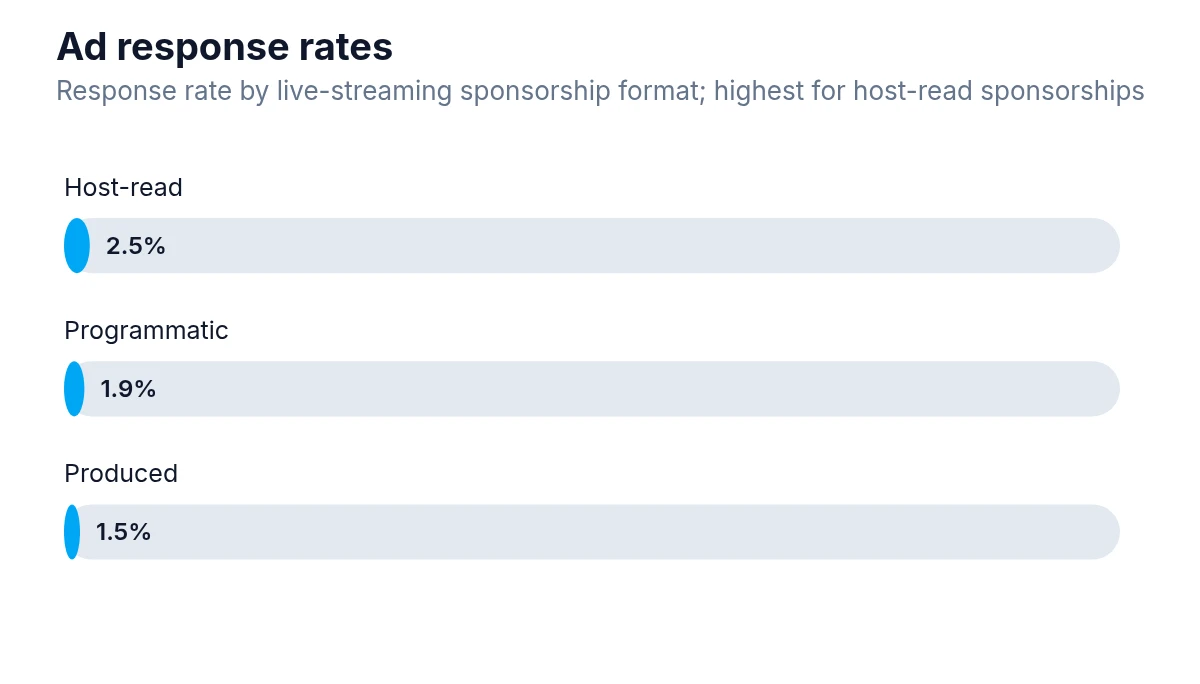
Host-read sponsorships have the highest response rate at 2.45% in live streaming. They outperform programmatic and produced sponsorship formats.
When a host pauses mid-stream to talk about a product they actually use, or at minimum can speak about naturally, the message lands differently than a pre-produced ad. The performance data backs this up: host-read ad response rates reached 2.45% in Magellan AI's benchmark report, ahead of produced ads at 1.51% and programmatic buys at 1.93%. Viewers are watching a real person in real time, and authenticity reads clearly. They can also ask questions in chat, and if the host answers them, the sponsorship becomes a conversation rather than a broadcast.
The key variable is fit. A gaming peripheral brand sponsoring a gaming stream makes obvious sense. The same brand sponsoring a cooking stream requires more creative work to feel natural. The best host-read integrations happen when the product connects logically to what the audience already cares about.
Branded Segments and Named Moments
Many live streams have recurring structural elements: a recap segment, a Q&A block, a highlight reel, a challenge round. These segments can be named after sponsors in the same way that sports broadcasts have named halftime shows or sponsored replay moments.
"This week's leaderboard update is brought to you by..." works because it attaches the sponsor to something the audience already values. The segment would exist without the sponsor, but the sponsor gets consistent, repeated association with a moment viewers look forward to.
This model scales well. A weekly live stream with five regular segments can accommodate five different sponsors without the content feeling like one long advertisement. Each sponsor owns their moment, and the audience learns to associate them with it over time.
Visual Overlays and On-Screen Branding
Live streams typically display a visual interface around the content itself, including panels, alerts, and overlays. These elements can carry sponsor logos and messaging without interrupting the stream.
The challenge with static visual branding is that it can become invisible. Viewers habituate to elements that never change, which is the same problem banner ads face on websites. The solution is to tie visual branding to moments of activity. A sponsor logo that appears prominently when a viewer subscribes, when a donation alert fires, or when a milestone is reached gets seen because it appears during moments the audience is already paying attention to.
Some platforms allow for interactive overlays where viewers can click on sponsor elements directly, turning passive brand exposure into a measurable action. This bridges the gap between awareness and conversion in a way that a logo on a jersey cannot.
Sponsored Giveaways and Audience Participation
Live audiences respond strongly to participation. Giveaways, polls, prediction games, and challenges all drive engagement, and they create natural sponsorship opportunities.
A sponsor providing products for a giveaway gets their items shown on screen, discussed by the host, and associated with the excitement of winning. Viewers who do not win still see the product in a positive context. The giveaway format also drives specific behaviors, such as subscribing, following, or sharing, that benefit both the creator and the sponsor.
The participation element is important here. A giveaway where viewers have to do nothing is less engaging than one where they have to answer a question, make a prediction, or complete a small action. The more active the audience, the more memorable the sponsor association.
Exclusive Sponsorship of Events and Streams
Some of the strongest live streaming sponsorship opportunities come from exclusive arrangements around specific events. A product launch stream, a championship tournament, a charity marathon, or a major interview can be sponsored exclusively by a single brand, giving that brand full association with the event rather than sharing space with competitors.
Exclusive event sponsorship works particularly well when the event itself has cultural weight. Viewers remember where they were when something significant happened, and a brand that was visibly part of that moment benefits from that memory.
Building a Sponsorship Package That Holds Value
A common mistake when approaching live streaming sponsorships is treating them as a single line item: "logo placement for X dollars per stream." This undervalues what live streaming can offer and makes it harder to justify the investment compared to more familiar formats.
A well-built sponsorship package layers multiple elements together so that the sponsor's presence is felt across different moments and touchpoints throughout the stream.
A complete package might include:
- A host-read integration at the start of the stream
- A named segment in the middle
- A sponsored giveaway toward the end
- A persistent but unobtrusive logo overlay throughout
- A post-stream social post tagging the sponsor
- Access to stream analytics showing reach and engagement
Each element serves a different purpose. The host-read builds awareness and trust. The named segment creates repeated association. The giveaway drives active engagement. The overlay provides consistent visibility. The social post extends the reach beyond the live audience. The analytics give the sponsor something concrete to evaluate.
When these elements are presented together as a package, the value is clearer and easier to compare against other media buys.
Measuring What Matters
Sponsorship measurement in live streaming is still developing, but it has real advantages over traditional broadcast measurement.
Concurrent viewer counts show how many people were watching at any given moment, which means you can see exactly how many people were present during a host-read integration. Chat activity during sponsored segments can indicate how much the audience engaged with the message. Click-through rates on interactive overlays provide direct conversion data. Unique promo codes or custom URLs let sponsors track purchases that originated from the stream.
What live streaming measurement cannot yet do reliably is match the panel-based audience research that traditional broadcast uses. Demographic breakdowns, household income data, and brand lift studies are harder to run at scale for individual streams. This is changing as platforms develop better tools, but sponsors should go in with realistic expectations about what the data will and will not show.
The most useful approach is to define what success looks like before the stream happens. If the goal is brand awareness, concurrent viewers and chat mentions are the right metrics. If the goal is direct response, promo code redemptions and click-through rates matter more. Trying to evaluate a brand awareness campaign using direct response metrics, or vice versa, leads to frustration on both sides.
Finding the Right Creators and Platforms
Sponsorship value in live streaming depends heavily on the creator and platform match. A creator with a smaller but highly engaged audience in a specific category can deliver better results for a targeted sponsor than a larger creator whose audience is broad and loosely connected to the product.
When evaluating creators for sponsorship, look at:
- Average concurrent viewers relative to follower count (a high ratio suggests strong engagement)
- Chat activity during streams (active chats indicate an audience that is paying attention)
- How the creator has handled previous sponsorships (did they integrate naturally or read awkwardly from a script?)
- Audience demographics available from the platform or the creator directly
- Stream frequency and consistency (a creator who streams irregularly is harder to build a campaign around)
Platform matters too. Different platforms attract different audiences and have different norms around sponsorship. Twitch communities' influence on advertising perceptions runs through collective norms, peer influence, and parasocial relationships with streamers, which means sponsorships that fit the community's expectations land far better than those that feel imported from another medium. Platforms built around professional or educational content may have audiences with different tolerance levels for commercial integration.
The creator's relationship with their audience is ultimately the asset being accessed through a live streaming sponsorship. Protecting that relationship, by ensuring the sponsorship fits naturally and does not feel forced, protects the value of the investment.
Scaling Across Multiple Creators
Individual creator sponsorships work well for targeted campaigns, but brands looking for broader reach can build programs that span multiple creators simultaneously.
This approach, sometimes called a creator network or ambassador program, involves identifying a group of creators whose audiences collectively represent the target demographic, then running coordinated sponsorship activations across all of them during the same period.
The advantage is scale without the concentration risk of betting everything on a single stream. If one creator has a bad stream or a controversy, the campaign is not derailed. The combined reach of many mid-sized creators can match or exceed a single large creator, often at a lower cost per viewer.
The challenge is coordination. Running a consistent campaign across many creators requires clear guidelines, reliable communication, and a system for collecting and aggregating performance data. Brands that do this well treat it like a media buy with many individual placements rather than trying to manage each creator relationship as a unique negotiation.
Long-Term Partnerships vs. One-Off Deals
A single sponsored stream can generate awareness, but the real value in live streaming sponsorship tends to build over time. Viewers who see a brand mentioned once may notice it. Viewers who see it mentioned consistently across many streams, by a creator they trust, start to associate the brand with the content they love.
Long-term partnerships also give creators time to genuinely learn about the product, which makes their integrations more natural and convincing. A creator who has used a product for six months can speak about it with specificity that a creator reading a brief for the first time cannot match.
For sponsors, long-term deals also provide predictability. Rather than scrambling to book sponsorship slots stream by stream, a quarterly or annual agreement locks in placement and allows for more strategic planning around product launches, seasonal campaigns, or major events.
The trade-off is commitment. A long-term deal means accepting that some individual streams will perform better than others, and that the value is in the cumulative relationship rather than any single activation. Brands that think in terms of audience relationships rather than individual impressions tend to find this trade-off worthwhile.
What Creators Need to Make Sponsorships Work
Sponsors often focus on what they want from a creator without thinking about what the creator needs to deliver it well. This is a mistake that leads to awkward integrations and disappointed sponsors.
Creators need enough lead time to understand the product. Sending a brief 24 hours before a stream and expecting a polished integration is unrealistic. Good creators want to be able to speak honestly about what they are promoting, which means they need time to actually use it.
They also need clear but flexible guidelines. A sponsor who dictates every word of a host-read integration will get a stilted performance. A sponsor who explains the key messages and lets the creator find their own words will get something that sounds natural to their audience.
Finally, creators need sponsors who understand the live format. Requiring a specific segment length, a specific placement time, or a specific visual treatment that conflicts with how the stream flows creates friction. The best sponsors come in with goals rather than scripts, and trust the creator to achieve those goals in a way that fits their content.
The Direction This Is Heading
Live streaming sponsorship is not a finished model. Platforms are building better tools for interactive sponsorship, including direct purchase integrations, real-time audience polling tied to sponsor messages, and more sophisticated overlay systems. Measurement capabilities are improving as platforms invest in analytics infrastructure.
The creator economy is also maturing. Creators who have been building audiences for years are becoming more sophisticated about how they package and price their sponsorship inventory. Agencies that specialize in creator partnerships are developing standardized frameworks that make it easier for brands to buy at scale.
What is not going to change is the underlying dynamic: live streaming audiences are engaged, present, and connected to the creators they watch in ways that most media cannot replicate. Sponsorship that respects that dynamic, that fits naturally into the content and adds something rather than just interrupting, will continue to perform well.
Brands that treat live streaming as a checkbox or a cheap alternative to "real" media will get results that match that attitude. Brands that invest in understanding the format and building genuine partnerships with creators will find audiences that are genuinely receptive. The gap between those two outcomes is where the real opportunity sits.