Why Your YouTube Channel Is Leaving Money on the Table: A Multi-Touch Marketing Wake-Up Call

You just uploaded a video that took 40 hours to produce. Three weeks later, someone buys your course. YouTube Analytics tells you they came from "external." Your email platform says the sale came from your newsletter. Google Analytics credits a search for your brand name. Facebook Ads Manager shows a conversion from a retargeting campaign.
Four platforms. One sale. Everyone taking credit.
Here's the uncomfortable truth: you have no idea which piece of content actually drove that purchase. And if you're running your channel like most creators, you're making decisions based on incomplete data, pouring time into content that looks like it's failing, and potentially killing off your most valuable audience-building work.
This is the multi-touch marketing problem, and it's costing you money, time, and growth.
The Last-Click Trap That's Killing Your Content Strategy
Most creators operate on a simple mental model: someone watches a video, they click a link, they buy. Clean. Linear. Measurable.
Reality looks nothing like this.
According to Twilio, customers bounce across channels—Facebook ad, blog post, email, Google search, retargeting ad—before converting. Each platform claims credit for the conversion, but most attribution models only count one touchpoint.
This creates a dangerous illusion. Your analytics dashboard shows you what happened last, not what actually worked.
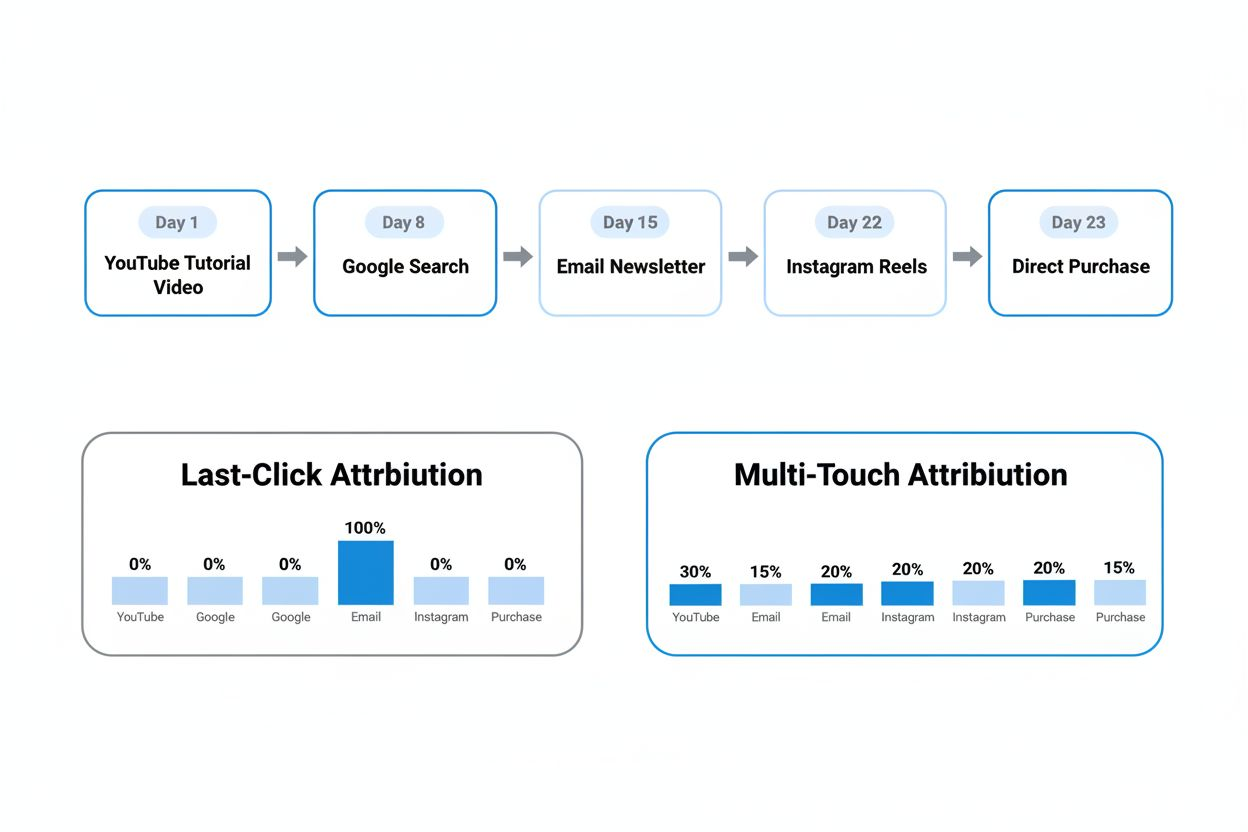
Symphonic Digital illustrates this with a common scenario: a customer discovers a brand through a TikTok video, researches via organic search, receives email content, and finally converts through a retargeting ad. In a last-click model, retargeting gets 100% of the credit. The TikTok video that started the entire journey? Zero credit. The email that kept them warm? Invisible.
For YouTube creators, this plays out in predictable ways. You make a detailed tutorial that introduces 5,000 new people to your work. Two months later, 50 of them buy your product after seeing a short-form clip on Instagram. Instagram looks like a winner. The tutorial looks like it generated zero revenue. You decide to make fewer tutorials.
You just killed the top of your funnel based on bad data.
What Multi-Touch Marketing Actually Means for Creators
Multi-touch marketing is the recognition that your audience doesn't convert in a straight line. They discover you in one place, build trust in another, and finally take action somewhere else entirely.
The "multi-touch" part refers to the multiple points of contact between you and a potential subscriber, customer, or fan before they commit. Each touch matters. Each one moves them closer to a decision.
For a traditional business, this might mean tracking how a customer interacts with ads, website visits, email campaigns, and sales calls. For creators, the touchpoints look different but the principle is identical.
Your viewer might:
- Discover you through a YouTube search for "how to edit videos in DaVinci Resolve"
- Watch three more of your tutorials over two weeks
- See your Instagram post in their feed
- Click through to your website from your YouTube channel page
- Sign up for your email list to get a free preset pack
- Receive five emails over the next month
- Finally buy your full editing course after watching a case study video
Seven touchpoints. Most analytics tools will only show you the last one.
Ruler Analytics reports that 75% of companies are using a multi-touch attribution model to measure marketing performance, and 71% of marketers view optimizing the customer journey across multiple touchpoints as "very important." Creators are behind the curve here, largely because the tools and education have focused on platform-specific metrics rather than cross-platform behavior.
Why Your Best Content Looks Like Your Worst
Last-click thinking creates a systematic bias against the content that builds your audience.
Twilio points out that last-touch attribution "overvalues bottom-funnel channels and ignores everything that built awareness and intent." In creator terms: it makes your promotional content look brilliant and your educational content look worthless.
Here's how this plays out in practice.
You create a comprehensive guide to starting a podcast. It ranks well in search. It gets 20,000 views over six months. Viewers spend an average of 12 minutes watching it. Comments are full of people saying "this is exactly what I needed." But your analytics show zero direct conversions to your microphone affiliate links.
Meanwhile, you post a 60-second Short saying "here's the mic I use" with a link. It gets 3,000 views and generates 15 affiliate sales.
Last-click logic says: make more Shorts, stop wasting time on long guides.
Multi-touch reality says: the guide introduced people to you, built credibility, and created the trust necessary for them to care about your mic recommendation. The Short was the final nudge, but it only worked because of the foundation the guide built.
Symphonic Digital notes that brand-building initiatives appear to have zero value in a last-click model, creating a bias toward short-term performance marketing. For creators, this means your best audience-building work gets systematically undervalued.
The content that introduces you to new audiences, the videos that establish your expertise, the deep dives that create superfans—all of it looks like it's failing if you only measure last-click conversions.
The Hidden Economics of Your Content
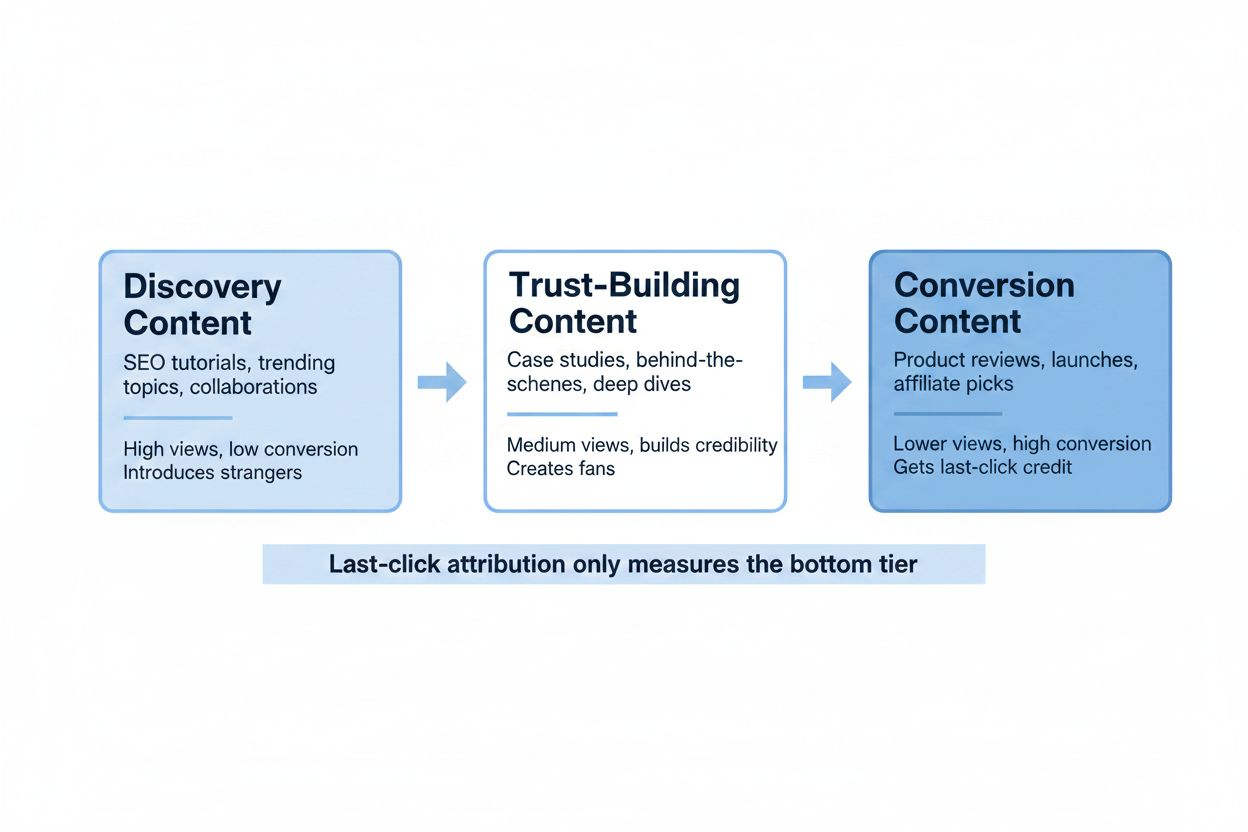
Every piece of content you create serves a function in your audience's journey. Some content is built for discovery. Some for trust-building. Some for conversion.
Discovery content gets people in the door. These are your SEO-optimized tutorials, your trending topic commentary, your collaborations with other creators. They cast a wide net. They answer questions people are actively searching for. They introduce strangers to your work.
This content rarely converts directly. Someone searching "how to fix a squeaky bike chain" is not ready to buy your $500 bike maintenance course. They just want their chain to stop squeaking. But now they know you exist. Now you're on their radar.
Trust-building content turns strangers into fans. These are your in-depth case studies, your behind-the-scenes vlogs, your personal stories, your detailed breakdowns of how you approach your craft. This content doesn't get as many views as discovery content, but the people who watch it are qualifying themselves as your audience.
They're investing time. They're learning how you think. They're deciding if they like you.
Conversion content asks for the sale. These are your product reviews, your course announcements, your affiliate recommendations, your "here's how I can help you" videos. This content gets the credit in last-click models, but it only works if the first two types of content did their job.
When you ignore multi-touch dynamics, you optimize for conversion content and starve the top of your funnel. Short-term, you might see a bump in revenue per view. Long-term, you run out of new people to convert.
How to Start Thinking Multi-Touch
You don't need expensive attribution software to start thinking about your content in multi-touch terms. You need to change how you evaluate performance.
Stop asking: "Did this video generate sales?"
Start asking: "What role did this video play in my audience's journey?"
A few practical shifts:
Track assisted conversions, not just last-click conversions. If you're using Google Analytics, look at the "Assisted Conversions" report under Conversions > Multi-Channel Funnels. This shows you which traffic sources were present earlier in the conversion path, not just at the end. You'll often find that your YouTube channel assists far more conversions than it gets credit for in last-click reports.
Survey your customers. When someone buys your product or joins your membership, ask them: "How did you first hear about me?" and "What convinced you to buy?" You'll get answers like "I found your channel six months ago through a tutorial, then I watched a bunch of your other videos, and finally decided to buy after seeing your email about the sale." That's a multi-touch journey you'd never see in analytics.
Look at view duration and engagement, not just conversion rate. A video with a 60% average view duration and hundreds of comments is doing something valuable, even if it's not generating direct clicks. It's building the relationship that makes future conversions possible.
Map your content to journey stages. Look at your last 20 videos. Which ones were designed for discovery? Which for trust-building? Which for conversion? If you have 15 conversion videos and 5 discovery videos, you're optimizing for the bottom of a funnel that's running dry.
Use UTM parameters to track cross-platform movement. When you link from YouTube to your website, add UTM parameters to the URL (example.com?utm_source=youtube&utm_medium=video&utm_campaign=tutorial-series). This lets you see in Google Analytics when someone discovered you on YouTube but converted later through a different channel. It's not perfect attribution, but it's better than nothing.
Pay attention to time lag. Look at how long it takes people to convert after their first interaction with you. If the average is 30 days, then judging a video's performance after one week is meaningless. You're measuring before the journey is complete.
The Content Mix That Actually Works
Ruler Analytics found that attribution across multiple marketing channels can provide efficiency gains of 15-30%. For creators, this translates to getting more results from the same amount of work by understanding which content types support each other.
A balanced content strategy for multi-touch thinking might look like this:
40% discovery content. These are your search-optimized videos, your trending topic responses, your "how to" tutorials. They won't convert immediately, but they fill your funnel with new potential fans. Measure success by views, new subscribers, and watch time, not by direct conversions.
40% trust-building content. These are your deeper dives, your personal stories, your unique perspectives on your niche. They serve your existing audience and turn casual viewers into committed fans. Measure success by engagement rate, repeat viewers, and community growth.
20% conversion content. These are your product launches, your affiliate recommendations, your sales-focused videos. They get the last-click credit, but they only work because the other 80% built the audience and the trust. Measure success by conversion rate and revenue, but understand that this number depends entirely on the health of the rest of your content mix.
This is not a rigid formula. A channel in growth mode might skew more toward discovery. A channel with a large existing audience might focus more on trust and conversion. The point is to have a mix, not to optimize everything for immediate conversions.

What This Means for Your Next 90 Days
If you've been making decisions based on last-click thinking, you've probably been killing off your best content without realizing it.
Here's what to do differently:
Resurrect your "failed" educational content. Go back through your analytics and find videos with high watch time, strong engagement, and good retention, but low click-through rates on your links. These videos didn't fail. They're doing discovery and trust-building work. Make more content like them.
Stop panicking about videos that don't convert immediately. If a video gets good views and watch time but doesn't drive sales in the first week, that's normal. It's doing its job at the top of the funnel. Give it time.
Create a content calendar that balances all three types. Plan your next month of content with a deliberate mix of discovery, trust-building, and conversion videos. Track how this changes your overall channel performance over 60-90 days, not week to week.
Build a system to capture the full journey. Start surveying buyers. Use UTM parameters. Check assisted conversions in Google Analytics. You don't need perfect data, just better data than "this video got 5,000 views and zero sales."
Invest in content that builds compounding value. Evergreen tutorials, comprehensive guides, and deep-dive case studies might not pop in your weekly analytics report, but they work for months or years, constantly feeding new people into your funnel. A video that brings in 50 new viewers per month for two years is worth more than a video that brings in 5,000 viewers in one week and then dies.
The Real Cost of Ignoring Multi-Touch Dynamics
When you optimize for last-click conversions, you make your channel smaller and more fragile.
You stop creating the content that brings in new audiences because it doesn't show immediate ROI. Your subscriber growth slows. Your view counts plateau. You become dependent on your existing audience, and when they churn (which all audiences do over time), you have no pipeline of new people to replace them.
You also train yourself to think transactionally instead of relationally. Every video becomes a sales pitch. Your audience feels it. They start tuning out your calls to action because you've become predictable and pushy.
Twilio notes that every platform claims credit for a conversion, but most attribution models only count one touchpoint. This creates a false competition between your channels. You start thinking "YouTube vs. email vs. Instagram" when the reality is "YouTube and email and Instagram working together."
The creators who understand multi-touch marketing build systems where each platform and each piece of content plays a specific role. They don't expect every video to do everything. They build journeys, not individual transactions.
Moving Beyond Platform Silos
One of the biggest barriers to multi-touch thinking is that every platform wants you to believe it's the only platform that matters.
YouTube wants you to think YouTube drives all your results. Instagram wants credit for everything. Your email platform has dashboards showing how email is your secret weapon. They're all lying, and they're all telling the truth.
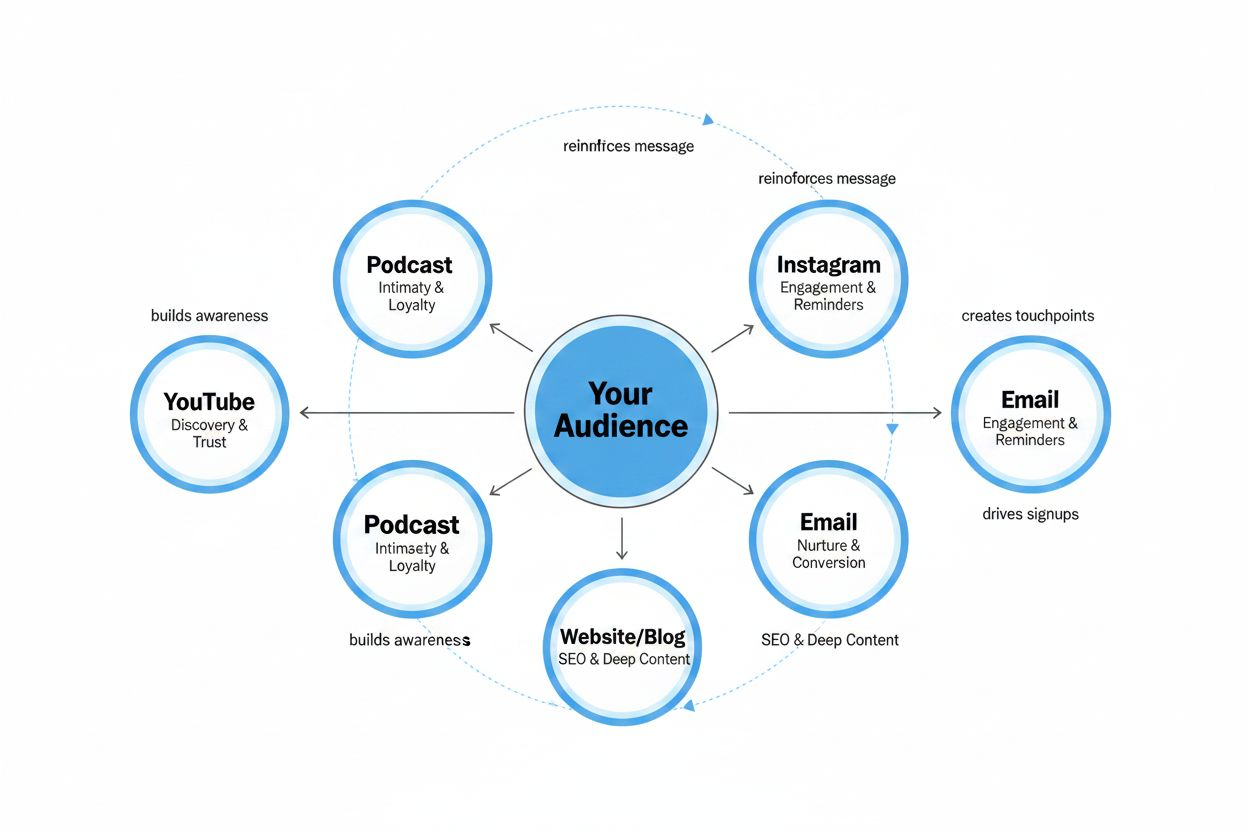
The reality is that your audience lives across platforms. They discover you on YouTube, follow you on Instagram, join your email list, listen to your podcast, and buy from your website. Each touchpoint reinforces the others.
A viewer who only watches your YouTube videos is less likely to buy than a viewer who watches your videos, follows you on Instagram, and reads your emails. The combination creates trust and familiarity that any single channel can't match.
This is why Ruler Analytics found that 71% of marketers view optimizing the customer journey across multiple touchpoints as "very important." The journey is what matters, not any individual touchpoint.
For creators, this means:
Don't abandon a platform just because it doesn't show direct conversions. If your Instagram doesn't drive clicks to your website, that doesn't mean it's worthless. It might be doing critical brand-building work that makes your YouTube calls to action more effective.
Cross-promote strategically. Use each platform to feed the others. Your YouTube videos can drive email signups. Your emails can drive YouTube views. Your Instagram can remind people to check their email. Each touchpoint makes the others more effective.
Think in campaigns, not individual posts. Instead of "I'm making a video about X," think "I'm running a campaign about X that includes a YouTube video, three Instagram posts, two emails, and a blog article." The campaign is the unit of work, not the individual piece of content.
The Questions You Should Be Asking
Instead of "Which video made the most money?" ask:
- Which videos brought in the most new subscribers who are still watching three months later?
- Which videos have the highest percentage of viewers who go on to watch three or more of my other videos?
- Which videos get mentioned most often in customer surveys when people explain how they found me?
- Which videos continue to generate views and subscribers months or years after publication?
- Which combinations of content seem to work together? (Do people who watch video A tend to also watch video B and then convert?)
These questions force you to think about the journey, not just the transaction.
They also require different data sources. You'll need YouTube Analytics for subscriber and view data, Google Analytics for website behavior, email platform data for engagement, and qualitative feedback from surveys and comments. It's messier than looking at a single dashboard, but it's far more accurate.
What Success Actually Looks Like
A creator who understands multi-touch marketing doesn't panic when a video doesn't generate immediate sales. They understand that some videos are investments in future conversions.
They track metrics that matter for each type of content. Discovery content gets judged on views and new subscribers. Trust-building content gets judged on watch time and engagement. Conversion content gets judged on sales and clicks.
They build systems to capture the full customer journey, even if those systems are imperfect. They survey buyers. They use UTM codes. They pay attention to patterns in comments and DMs.
They make content decisions based on the whole funnel, not just the bottom. They protect their discovery and trust-building content even when it doesn't show up in revenue reports, because they understand that killing that content kills future revenue.
And they see results that compound over time. Their channels grow more sustainably. Their audiences are more engaged. Their conversions are more consistent because they're built on a foundation of trust and multiple touchpoints, not just a single desperate pitch.
Your Channel Is a System, Not a Slot Machine
The last-click model treats your channel like a slot machine. Pull the lever (make a video), see if you win (get a conversion). Each video is independent. Each one either pays out or it doesn't.
Multi-touch thinking treats your channel like a system. Each video is a component. Some components bring in raw material (new viewers). Some components process that material (build trust and engagement). Some components produce the final output (conversions and revenue).
You wouldn't judge a factory by looking only at the shipping dock and ignoring the production line. You wouldn't evaluate a restaurant by counting only the meals that left the kitchen and ignoring the prep work, the ingredient sourcing, and the reservation system.
Your channel works the same way. The video that makes the sale is the visible output, but it's supported by dozens of other videos that did invisible work earlier in the journey.
When you understand this, you stop making decisions that optimize one part of the system while breaking the others. You stop killing your discovery content because it doesn't convert. You stop abandoning platforms that don't show last-click revenue. You stop thinking in transactions and start thinking in journeys.
That shift is worth more than any individual video you'll ever make.