Maximizing Impact with Product Placements

When Advertising Disappears into the Story
There is a scene in almost every major Hollywood film where a character reaches for a specific phone, drives a particular car, or opens a distinctly labeled bottle. You notice it, but you keep watching. That is the whole point.
Product placement is the practice of embedding a brand, product, or service into media content in a way that feels organic to the story rather than interrupting it. Unlike a 30-second commercial, a well-executed placement does not ask the audience to pause their experience. It lives inside the experience.
This matters more now than it did a decade ago. Online video ad skipping affects 65 percent of viewers, who do so as soon as they get the chance, and ad-blocker usage now covers 29.5% of internet users worldwide. Brands that rely entirely on traditional advertising are fighting for attention that is increasingly hard to hold. Product placement offers a different path: instead of interrupting content, the brand becomes part of it.
But placement done poorly is worse than no placement at all. A clunky, forced integration can break immersion, annoy viewers, and attach negative associations to a brand. The difference between a placement that works and one that backfires comes down to strategy, fit, and execution.
What Product Placement Actually Covers
The term gets used loosely, so it helps to be specific about what it includes.
At its most basic level, product placement means a brand pays (in money, product, or services) to have its product featured in a piece of media. That media can be a film, a television series, a video game, a podcast, a music video, a live stream, or a social media post. The format has expanded dramatically as media itself has fragmented.
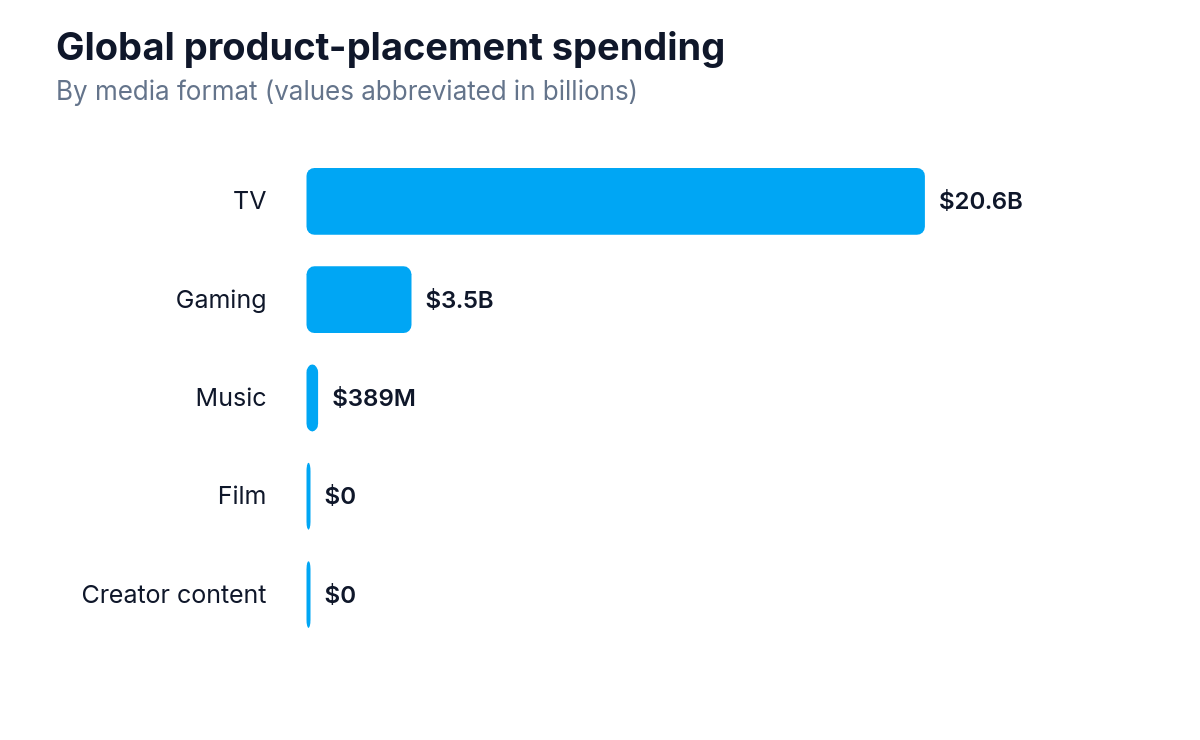
Global product-placement spending is dominated by TV at $20.63 billion, with gaming at $3.5 billion and music at $389 million while film and creator content report zero in this chart.
Placements generally fall into a few categories based on how the product appears:
- Visual placement: the product appears on screen but is not mentioned or used
- Verbal placement: a character mentions the brand by name without it necessarily being visible
- Active placement: a character uses the product in a way that is central to a scene
- Plot integration: the product is woven into the storyline itself, sometimes to the point where removing it would change the narrative
That last category represents the highest level of integration and, when done well, the most powerful form of placement. A character who drives a specific car throughout a film, whose identity is partly defined by that car, creates a much stronger brand association than a logo glimpsed on a shelf in the background.
There is also a distinction between paid placements and organic ones. Most unpaid product placements work by having the advertiser loan or give the product to the production rather than exchange any cash. These tend to feel more natural, though they offer less control over how the product is shown.
Why Placement Works on a Psychological Level
Understanding why product placement is effective requires looking at how people actually process information during entertainment.
When someone watches a film or television show, their critical defenses are lower than when they are watching an advertisement. They are in a state of engagement, not evaluation. They are not asking "should I trust this?" the way they might when a commercial makes a direct claim. The brand enters their awareness through a side door.
This connects to a well-documented psychological principle: repeated exposure to something in a positive context increases familiarity, and familiarity tends to generate preference. When a character the audience likes and identifies with uses a product, that association transfers. The audience does not consciously think "I should buy that." The connection forms at a more subtle level.
Research bears this out: brand recall from product placement is higher than from traditional commercials, with brands presented this way more frequently recalled by viewers even under cognitive load.
There is also the aspirational dimension. Audiences often watch content that depicts lives they find appealing. A luxury watch worn by a character who embodies sophistication and success carries a different weight than the same watch in a print ad. The product absorbs the qualities of the world it inhabits.
This is why brand fit matters so much. A premium car brand placed in a gritty crime drama about poverty sends a confused signal. The same car in a thriller featuring a wealthy protagonist lands completely differently. The context is not just background; it is part of the message.
The Strategic Decisions That Determine Success
Placement is not just about getting your product on screen. The brands that extract real value from it make deliberate choices at every stage.
Choosing the Right Property
The most important decision is where the placement lives. A brand should look at the content's audience demographics, the tone and values the content projects, and how central the placement will be to the story.
Audience alignment is the starting point. A sports nutrition brand placing products in a drama watched primarily by retirees is wasting budget. The audience has to match the target customer.
Tone alignment is equally important and often overlooked. A brand built on playfulness and irreverence placed in a somber prestige drama creates cognitive dissonance. The brand's personality should feel at home in the content's world.
Reach matters, but it is not everything. A placement in a smaller, highly specific piece of content watched by exactly the right audience can outperform a placement in a blockbuster where the brand is one of dozens competing for attention.
Negotiating the Terms of Integration
How a product appears is as important as where it appears. Brands that negotiate carefully can secure:
- Guaranteed screen time and visibility
- Specific scenes or contexts for the placement
- Character dialogue that mentions the product
- Exclusivity clauses preventing competitor placements in the same content
- Approval rights over how the product is depicted
Without these protections, a brand might pay for a placement and find its product used in an unflattering context, barely visible, or cut in the final edit.
Amplifying the Placement Beyond the Screen
Sophisticated brands treat the placement itself as the beginning, not the end. They build campaigns around it: social media content referencing the placement, behind-the-scenes footage, co-branded promotions with the content creators, and press coverage timed to the release.
A placement that generates conversation extends its reach far beyond the audience who saw the original content. When a placement becomes a cultural moment, the earned media value can dwarf the cost of the placement itself.
The Real Advantages Brands Gain
Product placement offers specific advantages that other advertising formats cannot replicate.
Bypassing ad avoidance. The audience cannot skip a placement the way they skip a pre-roll ad. If they are watching the content, they are seeing the brand. This is increasingly valuable as ad-blocking technology and subscription streaming erode the reach of traditional advertising.
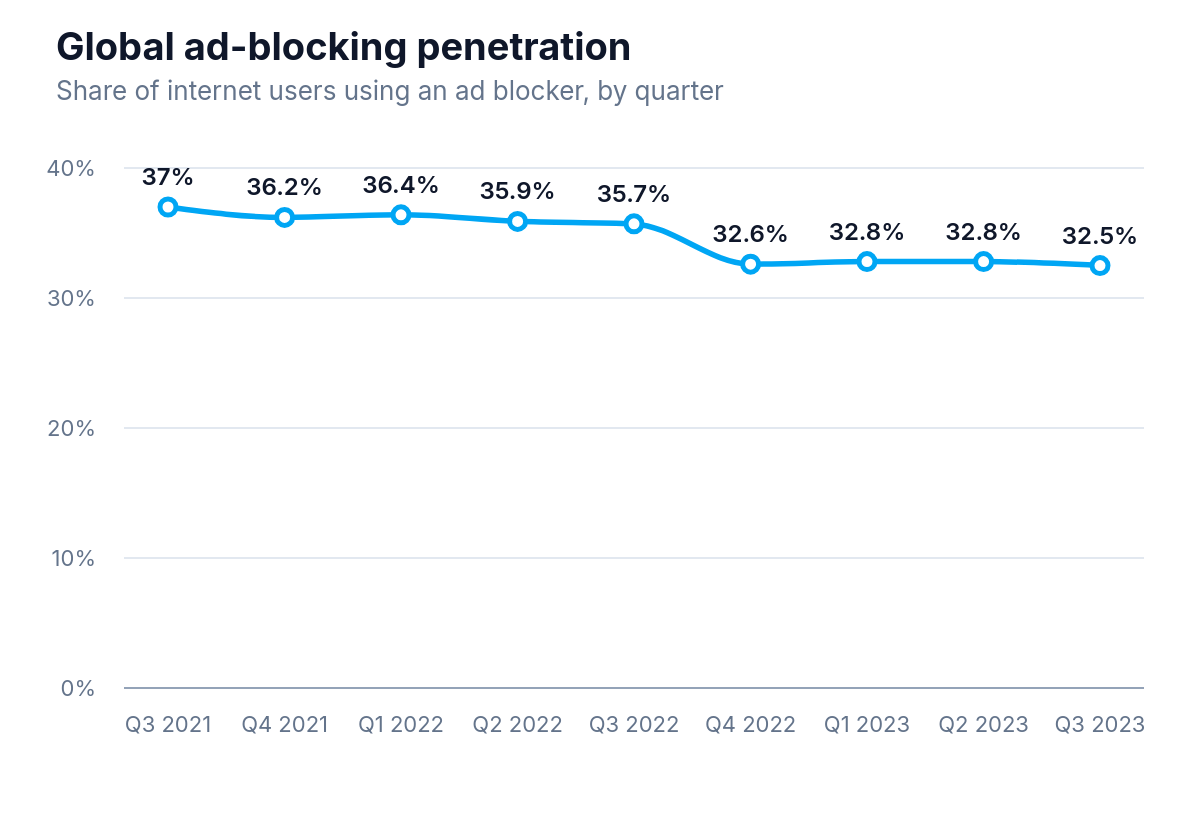
Global ad-blocking penetration declined from 37% of internet users in Q3 2021 to 32.5% in Q3 2023.
Long content life. A television series or film can be watched for years or decades after its original release. A placement made in a show that becomes a long-running hit or a cult classic continues generating impressions long after the campaign budget was spent. Some placements from films made in the 1980s still generate brand recognition today.
Global reach without localization costs. Content travels internationally. A placement in a globally distributed streaming series reaches audiences in dozens of countries without requiring separate campaigns for each market.
Association with creative quality. When a brand is embedded in content that audiences love, some of that goodwill transfers. The brand becomes associated with entertainment, storytelling, and culture rather than just commerce.
Authenticity signals. Younger audiences in particular are skeptical of traditional advertising. A brand that appears in content they already trust can feel more credible than one that interrupts their feed with a polished ad.
The Risks and Limitations Worth Acknowledging
Product placement is not a guaranteed win. The risks are real and worth taking seriously before committing budget.
The most obvious risk is poor fit. A placement that feels forced or incongruous does not just fail to help the brand; it can actively damage it. Audiences notice when a character's brand choice makes no sense in context, and that incongruity creates a negative association.
There is also the risk of content failure. A brand that places heavily in a film that bombs at the box office, or a television series that gets cancelled after two episodes, gets very little return on that investment. Unlike traditional advertising where the brand controls the media buy, placement ties the brand's fortunes to the success of someone else's creative project.
Measurement is another genuine challenge. It is difficult to draw a direct line between a product placement and a sale. Brands can track metrics like brand recall, sentiment shifts, and social media mentions, but attributing revenue to a specific placement requires sophisticated research that many brands do not invest in. This makes it harder to justify placement budgets compared to channels with clearer performance data.
Regulatory scrutiny is increasing in some markets. Under the EU Audiovisual Media Services Directive, product placement disclosure is required at the start and end of programmes and whenever a programme resumes after an advertising break. The rules vary significantly by country and by media type, and brands that fail to comply face reputational and legal risk.
Finally, there is the issue of control. Once a brand's product is in a piece of content, the brand cannot fully control how it is used or how the content is received. If the content becomes controversial, the brand is associated with that controversy.
Measuring Whether a Placement Actually Worked
The measurement problem is solvable, but it requires planning before the placement goes live.
Brand lift studies are the most direct tool. These compare brand awareness, favorability, and purchase intent between audiences who saw the content and those who did not. The difference in those metrics gives a reasonable estimate of the placement's effect.
Social listening provides real-time signal. When a placement airs, brands can track mentions, sentiment, and conversation volume across social platforms. A spike in positive mentions tied to the content release suggests the placement landed.
Search volume is another useful proxy. If branded search increases around the time a placement airs, that suggests the placement drove curiosity and intent.
For brands selling products online, tracking direct traffic and conversion rates during and after a content release can reveal whether the placement influenced purchasing behavior, though isolating the placement's effect from other marketing activity requires careful analysis.
The brands that get the most out of placement are the ones that define success metrics before the placement happens, not after. Knowing what you are trying to measure shapes how you structure the deal and what data you collect.
Formats That Are Changing the Game
Product placement has moved well beyond film and television. Several newer formats are worth understanding.
Streaming platforms have created new opportunities and new complications. On one hand, streaming content reaches global audiences and often has longer shelf lives than broadcast television. On the other hand, streaming services have historically been more cautious about placement than traditional broadcasters, though this is changing as they seek additional revenue streams.
Gaming has become a significant placement channel. In-game advertising and product placement within video game environments can reach highly engaged audiences for extended periods. A brand appearing on a billboard in an open-world game, or as equipment a player can choose, gets repeated exposure in a context where the player is actively engaged.
Creator content on platforms like YouTube and streaming platforms has created a more direct and personal version of placement. When a creator integrates a product into their content, their audience's trust in the creator transfers to the brand in a way that feels different from traditional placement. The creator's voice and personality become part of the brand message.
Podcasts represent a growing placement opportunity, though the format is primarily verbal. A host mentioning a product in the flow of a conversation, rather than reading a scripted ad break, can feel more natural and carry more weight.
Building a Placement Strategy That Holds Up
Brands that treat product placement as a one-off tactic rarely get the results they want. The ones that build it into a broader strategy tend to do better. Product placement spending grew 12.3% worldwide and is on track to expand at roughly the same rate this year, according to PQ Media's Global Product Placement Forecast, which suggests brands across industries are reaching similar conclusions.
A few principles that hold across formats and industries:
Start with brand clarity. Know what your brand stands for and what kind of content reflects those values. Without that clarity, it is impossible to evaluate whether a placement opportunity is a good fit.
Think in terms of audience first, content second. The question is not "is this a popular show?" but "does this show reach the people we want to reach, in a context that serves our brand?"
Negotiate for integration, not just visibility. A product that appears in the background of a scene is worth less than one that a character actively uses. A product that a character uses and talks about is worth more still. Push for meaningful integration wherever possible.
Plan the amplification before the placement airs. The content creator's audience is the starting point, not the ceiling. A well-planned campaign around a placement can multiply its reach significantly.
Be patient with measurement. Brand building takes time. A placement that does not produce an immediate sales spike may still be shifting awareness and preference in ways that pay off over months or years.
Getting the Most Out of Every Placement
Product placement works best when it stops being thought of as advertising and starts being thought of as storytelling partnership. The brands that succeed at it are the ones that understand what the content is trying to do, what the audience cares about, and how their product can genuinely belong in that world.
The mechanics matter: the negotiation, the measurement, the amplification. But the foundation is always fit. A product that makes sense in a scene, that a character would plausibly use, that reflects the world the content is building, does not need to announce itself. It just has to be there, doing what it does, while the audience watches.
That quiet presence, repeated across enough touchpoints over enough time, is how brands build the kind of recognition and preference that advertising alone rarely achieves.