How YouTubers Can Join and Profit from Referral Companies in 2025

You upload videos every week. Views climb. Comments roll in. But ad revenue alone barely covers your coffee budget. Meanwhile, creators with half your subscriber count are pulling in four figures monthly from referral commissions.
The gap is not talent. It is strategy. Referral and affiliate companies pay content creators to recommend products their audiences already want. For YouTubers and video bloggers, this means turning genuine recommendations into reliable income streams without waiting for monetization thresholds or chasing brand deals.
This guide walks you through joining the top referral companies in 2025, understanding commission structures, meeting payout requirements, and placing links where they actually convert. Whether you run a tech review channel, a vlogging series, or tutorials, you will find programs that match your niche and actionable steps to start earning this month.
Why Referral Income Beats Ad Revenue for Most Video Creators
Ad revenue requires massive view counts to generate meaningful income. A video with 10,000 views might earn $20-50 through AdSense, depending on CPM rates and viewer geography. That same video, with a well-placed affiliate link to a $200 product paying 10% commission, needs just two conversions to match or exceed ad earnings.
According to MilX, affiliate commissions for video creators often outpace ad revenue, especially for channels under 100,000 views. The math is simple: referral programs pay for action (purchases, sign-ups), not passive attention. Your 5,000 engaged subscribers who trust your recommendations are worth more than 50,000 casual viewers who skip ads.
Referral income also diversifies revenue. Channels relying solely on ads face demonetization risks, algorithm changes, and seasonal CPM fluctuations. Affiliate partnerships create multiple income sources tied to different companies and products. If one program cuts rates, others continue paying.
The barrier to entry is lower too. You do not need 1,000 subscribers and 4,000 watch hours to join most affiliate programs. Many accept creators at any size, making referral income accessible from your first upload.
Top Referral Companies for YouTubers in 2025
YouTube-Focused Tool Companies
Creators who make content about YouTube itself have the highest-converting referral opportunities. Your audience is already looking for tools to improve thumbnails, optimize SEO, or edit faster.
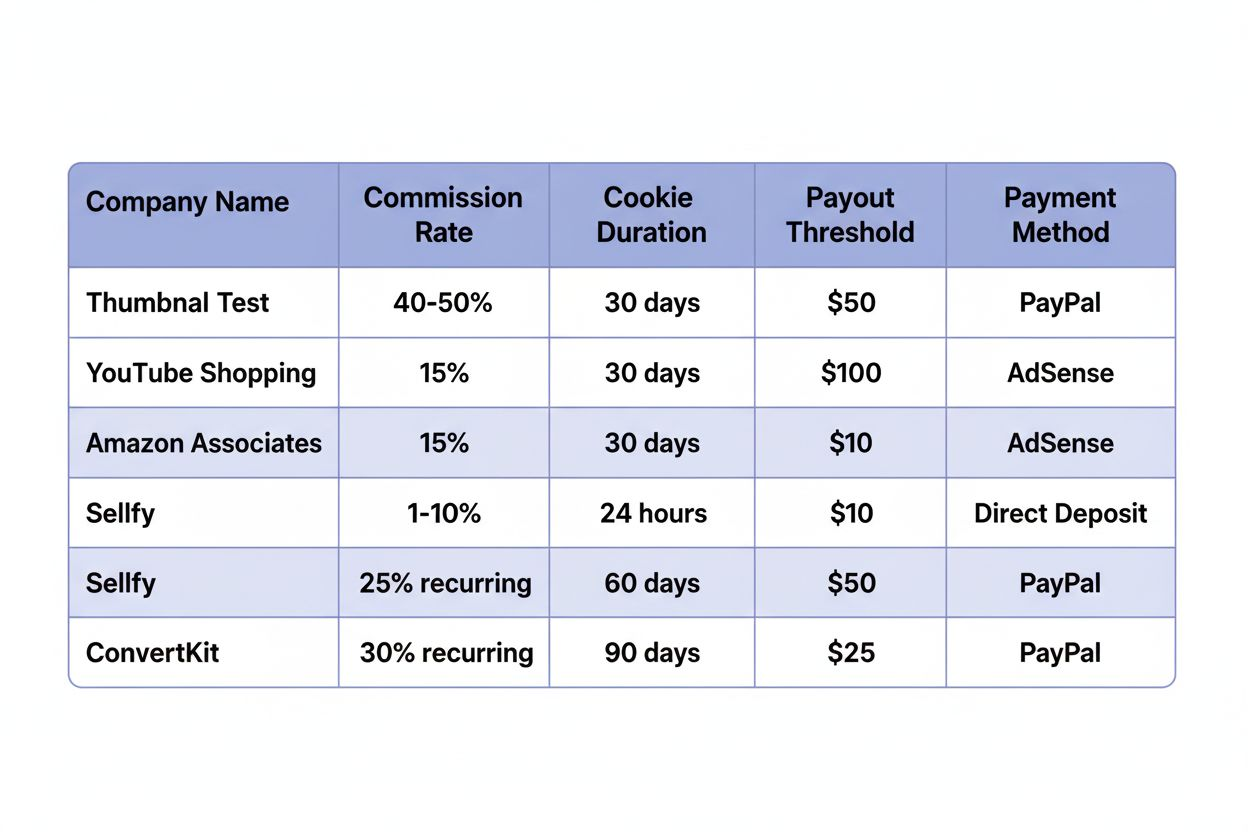
Thumbnail Test offers the highest commission in the YouTube industry: 40-50% per sale, scaling up once affiliates earn over $200/month. Payments are made via PayPal at the start of each month with a $50 minimum payout threshold. Successful affiliates can earn over $1,000/month promoting this thumbnail A/B testing tool.
Other top-paying companies for YouTuber affiliates include vidIQ, TimeBolt, VEED, and the YouTube Partner Program itself, according to Thumbnail Test. These tools solve specific creator problems (analytics, editing speed, video production), which makes them easier to recommend authentically.
VidIQ typically pays 30% recurring commissions on subscription plans. TimeBolt, which automatically cuts silence from videos, offers similar rates. VEED's online video editor pays commissions on both free-to-paid conversions and direct purchases.
The advantage of YouTube tool affiliates: your audience is pre-qualified. If someone watches your "How I Grew My Channel" video, they are actively seeking solutions you can provide through referral links.
E-Commerce and Retail Platforms
Amazon Associates remains the default for product-focused channels. Commissions vary by category from 1-10%, but global reach and trust drive volume. Tech products earn 2-3%, while luxury beauty can hit 10%. The cookie window is 24 hours, meaning viewers must purchase within a day of clicking your link.
Amazon's strength is breadth. You can link to any product in your video, from camera gear to kitchen gadgets, without joining separate programs. The weakness is low commission rates and short cookie duration compared to direct brand programs.
YouTube Shopping's affiliate program requires a non-music channel in the YouTube Partner Program with more than 10,000 subscribers (US or Korea only). It pays an average commission of around 15%, paid through AdSense 60-120 days after a referral purchase. This program integrates directly into YouTube's interface, letting viewers shop without leaving the platform.
Shopify's affiliate program pays $150 per referred merchant who stays subscribed for two months. This works well for business and entrepreneurship channels whose audiences are building online stores.
Software and Digital Services
Recurring commission programs pay you monthly as long as the customer stays subscribed. Sellfy's affiliate program pays 25% recurring revenue for as long as the referred user stays subscribed. One customer can generate income for years.
ConvertKit, a popular email marketing platform for creators, pays 30% recurring commissions. If you refer a customer paying $50/month, you earn $15 every month they remain subscribed. Ten referrals create $150 in monthly passive income.
Canva, Epidemic Sound, and Adobe Creative Cloud all offer affiliate programs with varying structures. Canva pays per Pro subscription sign-up. Epidemic Sound offers tiered commissions based on subscription length. Adobe typically pays a flat fee per Creative Cloud subscription.
The key with software affiliates is demonstrating the tool in your content. A tutorial showing how you design thumbnails in Canva is more effective than mentioning it in passing.
Understanding Commission Structures and Payment Terms
Commission rates tell only part of the story. Payment terms, cookie durations, and payout thresholds determine how much you actually earn and when you receive it.
Commission Types
Flat-rate commissions pay a fixed amount per conversion. Shopify pays $150 per merchant, regardless of which plan they choose. This simplifies calculations and works well for high-value products or services.
Percentage commissions pay a portion of the sale price. A 10% commission on a $500 camera lens earns $50. These scale with product value but can be unpredictable if customers buy lower-priced items than you expected.
Recurring commissions pay monthly or annually as long as the customer stays subscribed. A 30% recurring commission on a $30/month software subscription pays $9 every month. After 12 months, that single referral has generated $108.
Tiered commissions increase as you drive more sales. Thumbnail Test scales from 40% to 50% once you earn over $200/month. This rewards high-performing affiliates and incentivizes promotion.
Cookie Duration and Attribution
Cookie duration determines how long after clicking your link a purchase still counts as your referral. According to Shopify, cookie durations across programs range from 1 to 400 days.
Amazon's 24-hour window is among the shortest. If a viewer clicks your link on Monday but purchases on Wednesday, you earn nothing. This works against YouTubers because viewers often research before buying.
Longer cookies (30-90 days) better match how people actually shop. Someone might watch your review, think about it for a week, then purchase. A 30-day cookie captures that conversion.
Some programs use last-click attribution, crediting the most recent affiliate link. Others use first-click, crediting whoever introduced the customer. Last-click is more common but means you can lose commissions if the customer clicks another affiliate's link before purchasing.
Payout Thresholds and Timing
Shopify notes that minimum payouts typically range from $10 to $200. Thumbnail Test sets its threshold at $50, paying via PayPal at the start of each month.
Low thresholds ($10-25) mean you receive payments faster, which helps small channels see results quickly. High thresholds ($100-200) can delay your first payment by months if you are just starting.
Payment timing varies widely. YouTube Shopping pays through AdSense 60-120 days after a referral purchase. Amazon pays roughly 60 days after the end of the month in which you earned commissions. Direct programs like Thumbnail Test pay monthly, usually within the first week.
Factor in payment processing time too. PayPal transfers are instant once sent. Bank deposits can take 3-5 business days. International payments may incur currency conversion fees.
How to Join Referral Programs: Step-by-Step
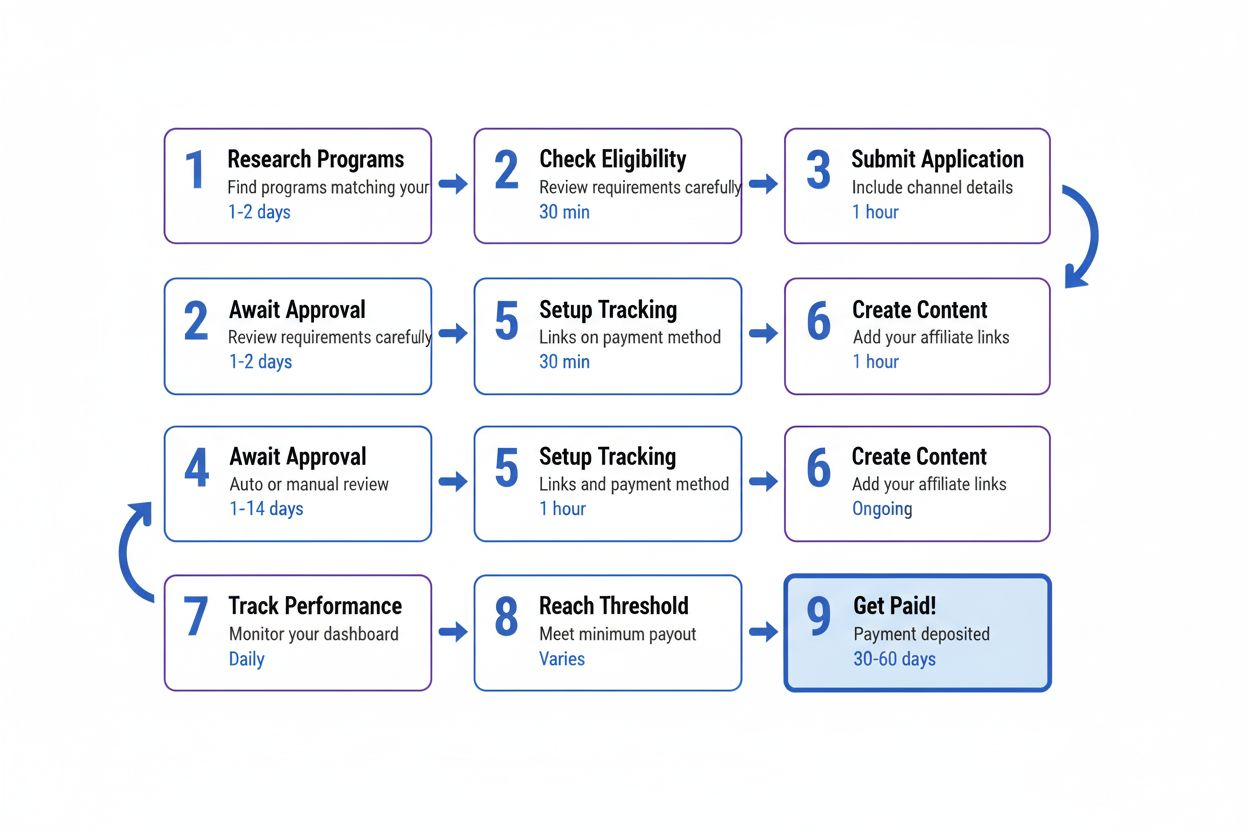
Research Programs That Match Your Niche
Start by listing products and services you already use and recommend. Authenticity converts better than promoting random products for higher commissions.
If you run a tech review channel, look for electronics retailers, software companies, and gear manufacturers. Vloggers should explore camera equipment, editing software, and travel services. Gaming channels can join game key resellers, peripheral manufacturers, and streaming tool companies.
Search "[your niche] affiliate programs" to find options. Most companies list their programs in the footer of their website under "Affiliates" or "Partners."
Check commission rates, but also evaluate product quality and company reputation. Promoting a terrible product for 50% commission will damage your credibility more than it is worth.
Meet Eligibility Requirements
Most programs require:
- An active YouTube channel or blog
- Original content (not reposts or compilations)
- Compliance with platform terms of service
- Minimum subscriber or view counts (for some programs)
YouTube Shopping requires a non-music channel in the YouTube Partner Program with more than 10,000 subscribers, and availability is limited to the US or Korea only.
Many programs have no minimum requirements. Amazon Associates, for example, accepts channels of any size but requires at least three sales within 180 days to remain active.
Prepare basic information before applying:
- Channel URL and statistics (subscribers, average views)
- Website or blog URL if you have one
- Traffic sources and audience demographics
- How you plan to promote products
Complete the Application Process
Most applications ask why you want to join and how you will promote products. Be specific. Instead of "I will mention products in my videos," write "I create weekly camera gear reviews with 5,000-10,000 views per video. I will feature your products in dedicated review videos and include affiliate links in descriptions."
Some programs auto-approve within minutes. Others manually review applications, which can take 1-7 days. High-value programs (luxury goods, financial services) may require a call or additional verification.
If rejected, ask why. Common reasons include:
- Insufficient content or traffic
- Poor content quality
- Niche mismatch (applying to a cooking program with a gaming channel)
- Previous terms violations
You can often reapply after addressing the issue. Build more content, grow your audience, or apply to programs that better match your niche.
Set Up Tracking and Payment
Once approved, you will receive a unique affiliate ID or tracking link. This identifies you when someone clicks through and purchases.
Most programs provide a dashboard showing:
- Clicks on your links
- Conversion rate (clicks that became sales)
- Earnings (pending and paid)
- Top-performing products
Set up your payment method immediately. Options typically include:
- PayPal (most common, fastest)
- Direct bank deposit
- Wire transfer (for international payments)
- Check (slow, becoming rare)
Verify your tax information. US-based programs require a W-9 form for US affiliates or W-8BEN for international affiliates. This ensures proper tax reporting and prevents payment delays.
Placement Strategies That Actually Convert
Where and how you place referral links determines whether viewers click and buy. Sloppy placement kills conversions even with great products.
Video Description Best Practices
Put your most important affiliate link in the first two lines of your description. YouTube truncates descriptions after about 100 characters in search results and suggested videos. Viewers must click "Show more" to see the rest.
Bad example: "Hey everyone! Thanks for watching my latest video. If you enjoyed it, make sure to like and subscribe. I really appreciate all your support. You can follow me on Instagram and Twitter. Oh, and here's the link to the camera I mentioned: [link]"
Good example: "Camera I'm using: [affiliate link] Lens: [affiliate link] Microphone: [affiliate link]
In this video, I test the new Sony A7 IV in low light conditions..."
Group related links under clear headers: Gear in This Video: Software I Use: Recommended Resources:
This organization helps viewers find what they need quickly. It also signals that you are providing value, not just dumping links.
Include a brief disclosure at the top: "Links marked with * are affiliate links. I earn a small commission if you purchase through them at no extra cost to you." This builds trust and complies with FTC guidelines.
In-Video Mentions and Demonstrations
Verbal mentions increase click-through rates significantly. When you hold up a product and say "Link in the description," viewers are more likely to check the description than if you never mention it.
Demonstrate the product solving a problem. Show the before and after. Walk through the features you actually use. Viewers buy solutions, not specifications.
Time your mention strategically. Early in the video (first 2-3 minutes) captures viewers before they drop off. But mentioning too early, before establishing value, feels pushy.
Mid-roll mentions work well in longer videos (10+ minutes). After delivering value, you have earned the right to recommend a product. "This is the editing software I used to create this effect. If you want to try it, link is in the description."
End-of-video mentions catch viewers who watched all the way through. These are your most engaged audience members, more likely to take action.
Use on-screen graphics to reinforce the link. A simple text overlay with "Link in description" or "See description for details" reminds viewers without interrupting your narration.
Pinned Comments and Community Posts
Pin a comment with your affiliate links immediately after publishing. This puts them at the top of the comment section, where engaged viewers look first.
Format pinned comments like your description: clear headers, organized links, brief explanations.
Example: "📷 Gear from this video: Camera: [link] Lens: [link] Tripod: [link]
💡 Software I used: Editing: [link] Thumbnails: [link]
Thanks for watching! Let me know what you want to see next."
Community posts (for channels with 1,000+ subscribers) let you share affiliate links directly with subscribers. Use these for:
- Product launches or sales
- Follow-up recommendations after a popular video
- Curated lists ("My 5 favorite budget microphones")
Keep community posts valuable, not spammy. One well-crafted post per week outperforms daily link dumps.
Creating Dedicated Resource Pages
If you have a website or blog, create a gear page or resources page listing all your affiliate recommendations. Link to this page from every video description.
This centralizes your recommendations and gives you a single URL to promote across platforms. It also captures search traffic from people looking for "[your name] camera setup" or "[your name] editing software."
Organize by category:
- Camera gear
- Audio equipment
- Lighting
- Software
- Accessories
Include brief reviews or notes explaining why you recommend each item. This adds value beyond a simple link list and helps viewers make informed decisions.
Update this page regularly as you switch gear or discover new tools. Date your updates so viewers know the information is current.
Maximizing Earnings: Advanced Tactics
Track What Works
Most creators place links and hope for the best. Top earners track performance and double down on what converts.
Use UTM parameters to identify which videos drive the most sales. Append tracking codes to your affiliate links:
?utm_source=youtube&utm_medium=description&utm_campaign=video-title
Your affiliate dashboard will show which campaigns (videos) generated clicks and sales. This reveals:
- Which topics convert best
- Whether viewers prefer description links or pinned comments
- If longer or shorter videos drive more purchases
Create more content around high-converting topics. If your camera comparison video drove 50 sales while your vlog drove 2, make more comparison content.
Test different placements. Try putting links at the top of the description for one video, mid-description for another. Compare click-through rates.
Bundle Recommendations
Instead of promoting single products, create curated kits or setups. "My complete beginner streaming setup" bundles a camera, microphone, lighting, and software into one recommendation.
Bundles increase average order value. A viewer who came for a microphone recommendation might also buy the audio interface and boom arm you suggest.
Create different tiers:
- Budget setup ($500 total)
- Mid-range setup ($1,500 total)
- Professional setup ($5,000 total)
This gives viewers options at different price points and increases the chance they find something within their budget.
Leverage Seasonal Opportunities
Commission rates and product availability change throughout the year. Plan content around:
Black Friday and Cyber Monday: Many programs increase commissions during this period. Create gift guides, deal roundups, and "what I'm buying" videos.
Back to School (August-September): Promote student-focused products like laptops, software, and productivity tools.
New Year (January): Fitness equipment, productivity software, and self-improvement products convert well.
Prime Day (July): Amazon-focused content performs well during this sale period.
Publish seasonal content 1-2 weeks before the event to capture early shoppers and rank in search results.
Build Email Lists
YouTube owns your subscriber relationship. Email lists give you direct access to your audience.
Offer a free resource (gear checklist, editing templates, tutorial PDF) in exchange for email addresses. Include affiliate recommendations in your welcome sequence and regular newsletters.
Email converts higher than YouTube descriptions because recipients opted in and expect product recommendations. A well-crafted email to 1,000 subscribers can generate more sales than a video with 10,000 views.
Use email to:
- Announce new videos with affiliate links
- Share exclusive deals or discount codes
- Recommend products between video uploads
- Re-promote evergreen content with affiliate links

Common Mistakes That Kill Conversions
Promoting Products You Do Not Use
Viewers detect inauthentic recommendations instantly. If you have never used the product, your explanation will be vague and unconvincing.
You cannot answer specific questions in comments. You cannot demonstrate real use cases. You cannot compare it to alternatives from personal experience.
Stick to products you actually own and use. Your genuine enthusiasm and detailed knowledge will convert far better than scripted talking points about a product you have never touched.
Overloading Descriptions With Links
Forty affiliate links in one description overwhelms viewers and dilutes your recommendations. They do not know what to click, so they click nothing.
Limit yourself to 5-10 highly relevant links per video. Focus on products you actually featured or mentioned, not everything tangentially related to the topic.
Quality over quantity applies to affiliate marketing. Three well-explained, genuinely useful recommendations will earn more than 30 random links.
Ignoring Disclosure Requirements
The FTC requires clear disclosure of affiliate relationships. "I may earn a commission" is not optional. It is legally required.
Failing to disclose can result in:
- FTC fines
- Loss of affiliate partnerships
- Damage to your reputation
- Removal from YouTube Partner Program
Make disclosures clear and conspicuous. Include them:
- In the first few lines of your description
- Verbally in the video ("This video contains affiliate links")
- In pinned comments
Do not hide disclosures in walls of text or use vague language like "I may be compensated." Be direct: "I earn a commission if you purchase through these links."
Neglecting Mobile Viewers
Over 70% of YouTube watch time happens on mobile devices. Your carefully formatted description with organized links might look great on desktop but render as a wall of text on phones.
Keep descriptions scannable on mobile:
- Use short paragraphs (1-2 sentences)
- Include line breaks between sections
- Put the most important links first
- Use emojis sparingly as visual separators
Test how your descriptions look on mobile before publishing. What seems organized on your computer might be unreadable on a phone.
Chasing High Commissions Over Relevance
A 50% commission on a product your audience does not need earns nothing. A 5% commission on something they actively want can generate substantial income.
Match products to your audience's actual needs and interests. A gaming channel promoting kitchen appliances for high commissions will see zero conversions and confused viewers.
Stay in your lane. Promote products that make sense for your content and audience, even if commissions are lower. Trust and relevance drive sales, not commission rates.
Building Long-Term Referral Income
Referral income compounds. Your first month might generate $50. Six months later, with more videos and refined strategies, you could be earning $500-1,000 monthly.
Thumbnail Test notes that successful affiliates can earn over $1,000/month promoting their platform alone. That is one program. Diversify across 5-10 relevant programs and monthly income can reach several thousand dollars.
The key is consistency. Every video is an opportunity to include relevant affiliate recommendations. Over time, your library of content creates multiple income streams. A video published six months ago continues generating commissions from new viewers discovering it through search.
Focus on evergreen content. Product reviews, tutorials, and how-to guides continue attracting viewers and driving sales for years. Timely content (news, trends) spikes quickly but fades fast.
Build relationships with affiliate managers. As you drive more sales, you gain leverage to negotiate higher commission rates, exclusive discount codes for your audience, or early access to new products.
Track your progress monthly. Review which programs generate the most income, which videos convert best, and where you should focus your efforts. Double down on what works. Cut programs that consistently underperform.
Referral income will not replace a full-time salary overnight. But for most YouTubers, it can become the largest revenue stream within 6-12 months of consistent effort, surpassing ad revenue and sponsorships.
Start with one or two programs that align perfectly with your content. Master the basics of placement and promotion. Then expand to additional programs as you refine your approach. The creators earning four and five figures monthly from referrals started exactly where you are now, with a single link in a single video description.