SEO Techniques to Boost YouTube Visibility and Revenue

Why Most YouTube Channels Stay Small
YouTube has over 800 hours of video uploaded every minute. That number is not meant to discourage you. It is meant to explain why most channels, even those with genuinely good content, never find an audience. The problem is rarely quality. It is discoverability.
Search engine optimization on YouTube works differently from Google SEO, but the underlying logic is the same: help the platform understand what your content is about, match it to the right searchers, and give viewers enough reason to click. Do those three things consistently, and the algorithm starts working with you instead of against you.
This article covers the specific techniques that move the needle on YouTube visibility, how those techniques connect to revenue, and what to prioritize if you are starting from scratch.
How YouTube's Algorithm Actually Works
YouTube's algorithm has two jobs: keep people on the platform as long as possible, and surface content that satisfies what a viewer came to find. Every ranking decision flows from those two goals.
The recommendation signals the algorithm weighs include watch time, click-through rate (CTR), satisfaction surveys, and viewing habits across different devices and times of day:
- Click-through rate (CTR) on impressions
- Average view duration and percentage watched
- Likes, comments, and shares relative to views
- How quickly a video gains traction after publishing
- Whether viewers continue watching other videos after yours
Notice that keyword stuffing your description is not on that list. Keywords matter, but they are the starting point, not the finish line. They get your video in front of the right audience. Engagement signals tell the algorithm whether that audience actually liked what they found.
This is why optimizing for SEO and optimizing for viewer experience are not separate tasks. They are the same task.
Keyword Research for YouTube
YouTube is the second largest search engine in the world. People search it the same way they search Google: they type a question or a topic, and they expect relevant results. Your job is to understand what your target audience types.
Finding the Right Keywords
Start with YouTube's own search bar. Type a partial phrase related to your topic and watch the autocomplete suggestions. These are real searches people are making, ranked roughly by volume. If you type "how to edit" and YouTube suggests "how to edit videos on iPhone," that is a real demand signal.
Go further by looking at what your competitors rank for. Find channels in your niche with strong view counts on recent videos. Look at their titles, descriptions, and tags. The tags field is not weighted heavily by the algorithm anymore, but it still reveals what creators think their video is about, which gives you clues about their keyword strategy.
Tools like TubeBuddy and VidIQ integrate directly into YouTube and show you search volume estimates, competition scores, and keyword suggestions. Neither tool is perfect, but both are useful for comparing keyword difficulty. A keyword with high search volume and low competition is the target.
Matching Search Intent
Not every keyword is worth chasing. A video titled "Sony A7IV review" will attract people who want to buy or understand that camera. A video titled "Sony A7IV vs A7III" attracts people comparing two options before a purchase decision. Both are valid, but they serve different viewers at different stages.
Before you commit to a keyword, ask yourself: what does someone who types this actually want to see? If your video does not deliver that, your watch time will suffer, and the algorithm will stop pushing it regardless of how well you optimized the title.
Titles, Thumbnails, and the Click Problem
A video that nobody clicks on does not exist, as far as YouTube is concerned. CTR is one of the most direct signals the algorithm uses to judge whether a video deserves more distribution.
Writing Titles That Work
Good YouTube titles do two things at once: include the target keyword and give a viewer a reason to click. The keyword placement matters. Put it near the front of the title when possible, because YouTube title truncation kicks in past 70 characters, cutting the rest off with an ellipsis in search results and on mobile.
Compare these two titles for the same video:
- "My Morning Routine"
- "Morning Routine That Helped Me Sleep Better and Work Less"
The second title includes a specific outcome. Viewers can see what they will get from watching. That specificity drives clicks.
Keep titles under 60 characters where possible. Longer titles get cut off, and the most important words end up hidden.
Thumbnails as SEO
Thumbnails are not technically part of YouTube's text-based SEO, but they are inseparable from it in practice. A strong thumbnail increases CTR, which signals to the algorithm that your video is worth showing more. A weak thumbnail wastes every other optimization you have done.
The most effective thumbnails tend to share a few traits: high contrast, a clear focal point, minimal text (three to five words at most), and a visual that creates curiosity or promises a clear payoff. Human faces with expressive reactions perform well because viewers are wired to respond to facial cues.
Test your thumbnail at small sizes. Most people see it as a small rectangle on a phone screen. If the image is unclear at that size, redesign it.
Descriptions, Tags, and Metadata
The video description is one of the most underused SEO tools on YouTube. Most creators write two sentences and move on. A well-written description does several things: it tells YouTube what the video is about, it gives viewers context, and it can include links that drive traffic to your other content or external sites.
Writing Descriptions That Help
Put your target keyword in the first two sentences of the description. YouTube shows only the first 150 characters or so before the "Show more" button, so the opening lines carry more weight.
After the opening, expand naturally. Write a paragraph or two summarizing what the video covers. Include related terms and phrases that a viewer might also search for. You are not stuffing keywords; you are writing a genuine summary that happens to use relevant language.
Below the main description, add:
- Timestamps (chapters) for longer videos
- Links to related videos on your channel
- Links to your social profiles or website
- A clear call to action (subscribe, comment, watch next)
Key Moments (video chapters) are particularly valuable. When available, they appear directly in Google search results as well as YouTube search, giving your video more surface area in both places.
Tags: Useful but Not Critical
Tags once carried significant weight in YouTube's ranking system. According to YouTube's own guidance, video tags play a minimal role in a video's discovery. Still, they cost nothing to add and can help in edge cases, particularly for topics where spelling varies or where your video covers multiple related terms.
Use your primary keyword as the first tag. Add five to ten related terms. Do not add tags that have nothing to do with your video; YouTube has stated this can hurt your rankings.
Watch Time and Engagement: The Real Ranking Factors
You can optimize every piece of metadata perfectly and still rank poorly if your videos do not hold attention. Watch time is the metric YouTube cares about most, because it directly serves their goal of keeping people on the platform.
Structuring Videos for Retention
The first 30 seconds of a video are where most viewers decide whether to stay or leave. Avoid long intros, slow builds, and unnecessary context. Get to the value immediately. Tell viewers what they will get, then deliver it.
Pacing matters throughout. Long pauses, repeated filler phrases, and slow delivery all increase the chance that a viewer skips ahead or leaves entirely. Review your retention graph in YouTube Analytics. The points where viewers drop off are telling you something specific about your content.
Pattern interrupts, such as a change in camera angle, a cut to a graphic, or a shift in topic, help maintain attention in longer videos. They do not need to be dramatic. Even a simple cut from a wide shot to a close-up resets viewer attention.
Comments and Community Signals
YouTube treats comments as an engagement signal. A video with active discussion is one that clearly provoked a reaction, which the algorithm reads as a positive sign. Ask a specific question at the end of your video rather than a generic "let me know in the comments." Specific questions get specific answers, and those answers generate more replies.
Respond to comments, especially in the first 24 to 48 hours after publishing. Early engagement velocity matters. A video that generates activity quickly after upload gets pushed to more impressions, which creates a compounding effect.
Publishing Strategy and Channel Structure
Individual video SEO matters, but channel-level signals also affect how YouTube treats your content. A channel with a clear niche, consistent publishing schedule, and strong subscriber engagement gets more favorable treatment than a scattered channel with inconsistent output.
Niche Consistency
YouTube's recommendation system works by grouping viewers into interest clusters. If your channel covers cooking, personal finance, and gaming equally, the algorithm struggles to know who to recommend your videos to. A tightly focused channel builds a clear audience profile, which makes recommendations more accurate and more frequent.
This does not mean you can never expand your topics. It means you should expand deliberately, and ideally only after your core niche has a solid subscriber base.
Publishing Frequency and Timing
Consistency matters more than frequency. Publishing twice a week reliably beats publishing five times one week and nothing the next. YouTube's algorithm rewards channels that give it a predictable content stream.
Timing your uploads to match when your audience is most active can give a small boost to early engagement. Check your YouTube Analytics under "When your viewers are on YouTube" to find those windows. For most channels, late afternoon to evening on weekdays performs well, but your specific audience may differ.
Playlists and Internal Linking
Playlists are an underrated SEO tool. They create a structured viewing experience that increases session time, which is a strong positive signal for the algorithm. When a viewer finishes one video and the next one in a playlist auto-plays, YouTube counts that continued viewing against your channel's overall performance.
Create playlists around specific topics or series. Give each playlist a keyword-rich title and description. Link to playlists from your video descriptions and end screens.
End screens and cards are YouTube's built-in tools for internal linking. Use them to direct viewers to related videos or playlists. A viewer who watches two or three of your videos in a session is far more likely to subscribe than one who watches a single video and leaves.
YouTube SEO and Revenue: The Connection
Visibility and revenue are directly linked on YouTube, but the relationship is not as simple as more views equals more money.
How YouTube Revenue Works
YouTube Partner Program eligibility requires 1,000 subscribers plus either 4,000 qualified watch hours in the last 12 months or 10 million qualified Shorts views in the last 90 days. Once you qualify, you earn a share of ad revenue based on CPM (cost per thousand impressions) and RPM (revenue per thousand views after YouTube's cut).
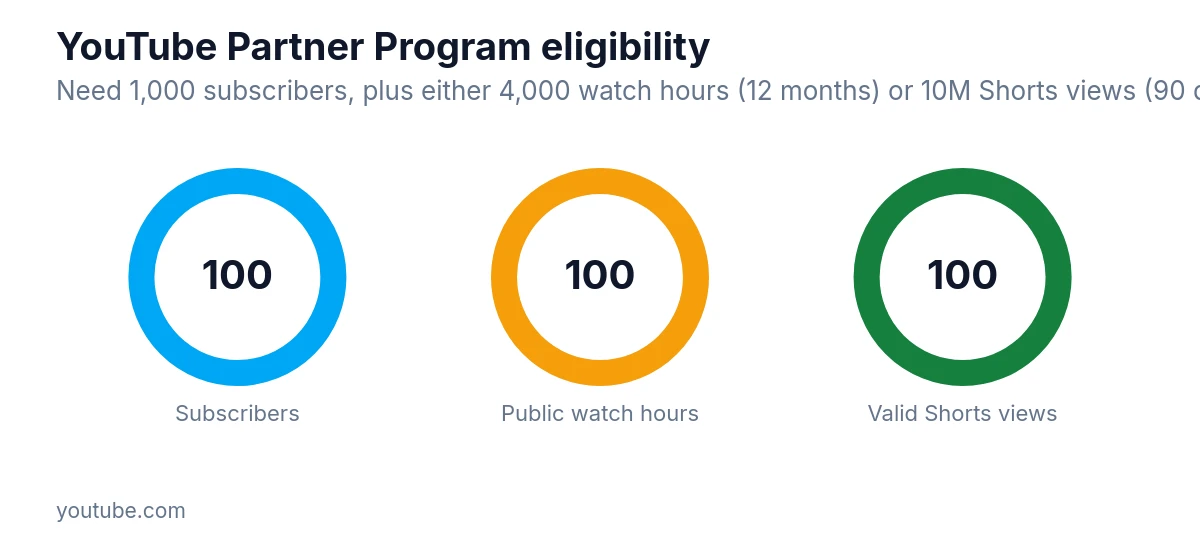
To join the YouTube Partner Program you need 1,000 subscribers and, as the larger threshold, 10 million valid Shorts views in 90 days; alternatively, 4,000 public watch hours in 12 months.
CPM varies enormously by niche, audience location, and time of year. Finance, business, and technology content typically commands higher CPMs than entertainment or gaming. A finance channel with 100,000 views per month may earn significantly more than an entertainment channel with 500,000 views.
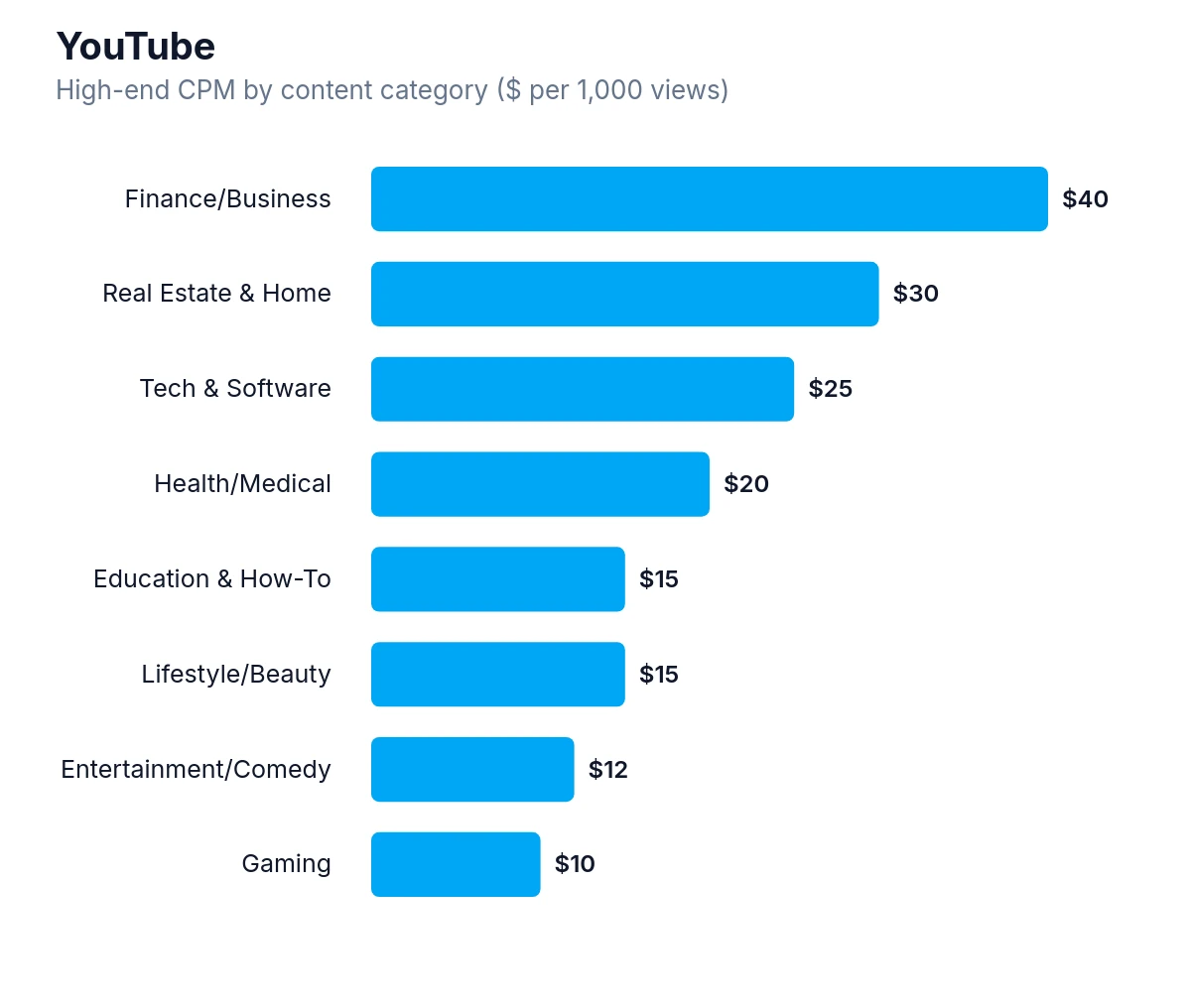
Finance and business videos show the highest high-end CPM at $40 per 1,000 views, while gaming is the lowest at $10 per 1,000 views.
This means the path to meaningful revenue is not just about getting more views. It is about attracting the right viewers in high-value niches, keeping them engaged long enough to see ads, and building a loyal audience that returns.
Beyond Ad Revenue
Creators who rely solely on ad revenue are vulnerable to algorithm changes, advertiser pullbacks, and CPM fluctuations. The most financially stable YouTube channels treat ad revenue as one income stream among several.
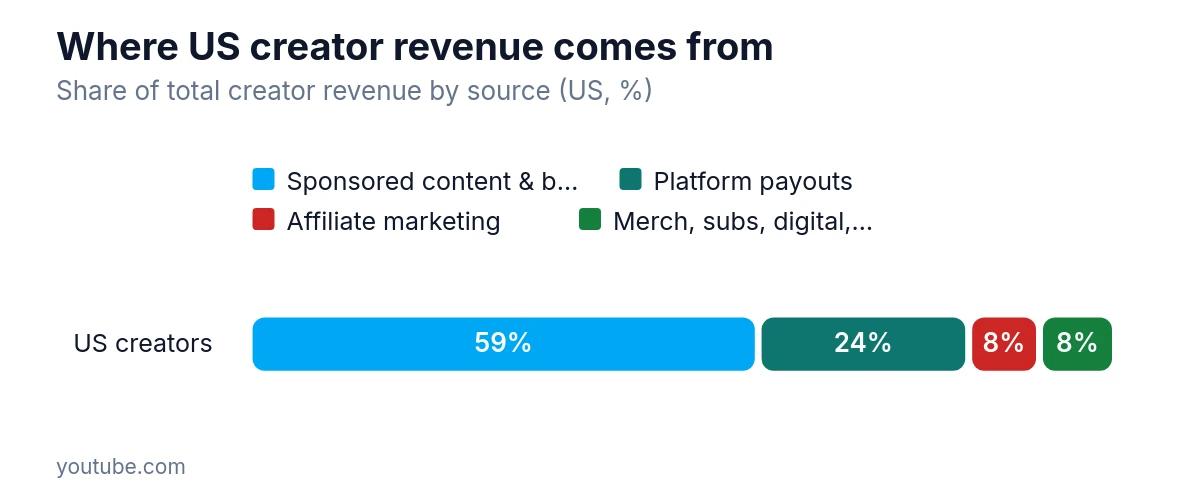
A majority of US creator revenue comes from sponsored content and brand deals, which make up 59% of total creator income.
The range of creator revenue streams includes Patreon, consulting, YouTube ad revenue, courses, Substack, and newsletters, and all of them convert better when a channel has a loyal, engaged audience. SEO builds that audience by consistently bringing in viewers who are actively searching for what you create.
A channel that ranks well for specific search terms attracts viewers with clear intent. Those viewers are more likely to subscribe, more likely to buy, and more likely to share. That is the revenue case for taking YouTube SEO seriously.
Practical Steps to Start Improving Your Rankings
If you want to apply this systematically rather than randomly, here is a workable sequence:
- Audit your existing videos using YouTube Analytics. Identify which videos have the highest CTR and best retention. Study what those videos did differently.
- Pick one keyword research tool (TubeBuddy or VidIQ are the most accessible) and spend time understanding what your audience actually searches for before you script your next video.
- Rewrite the descriptions on your five most-viewed videos. Add chapters, improve the opening two sentences, and include links to related content.
- Create at least two playlists from existing content and link to them from your channel page and video descriptions.
- For your next three uploads, track CTR and average view duration weekly. Use those numbers to inform your next title and thumbnail decisions.
None of this requires expensive tools or advanced technical knowledge. YouTube SEO is learnable by anyone willing to pay attention to data and iterate based on what it shows.
What Stays True as AI Changes Search
There is a reasonable question about whether SEO matters as AI-generated answers become more common. For YouTube specifically, the concern is less relevant than it is for text-based Google search. People come to YouTube to watch, not to read a summary. A video about how to fix a leaky faucet cannot be replaced by a paragraph of AI text for someone who needs to see the repair done.
The fundamentals of YouTube SEO, understanding what your audience searches for, creating content that satisfies that search, and giving the algorithm clear signals about what your video covers, are not going away. If anything, the channels that invest in these fundamentals now will be better positioned as the platform continues to grow and competition increases.
The goal has always been the same: make content worth finding, then make it easy to find.