Key Performance Indicators for Sponsorship Success
Why Most Sponsorships Fail on Paper
A brand spends six figures sponsoring a music festival. The event sells out. Social media buzzes for a weekend. Then someone in finance asks what the company actually got for its money, and nobody has a clean answer.
This is the most common failure mode in sponsorship: not the deal itself, but the measurement. Without clear performance indicators defined before the activation begins, sponsorship value becomes a matter of opinion. And opinions rarely survive budget reviews.
The good news is that sponsorship measurement has matured considerably. Organizations like MASB have developed a sponsorship measurement approach that is independent, objective, and marketer-directed, with guidance on mid-funnel ROO measures that make quantification attainable. The challenge is choosing the right ones for your specific objectives and tracking them with enough discipline to make the data meaningful.
Setting the Foundation: Objectives Before Metrics
The single biggest mistake sponsors make is choosing KPIs after the fact. Metrics should follow objectives, and objectives should be set before any contract is signed.
A sponsorship can serve several distinct business purposes, and each one demands a different measurement approach.
Brand awareness goals call for metrics like aided and unaided recall, share of voice, and media impressions. These are harder to tie directly to revenue but matter enormously for companies entering new markets or repositioning their brand.
Lead generation goals require tracking how many qualified contacts the sponsorship produced, what it cost to acquire each one, and how many eventually converted. This is where sponsorship starts to look more like a sales channel than a marketing expense.
Customer retention and loyalty goals focus on existing customers. Did VIP access or exclusive experiences deepen relationships? Did churn rates change among customers who engaged with the sponsorship versus those who did not?
Direct revenue goals apply when the sponsorship includes a commercial component, such as on-site sales, promo codes, or affiliate links. Here, the measurement is more straightforward: revenue generated against sponsorship cost.
Once you know which category your sponsorship falls into (and it may span more than one), you can select KPIs that actually reflect progress toward those goals.
Brand Metrics: Measuring What People Think and Feel
Brand metrics are the most debated in sponsorship because they do not show up directly on an income statement. But for many sponsors, they represent the primary reason for the investment.
Awareness and Recall
Aided recall measures whether an audience recognizes your brand when prompted with a list of sponsors. Unaided recall measures whether they can name you without any prompting. The gap between these two numbers tells you something important about how strongly your brand registered.
Pre- and post-event surveys are the standard method here. Run a baseline survey with a sample of the target audience before the event, then run the same survey afterward. The lift in recall is your awareness gain.
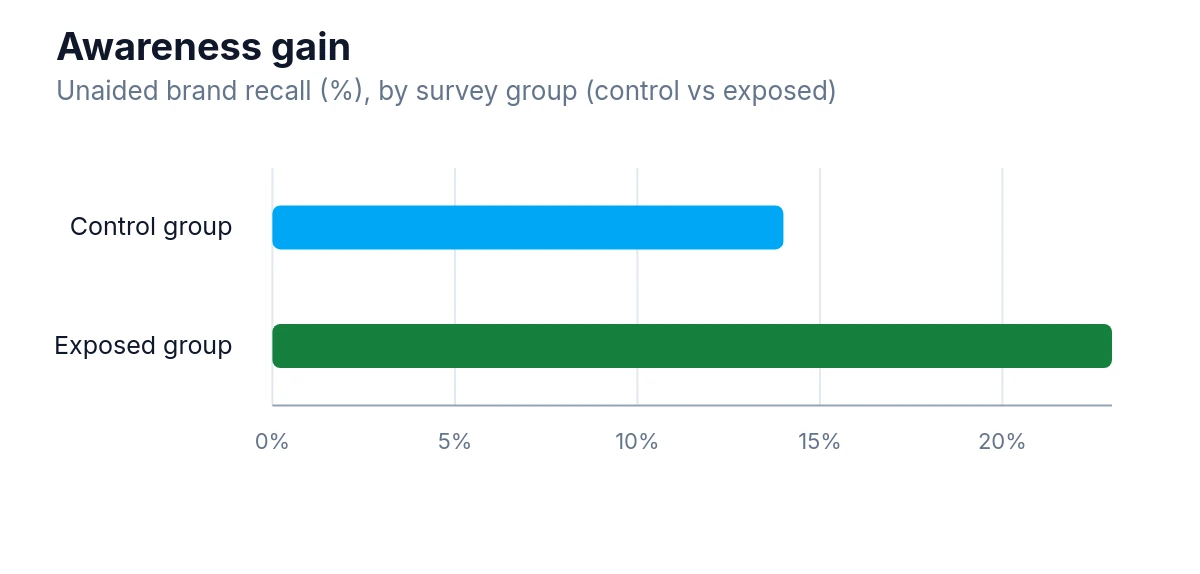
Exposure raised unaided brand recall to 23%, a nine percentage-point gain over the control group's 14%.
Brand Sentiment
Awareness alone does not tell you whether people feel positively about your brand. Sentiment analysis of social media mentions, post-event survey questions about brand perception, and net promoter score (NPS) comparisons can all give you a read on whether the sponsorship improved how people feel about the company.
Share of Voice
At multi-sponsor events, share of voice measures how much of the total sponsorship-related conversation your brand captured. If there are ten sponsors and your brand accounts for a third of all social mentions, that is meaningful. If you are barely registering, something about your activation needs to change.
Media Value Equivalent
Media value equivalent (sometimes called advertising value equivalent or AVE) attempts to assign a dollar figure to earned media coverage by calculating what it would have cost to buy equivalent advertising space. A logo appearing on broadcast television for a certain number of minutes is compared against the cost of a TV ad of the same duration.
This metric is controversial and worth treating carefully. It does not account for context, placement quality, or audience engagement. Use it as a rough benchmark rather than a precise valuation tool.
Audience Metrics: Who You Actually Reached
Reach without relevance is worthless. A sponsorship that puts your brand in front of a million people who have no interest in your product is not worth more than one that reaches fifty thousand people who are exactly your target customer.
Total Reach and Impressions
Reach refers to the number of unique individuals exposed to your sponsorship. Impressions count total exposures, including multiple views by the same person. Both matter, but reach is generally more meaningful for awareness goals.
For live events, this includes ticket holders, broadcast viewers, and online stream audiences. For digital activations, it includes social media reach, website traffic driven by sponsorship-related content, and email list exposure.
Audience Alignment
This is where many sponsors underinvest. Knowing that 200,000 people attended an event is less useful than knowing what percentage of them match your target customer profile. Request attendee demographic information from the property before signing, covering age, gender, location, occupation, income, and purchase behavior. Reputable event organizers and sports properties conduct regular audience research and should be able to share it. If they cannot, that is a red flag.
Engagement Rate
Passive exposure and active engagement are very different things. Engagement rate measures the percentage of the audience that interacted with your sponsorship content, whether by clicking, sharing, commenting, entering a contest, scanning a QR code, or stopping at your activation booth.
High engagement rates signal that your activation resonated. Low rates on high-reach sponsorships suggest you are paying for eyeballs that are not paying attention.
Revenue and Commercial Metrics: The Bottom Line
For sponsorships with a direct commercial component, these metrics bring the measurement closest to pure financial accountability.
Leads Generated and Cost Per Lead
If your sponsorship activation includes a lead capture mechanism (a sign-up form, a demo request, a badge scan at a trade show), you can count the leads produced and divide the total sponsorship cost by that number to get cost per lead.
Compare this against your other lead generation channels. Event cost per lead typically exceeds $800 once booth space, logistics, and staff travel are included, so if your sponsorship comes in well above that, you need to either improve the activation or reconsider the investment. If it costs less, you have found an efficient channel.
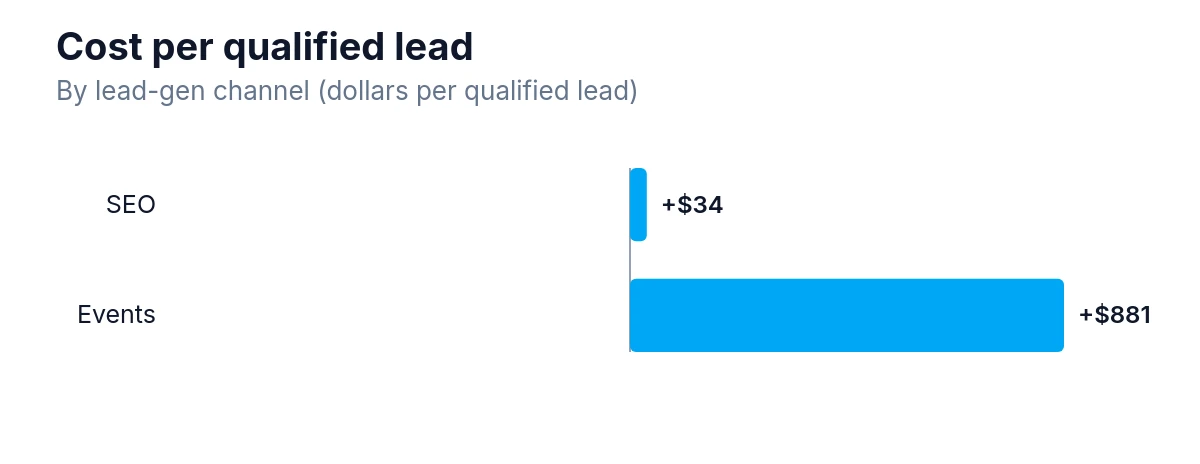
Events cost $881 per qualified lead, far higher than SEO at $34.
Conversion Rate and Revenue Attributed
Not all leads convert. Track what percentage of sponsorship-sourced leads eventually became customers, and what revenue those customers generated. This requires coordination with your CRM and sales team, but it is the most defensible way to demonstrate sponsorship value to finance.
Attribution is genuinely difficult here. A prospect might encounter your brand at a sponsored event, then convert three months later through a different channel. The use of multi-touch attribution is now widespread, with 81% of marketing organizations reporting they currently use it or plan to, though it requires more sophisticated tracking than most companies have in place. Start simple: tag sponsorship leads clearly in your CRM and track them through the pipeline.
Promo Code and Affiliate Link Performance
If your sponsorship includes a unique promo code or affiliate link, you have a clean measurement mechanism. Coupon code attribution works by moving attribution to the checkout stage rather than the click stage, which means it captures sales that link-based tracking can miss. This is one of the cleanest forms of sponsorship ROI measurement available and worth building into activations whenever possible.
Calculating Sponsorship ROI
Return on investment in sponsorship is calculated the same way it is in any other context: gain minus cost, divided by cost, expressed as a percentage.
The formula looks like this:
Sponsorship ROI (%) = ((Value Generated - Total Sponsorship Cost) / Total Sponsorship Cost) x 100
The hard part is defining "value generated." For revenue-focused sponsorships, this is revenue directly attributed to the sponsorship. For brand-focused sponsorships, you may need to assign a monetary value to awareness gains, media coverage, or other non-revenue outcomes.
What Counts as Total Cost
Many sponsors undercount their costs by including only the rights fee. Sponsorship activation refers to the investment by the sponsor above and beyond the fee required to acquire the official rights, and a complete cost picture must include all of it:
- The rights fee paid to the property
- Production costs for creative assets
- Staffing costs for the activation
- Travel and logistics
- Any media spend used to amplify the sponsorship
- Internal time spent managing the relationship
When you include all of these, the true cost is often significantly higher than the rights fee alone. That is not a reason to avoid sponsorship; it is a reason to account for it honestly.
What Counts as a Good ROI
There is no universal benchmark that applies across all sponsorship types. A sponsorship generating a 20% ROI might be excellent in one context and disappointing in another, depending on the company's cost of capital, the alternatives available, and the strategic value of the brand outcomes.
That said, a few reference points are useful:
For revenue-generating sponsorships with clean attribution, most experienced sponsors aim to at least break even on direct revenue while capturing brand benefits as additional upside. A positive ROI on the commercial component alone, before counting brand value, is a strong result.
For brand-focused sponsorships, the comparison should be against alternative ways to achieve the same awareness or sentiment goals. If a sponsorship delivers equivalent brand lift at a lower cost than a comparable advertising campaign, it is generating value even if the ROI formula does not produce a clean number.
The most important benchmark is internal consistency over time. If you measure the same sponsorship the same way year over year, you can identify whether performance is improving or declining, which is more actionable than any external standard.
Activation Quality Metrics
The sponsorship rights are just the starting point. What you do with them determines whether you get value. Activation quality metrics help you assess whether your execution matched your investment.
On-Site Engagement Volume
For live events, count the number of people who interacted with your activation, how long they spent, and what actions they took. Foot traffic counters, staff tallies, and digital interaction logs all contribute to this picture.
Digital Amplification Rate
How much did your owned and earned digital activity amplify the sponsorship? Compare your social media reach during the sponsorship period against your baseline. Track hashtag usage, content shares, and any influencer or partner amplification that extended the reach of your activation.
Content Performance
If the sponsorship produced content (event recap videos, behind-the-scenes posts, co-branded articles), measure how that content performed against your standard content benchmarks. Views, watch time, shares, and click-through rates all tell you whether the content was worth producing.
Building a Measurement System That Lasts
Tracking these metrics once is useful. Building a system that captures them consistently across every sponsorship is what separates organizations that get better at sponsorship over time from those that keep making the same expensive guesses.
A few practical steps make this possible.
Start with a measurement plan for every sponsorship before activation begins. Document which KPIs you will track, how you will collect the data, who is responsible, and what success looks like. This forces clarity on objectives and prevents post-hoc rationalization.
Create a standardized reporting template so that results from different sponsorships can be compared. If you measure media impressions one way for a sports sponsorship and a different way for a conference sponsorship, the data is not comparable and you cannot learn from it.
Conduct a debrief within 30 days of every sponsorship. Memory fades, team members move on, and the property's data takes time to compile. Set a deadline and hold it.
Finally, share results with the property. The best sponsorship relationships are partnerships, and properties that understand what is working for their sponsors can help improve activation, audience alignment, and measurement access over time. Sponsors who share data tend to get more cooperation in return.
Turning Data Into Better Decisions
The point of measuring sponsorship performance is not to produce a report. It is to make better decisions about where to invest, how to activate, and when to walk away.
A sponsorship that consistently underperforms on your key metrics deserves a hard look. Sometimes the fix is in the activation: a better booth, a more compelling offer, a stronger digital component. Sometimes the audience alignment was never right and no amount of creative execution will fix it.
A sponsorship that consistently outperforms should be protected, expanded, and studied. What is working? Can you replicate it elsewhere?
The organizations that get the most from sponsorship are not necessarily the ones with the biggest budgets. They are the ones that measure carefully, learn systematically, and adjust quickly. That discipline is available to any sponsor willing to build it.