Key Differences in Sponsorship Laws Across Countries
Why the Same Deal Can Be Legal in One Country and Illegal in Another
A global sports brand signs a jersey sponsorship with a football club. The deal is clean, the contract is signed, and the campaign launches simultaneously across 30 markets. Then the legal notices start arriving.
In one country, the brand's logo cannot appear during broadcasts because it sells alcohol. In another, the sponsorship triggers a tax liability nobody anticipated. In a third, the association with a gambling company listed in the fine print of the original deal violates local advertising codes and voids the entire arrangement.
This is not a hypothetical. It is the kind of situation that catches companies off guard when they treat sponsorship as a single global category rather than a patchwork of local legal frameworks. Sponsorship law does not exist as a unified international standard. It is assembled from advertising regulations, tax codes, employment law, intellectual property rules, and sector-specific restrictions that vary significantly from one jurisdiction to the next.
Understanding those differences is not just a compliance exercise. It shapes what deals are possible, how they must be structured, and what they can actually say in public.
Alcohol Sponsorship: A Study in Contradictions
Few categories show the global divide in sponsorship law more clearly than alcohol.
In France, the Evin Law has governed alcohol advertising since 1991. Under this law, alcohol brands cannot sponsor sporting events in ways that associate their products with athletic performance or youth culture. France is among the countries that have banned alcohol sports sponsorship outright, alongside Norway, with Ireland and New Zealand having signaled similar intentions. The restrictions extend to broadcast rights: if a French broadcaster airs a foreign sporting event where alcohol branding is visible, the broadcaster can face liability. This has led to some creative workarounds, including digitally replacing alcohol logos on stadium hoardings for French broadcasts, but the legal exposure remains real.
The United Kingdom takes a more permissive approach. Alcohol brands can sponsor sports, music events, and cultural institutions, provided they follow the Advertising Standards Authority's codes, which prohibit targeting under-18s and linking alcohol to social or sexual success. A beer brand can plaster its name across a Premier League stadium. It cannot run an ad campaign suggesting that drinking makes you attractive.
Australia sits somewhere in between. Alcohol sponsorship of sport is legal but heavily scrutinized, particularly in relation to youth audiences. State-level regulations add another layer: what is acceptable in New South Wales may face stricter interpretation in Queensland.
In many Muslim-majority countries, the question is simpler. Alcohol advertising and sponsorship are banned outright. In Saudi Arabia and the UAE, alcohol cannot be publicly promoted at all. Any international event held in those markets must strip alcohol branding from its visible assets, which creates significant contractual complexity for global rights holders who have sold category exclusivity to a beer or spirits brand.
The United States, despite its reputation for relatively open commercial speech, has its own complications. The Federal Trade Commission and state alcohol control boards each have authority over different aspects of alcohol marketing. A sponsorship that works in California may run into state-specific restrictions in Utah or Mississippi.
Gambling Sponsorship: Rapid Change, Uneven Rules
Gambling sponsorship law is changing faster than almost any other category, driven by the expansion of legal sports betting in markets that previously banned it and by growing public health concerns in markets where it has long been legal.
The United Kingdom has historically been one of the most open markets for gambling sponsorship. Betting companies sponsor Premier League clubs, appear on front-of-shirt kits, and advertise heavily during live sports broadcasts. But that is shifting. In April 2023, all 20 Premier League clubs agreed to voluntarily remove gambling sponsors from the front of matchday shirts, working with the Department for Culture, Media and Sport on the plan, and the UK government has been reviewing its Gambling Act with an eye toward tighter advertising restrictions. The legal framework is in flux.
Italy moved more decisively. Italy's gambling advertising ban took effect on 1 January 2019, though any marketing campaigns launched before that date were allowed to reach their conclusions. Italian football clubs, which had relied heavily on betting company partnerships, had to restructure their commercial arrangements quickly. The ban covers not just television advertising but also stadium naming rights, shirt sponsorships, and digital promotions.
In the United States, the Supreme Court's 2018 decision to allow states to legalize sports betting opened a new commercial market almost overnight. But because regulation happens at the state level, the rules differ dramatically. New Jersey has a relatively open framework. Other states have imposed restrictions on advertising near schools or during broadcasts with large youth audiences. A national gambling sponsorship campaign in the US requires a state-by-state legal review.
Australia has some of the most detailed gambling advertising rules in the world, including restrictions on live odds promotions during sports broadcasts and requirements that gambling ads include specific harm-minimization messages. Sponsorship agreements that include digital or broadcast components must account for these obligations.
Tobacco: The Category That Largely Disappeared
Tobacco sponsorship serves as a useful historical reference point because it shows how quickly legal change can reshape an entire commercial category.
Formula One racing was built partly on tobacco money. Marlboro, Camel, and other brands were central to the sport's identity for decades. The World Health Organization's Framework Convention on Tobacco Control, adopted in 2003, committed signatory countries to banning tobacco advertising, promotion, and sponsorship. Most major economies followed with domestic legislation. After ratifying the FCTC, the Islamic Republic of Iran implemented Iran's comprehensive tobacco advertising, promotion and sponsorship ban, becoming the first country in the Eastern Mediterranean Region to do so.
The EU Tobacco Advertising Directive banned tobacco sponsorship of cross-border events. The UK, France, Germany, and most other European countries have comprehensive bans in place. In the US, the Family Smoking Prevention and Tobacco Control Act gave the FDA authority over tobacco marketing, and tobacco sponsorship of sporting and entertainment events is effectively prohibited.
Some markets moved more slowly. For years, Formula One races held in countries with weaker tobacco advertising laws allowed teams to display tobacco branding that was covered up or replaced in broadcasts to markets where it was banned. This created a two-tier visual reality depending on where you were watching.
The lesson for sponsorship lawyers is that a category can go from commercially dominant to legally prohibited within a decade. Contracts that do not account for regulatory change risk leaving brands or rights holders exposed.
Tax Treatment of Sponsorship Income
The legal question of whether a sponsorship is permissible is separate from the tax question of how it is treated, and the two together determine whether a deal is actually worth doing.
In many countries, sponsorship income received by a non-profit organization, sports federation, or cultural institution is taxable as business income rather than as a donation. The distinction matters because donations often receive favorable tax treatment while commercial sponsorship does not.
The United States draws a clear line between a "qualified sponsorship payment," which is not subject to unrelated business income tax, and an arrangement that provides substantial return benefits to the sponsor, which is taxable. If a company sponsors a charity gala and receives prominent logo placement, speaking opportunities, and a table of tickets, the IRS may treat part of that payment as a commercial transaction rather than a contribution.
In the European Union, the treatment varies by member state. Germany, France, and the Netherlands each have different rules about when sponsorship income triggers VAT obligations for the recipient and whether the sponsor can deduct the payment as a business expense. Cross-border sponsorships within the EU can create situations where the same payment is treated differently in two countries simultaneously.
Brazil has a specific legal framework for cultural sponsorship through the Rouanet Law, which allows companies to direct a portion of their income tax liability toward approved cultural projects. This creates a category of sponsorship that is essentially subsidized by the government, but the approval process is strict and the eligible activities are defined by law.
Australia requires that sponsorship arrangements be documented carefully to distinguish them from gifts, because the tax treatment differs significantly. The Australian Taxation Office has published guidance on this, but disputes still arise in practice.
Intellectual Property and Ambush Marketing Laws
Sponsorship rights are only as valuable as the legal protection behind them. A brand that pays for official sponsor status needs to know that competitors cannot simply show up at the same event and associate themselves with it without paying.
This is the problem of ambush marketing, and countries handle it very differently.
South Africa passed specific anti-ambush marketing legislation in connection with the 2010 FIFA World Cup. The law created protected zones around venues and prohibited unauthorized commercial associations with the event. Similar legislation has been passed in other countries hosting major international events, including the UK for the 2012 Olympics and Brazil for the 2014 World Cup and 2016 Olympics. For the London Games specifically, the London Olympic Games and Paralympic Games Act 2006 introduced the London Olympics Association Right, a new intellectual property right prohibiting any unlicensed person from making a representation likely to create an association with the Games, going beyond just symbols and mottos.
Outside of major event-specific legislation, the protection available to official sponsors varies. In the UK, ambush marketing is addressed primarily through trademark law and the tort of passing off, which requires proving that the ambush marketer created a false impression of association. This is a higher bar than some rights holders would like.
In Australia, the Australian Consumer Law prohibits misleading or deceptive conduct, which can be applied to ambush marketing that creates a false impression of official sponsorship. But the law requires that consumers actually be misled, not just that a competitor benefited from proximity to an event.
The United States relies heavily on trademark law and the Lanham Act for sponsorship protection. Ambush marketing that does not use protected marks is difficult to challenge, which is why major events in the US often rely on contractual restrictions on venue access rather than legal prohibitions on competitor activity.
For brands operating globally, this means that the value of an official sponsorship is not uniform. The same deal provides stronger protection in some markets than others, and the enforcement strategy needs to be tailored accordingly.
Employment and Visa Considerations in Athlete Sponsorships
Individual athlete sponsorships add another layer of legal complexity that brand deals with organizations do not face. When a company sponsors an athlete, it may be entering into what looks like a commercial arrangement but functions legally like an employment relationship in some jurisdictions.
In France, athlete image rights are treated differently from other commercial rights, and the tax and social security implications of sponsorship payments to athletes depend on how the arrangement is structured. Payments made directly to an athlete for personal endorsement may be subject to social charges that would not apply to a payment made to a company the athlete controls.
In the UK, HMRC has scrutinized arrangements where athletes receive sponsorship through personal service companies, particularly where the economic reality looks more like employment. The IR35 rules, which address disguised employment, can apply to sponsorship arrangements in some circumstances.
Visa and work permit rules also affect athlete sponsorships. An athlete who travels to a country to fulfill sponsorship obligations, such as appearing at a product launch or filming a commercial, may need a specific visa category depending on the country. Under US immigration rules, P-1 visa promotional appearances for the petitioning employer are permitted when they relate to the competition, event, or performance, but the requirements differ from the O-1 category. The UAE has its own framework for commercial appearances by foreign nationals.
These are not abstract concerns. A brand that flies an athlete to a market for a promotional event without checking the visa requirements can find itself in violation of immigration law, which creates reputational and legal risk for both parties.
Sector-Specific Rules That Catch Companies Off Guard
Beyond the major categories of alcohol, gambling, and tobacco, a range of sector-specific restrictions affects sponsorship in ways that are easy to miss.
Pharmaceutical companies face strict limits on how they can associate their brands with health and wellness events in most countries. In the US, the FDA regulates pharmaceutical advertising, and sponsorship of medical conferences or health events can trigger disclosure and compliance obligations. In the EU, the rules differ by member state but generally prohibit direct-to-consumer advertising of prescription medicines, which limits how pharmaceutical brands can use event sponsorship.
Financial services companies face restrictions in many markets on associating their brands with events in ways that could be interpreted as financial advice or product promotion. In Australia, financial services sponsorships must be careful not to cross into territory that requires an Australian Financial Services License.
Children's products and services face restrictions in many countries on advertising and sponsorship directed at minors. Sweden and Norway have some of the strictest rules in the world on advertising to children, and sponsorship of children's events or programming is heavily regulated. Quebec has its own strict rules within Canada.
Building a Cross-Border Sponsorship Strategy That Actually Works
Given this complexity, companies that operate across multiple markets need a structured approach rather than a deal-by-deal reaction.
The starting point is mapping the markets where a sponsorship will have commercial effect. This is not just the country where the event takes place. It includes every market where the broadcast will air, where the digital campaign will run, and where the brand's products are sold. A sponsorship of a European football club may have commercial implications in Asia, North America, and the Middle East simultaneously.
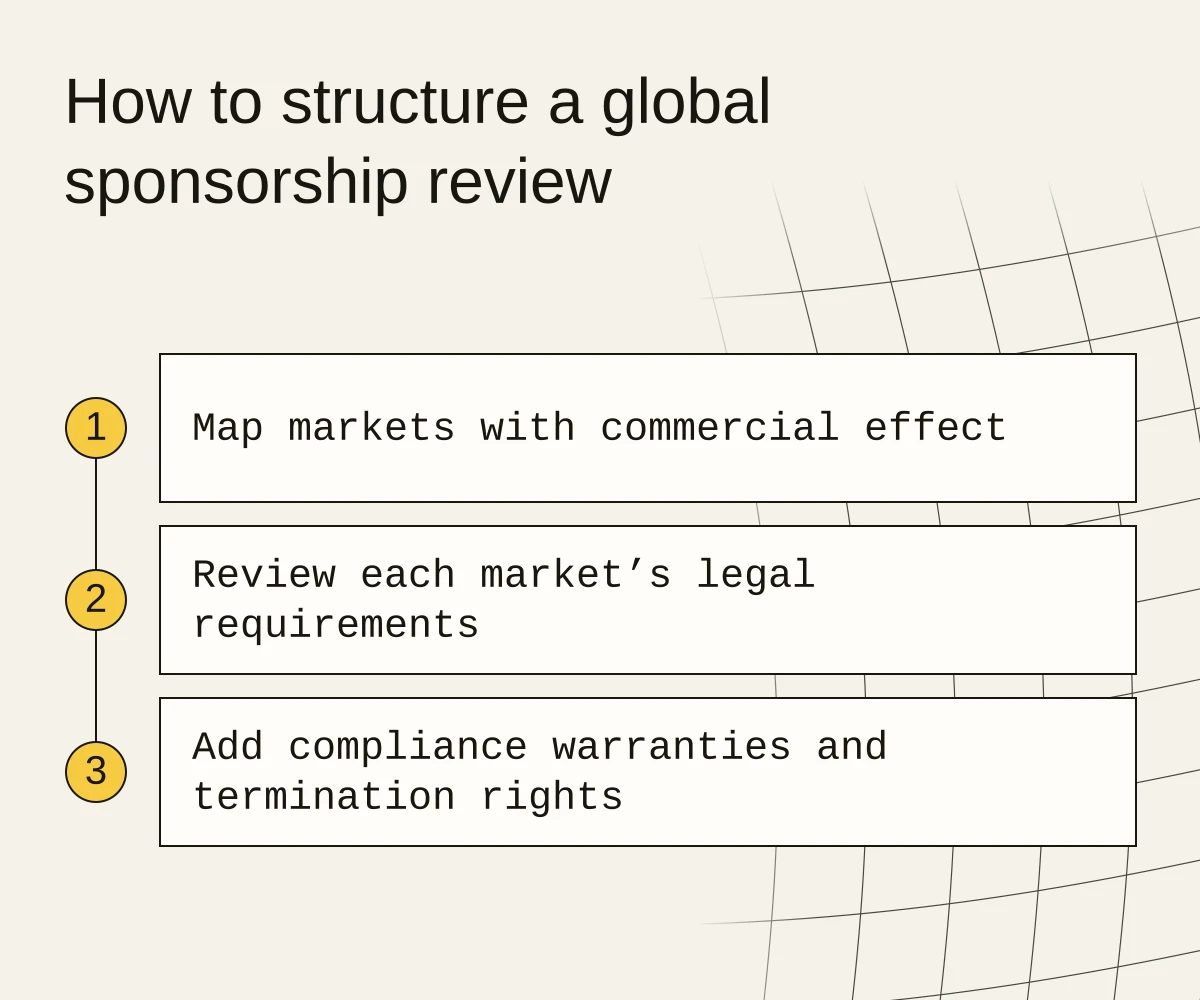
Once the relevant markets are identified, a legal review should address at least four questions for each one: Is the category of sponsorship permitted? How is the income treated for tax purposes? What intellectual property protection exists for the sponsor's rights? Are there any sector-specific restrictions that apply to the brand's products or services?
Contracts should include representations and warranties from both parties about their compliance with local law, along with termination rights if a regulatory change makes the arrangement illegal in a key market. Force majeure clauses that account for regulatory change are increasingly standard in international sponsorship agreements.
Rights holders who sell global sponsorships need to be transparent about the restrictions that exist in different markets. Selling "global exclusivity" to a brand in a category that is banned in several of the most commercially important markets creates disputes and damages relationships.
The Direction of Travel
Sponsorship law is not static. The trend in most developed markets is toward tighter restrictions on categories associated with public health concerns, particularly gambling and alcohol when youth audiences are involved. Digital advertising has complicated enforcement because online platforms do not respect national borders in the way that broadcast television did.
The growth of esports and gaming as sponsorship categories has created new legal questions that existing frameworks were not designed to answer. When a gambling company sponsors an esports tournament with a primarily young audience, does that trigger the same restrictions as a traditional sports sponsorship? Different countries are answering that question differently.
Data protection law is also becoming relevant to sponsorship. Sponsorship activations that collect audience data, run competitions, or require registration are subject to GDPR in Europe, CCPA in California, and a growing list of national data protection laws elsewhere. A sponsorship activation that works in one market may need significant modification to comply with data law in another.
The companies that manage this complexity well are the ones that treat legal review as part of the commercial process rather than an afterthought. The deal that looks attractive on paper can look very different once the local legal picture is clear. And the deal that seems complicated to structure in compliance with local law is often still worth doing, once the right framework is in place.