Future Trends in Sponsorship Measurement and Analytics

The Gap Between Spending and Proof
Brands collectively pour enormous sums into sponsorship deals every year, from stadium naming rights to athlete endorsements to festival activations. Yet for decades, the dominant method of measuring whether any of it worked was counting how many seconds a logo appeared on screen and multiplying that by an estimated advertising rate.
That approach was always a rough proxy. Now, with the tools available to measure almost every other form of marketing investment with precision, the gap between what sponsorship spending actually costs and what brands can prove it delivers has become harder to ignore. Rights holders, agencies, and brand managers are all feeling pressure to close it.
The good news is that the measurement tools catching up to that challenge are genuinely interesting. The shift happening across the industry is not just about better data collection. It is about rethinking what sponsorship is supposed to do in the first place, and building measurement frameworks that reflect that.
Why Media Equivalency Values Are Losing Ground
For a long time, the industry standard was the media equivalency value, or MEV. The logic was simple: if a sponsor's logo appeared on screen for 30 seconds during a broadcast, you could calculate what it would have cost to buy 30 seconds of advertising during that same broadcast, and that number became the "value" of the sponsorship.
The problems with this approach are significant. A logo glimpsed in the background of a stadium shot is not the same as a 30-second ad that commands full attention. MEV treats them identically. It also ignores whether anyone remembered seeing the logo, whether it changed how they felt about the brand, or whether it influenced any purchasing behavior.
More fundamentally, MEV was designed for a broadcast-first world. When most of the valuable sponsorship inventory existed on television, a metric tied to TV ad rates at least had internal logic. As audiences fragment across streaming platforms, social media, podcasts, and live digital events, the broadcast-centric model breaks down further.
Rights holders have been reluctant to abandon MEV entirely because it tends to produce large, impressive numbers that justify renewal conversations. But sophisticated brand clients are pushing back, demanding metrics that connect sponsorship activity to business outcomes rather than hypothetical advertising costs.
Computer Vision and Real-Time Logo Tracking
One of the more concrete advances already reshaping measurement is computer vision technology applied to broadcast and digital content. Rather than relying on human analysts to log logo appearances, AI-powered systems can scan video feeds in real time, identify brand marks, measure their size on screen, track their position, and estimate their visibility based on factors like contrast, obstruction, and duration.
This is a genuine improvement over manual tracking. It is faster, more consistent, and can process far more content than any human team. A brand with sponsorship placements across dozens of events, broadcast markets, and streaming platforms can get consolidated visibility data that would have been practically impossible to compile before.
The more interesting development is what these systems are starting to do beyond simple detection. Some platforms now weight logo impressions by estimated viewer attention, using data about where eyes tend to travel on screen during different types of content. A logo that appears prominently during a high-tension moment in a game is treated differently from one that appears during a replay graphic in the corner of the frame.
These systems are also getting better at tracking logos across social media clips, highlight reels, and user-generated content, which has historically been a blind spot. A single viral clip can generate more brand exposure than the original broadcast, and measurement frameworks that only count the live feed miss that entirely.
Audience Data and the Move Toward Outcomes
Better logo tracking still only measures exposure. The more significant shift in sponsorship measurement is the growing focus on what exposure actually produces.
This requires connecting sponsorship activity to audience behavior data, which is becoming more feasible as brands develop richer first-party data assets and as data partnerships between rights holders, sponsors, and measurement firms become more common.
The basic version of this is exposed and unexposed brand-lift measurement: running surveys with both groups to isolate the impact of the campaign and compare awareness, favorability, and purchase intent scores. This has been standard practice in digital advertising for years, and it is increasingly being applied to sponsorship contexts. If fans who attended a sponsored event show meaningfully higher purchase intent than a matched control group, that is a cleaner signal than any MEV calculation.
The more advanced version connects sponsorship exposure directly to transaction data. Some brands, particularly in retail and financial services, can track whether customers who attended sponsored events or engaged with sponsorship content actually bought something afterward. This kind of attribution is still difficult to execute cleanly, but the infrastructure for it is improving.
Social Media Attribution Gets More Sophisticated
Social media has always been a complicated part of sponsorship measurement. On one hand, it generates enormous amounts of data: mentions, impressions, engagement rates, sentiment scores, share of voice. On the other hand, most of that data is noisy, easy to manipulate, and hard to connect to anything a brand actually cares about.
The next generation of social measurement is trying to address those problems in a few ways.
Sentiment Analysis Beyond Positive and Negative
Early social listening tools classified mentions as positive, negative, or neutral. That is a crude categorization. A mention can be sarcastic, ironic, enthusiastic, or dismissive in ways that simple sentiment scoring misses. Natural language processing models trained on sports and entertainment content are getting better at capturing these distinctions, which matters when a brand is trying to understand whether a sponsorship is generating genuine affinity or just noise.
Influencer Attribution
Athlete and creator partnerships are a growing part of sponsorship spending, and measuring their impact has historically been even harder than measuring traditional placements. New attribution models track how content from sponsored athletes and creators moves through social networks, which accounts amplify it, and what downstream engagement it generates. This gives brands a clearer picture of whether the partnership is reaching genuinely new audiences or mostly circulating within existing fan communities.
Earned Media Tracking
One of the real advantages of sponsorship over traditional advertising is the potential to generate earned media: coverage, conversation, and content that the brand did not pay for directly. Quantifying that has always been tricky. Better tracking tools can now map the full spread of organic content generated by a sponsorship activation, separating paid and organic reach in ways that give brands a clearer sense of their total footprint.
The Rise of Attention Metrics
Across digital advertising broadly, there is a growing movement away from measuring whether an ad was technically served and toward measuring whether anyone actually saw it. Viewability standards were a first step, but attention metrics go further, using eye-tracking data, scroll behavior, and engagement signals to estimate whether a person was genuinely paying attention to content.
These same principles are being applied to sponsorship. The question is not just whether a logo appeared on screen but whether the audience was in a state of attention when it did. Research consistently shows that experiential event design and brand recall are linked, with effective event design shown to increase consumers' awareness, attitudes, and brand recall toward the sponsoring brand, and the same logic extends to high-engagement broadcast moments like the final minutes of a close game.
Building attention into sponsorship measurement frameworks is still early-stage, but it is one of the more promising directions. It would allow brands to value inventory based on the quality of audience attention it commands rather than just the raw size of the audience, which would change how rights holders price and package their assets.
Integrating Sponsorship into Multi-Touch Attribution
One of the persistent challenges in sponsorship measurement is that it rarely operates in isolation. A consumer might see a brand's stadium naming rights every time they watch a game, encounter the brand's sponsored content on social media, see a TV ad, and then receive a promotional email before finally making a purchase. Attributing any of that purchase to the sponsorship specifically is genuinely hard.
Multi-touch attribution models, which have become standard in digital marketing, try to assign partial credit to each touchpoint in a customer's journey. Integrating sponsorship into these models requires treating sponsorship exposures as trackable touchpoints, which is increasingly possible as digital and physical experiences converge.
The practical challenge is data connectivity. A brand's CRM system, its digital advertising platform, and a rights holder's audience data are often siloed. Building the integrations that allow sponsorship exposure data to flow into the same attribution model as paid search and email requires both technical work and commercial agreements that have not always been easy to establish.
Progress is happening, though. Data clean rooms, secure privacy-compliant environments where multiple parties can analyze and combine their first-party data without directly sharing raw data, are making some of these integrations more feasible. Brands and rights holders can find overlapping audiences and measure sponsorship impact without the privacy and competitive concerns that have historically blocked data sharing.
Watch how anonymized audience and purchase data are brought into the same collaboration.
Personalization and Segment-Level Measurement
Aggregate measurement tells you whether a sponsorship worked on average. But averages can hide a lot. A sponsorship might generate strong results with one audience segment and negative or neutral results with another. Without segment-level measurement, brands cannot tell the difference.
The next generation of measurement frameworks is moving toward understanding sponsorship impact at a more granular level. Which fan demographics showed the strongest lift in brand favorability? Which geographic markets responded most strongly to a particular activation? Which types of content generated the most durable recall?
This kind of segmentation is standard in digital advertising, where targeting and measurement can be done at the individual level. Applying it to sponsorship requires richer audience data from rights holders, who have historically been reluctant to share detailed fan data with sponsors. That is changing as rights holders recognize that better measurement data is a competitive advantage in renewal negotiations.
Predictive Analytics and Sponsorship Planning
Most sponsorship measurement has been retrospective: you run the campaign, then you measure what happened. Predictive analytics is starting to shift some of that work to the front end of the process.
By analyzing historical data from comparable sponsorships, brands can build models that estimate the likely impact of a proposed deal before signing it. These models can incorporate factors like the rights holder's audience demographics, the brand's existing awareness levels in that audience, the type of activation planned, and the competitive environment.
This is still an emerging capability, and the models are only as good as the historical data feeding them. But even rough predictive frameworks are useful for comparing options. If a brand is choosing between two sponsorship opportunities with similar price tags, a model that estimates relative brand lift potential based on historical patterns gives the decision more structure than intuition alone.
Rights holders are also starting to use predictive tools on their side of the table, modeling the likely commercial value they can deliver to a prospective sponsor based on their audience data and past performance. This creates a more data-informed negotiation dynamic on both sides.
The Measurement Challenge for Experiential Sponsorship
As brands invest more in experiential activations, the measurement challenge gets more complex. A branded fan zone, a hospitality suite, or an interactive installation creates an experience that is hard to reduce to impressions or reach metrics. The value is in the quality of the engagement, not the quantity.
Measuring experiential sponsorship well requires a different toolkit. The core experiential marketing performance indicators include lead generation quality, participant dwell time, activation rates, and social amplification reach. Some brands are using biometric data, with participant consent, to measure emotional response during activations. Others are tracking whether experiential attendees show different behavior patterns in the weeks following an event compared to non-attendees.
The honest answer is that experiential measurement is still catching up to the investment. The industry needs better frameworks for capturing the value of deep, memorable brand experiences rather than trying to force them into impression-based metrics that were designed for a different type of activity.
What Rights Holders Need to Do Differently
The measurement evolution is not just a challenge for brands. Rights holders, whether sports leagues, entertainment properties, or event organizers, need to adapt their own data infrastructure and commercial practices to stay relevant.
Properties that can offer sponsors rich, verified audience data, real-time performance dashboards, and clean attribution pathways will have a significant advantage over those that can only offer broadcast reach estimates and a logo placement inventory. As one industry report noted, providing more data and insights to help partners with sponsorship measurement and renewal decisions could help them measure ROI and make more informed choices about renewing a partnership. The brands willing to pay premium prices for sponsorship are increasingly the ones with sophisticated marketing organizations that expect sophisticated measurement in return.
This means rights holders need to invest in first-party data collection, build or buy measurement capabilities, and be willing to share data in ways that have not always been comfortable. It also means being honest when a sponsorship underperforms, which is a harder cultural shift for properties accustomed to presenting everything as a success.
Building Measurement Into Deals From the Start
One of the most practical changes brands can make is treating measurement as a deal requirement rather than an afterthought. Too many sponsorship agreements are signed without clear definitions of what success looks like, what data will be collected, who is responsible for collecting it, and how disputes about performance will be resolved.
Building measurement frameworks into the contract negotiation process forces both parties to align on objectives before money changes hands. It also creates accountability structures that make the relationship more productive over time. A brand that can show a rights holder exactly which activations drove the strongest results is in a much better position to optimize future investments than one that is working from vague impressions.
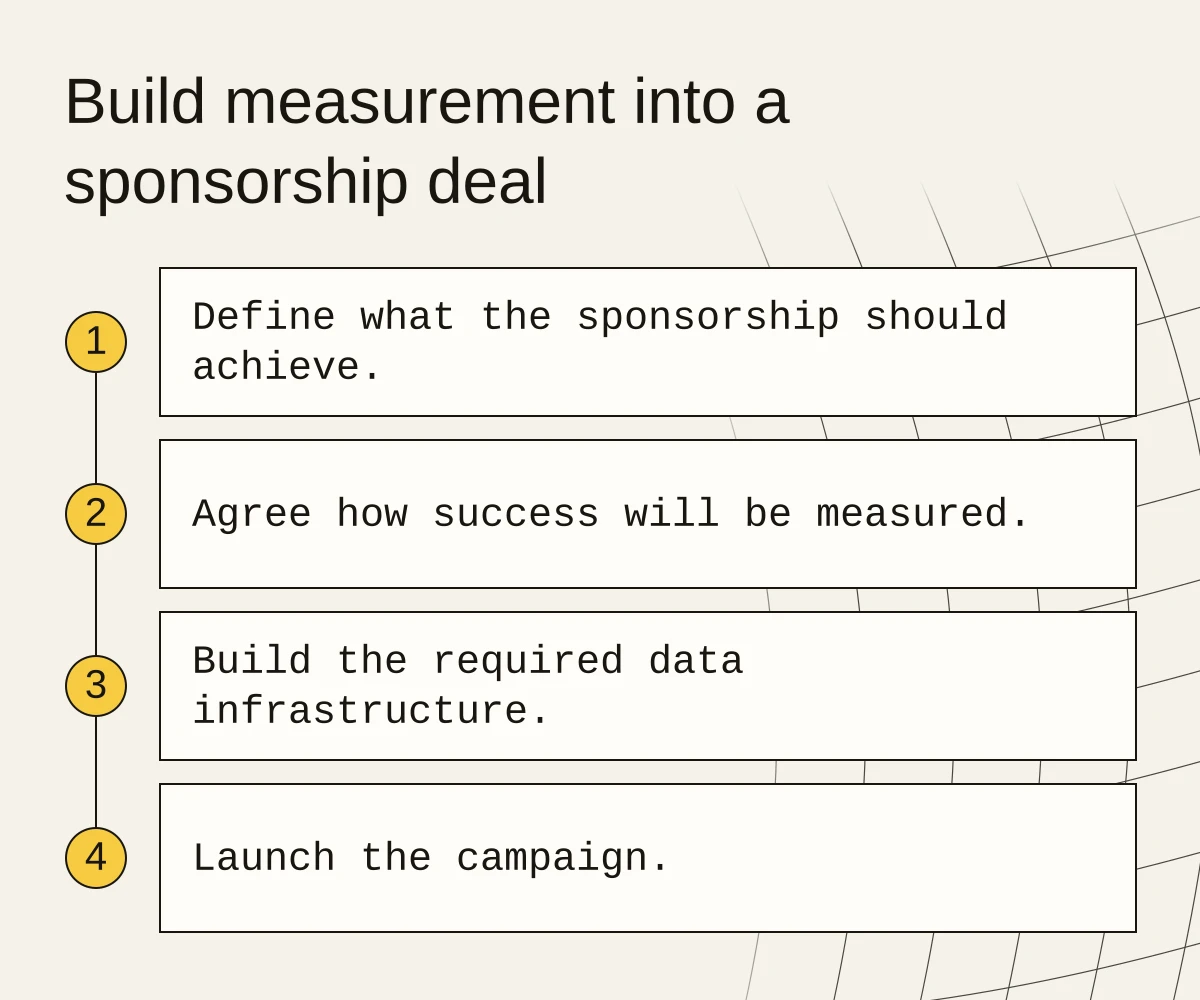
The specific metrics that belong in a deal will vary by category, audience, and activation type. But the principle holds broadly: define what you are trying to achieve, agree on how you will measure it, and build the data infrastructure to actually do so before the campaign launches.
Where the Industry Is Heading
The direction of travel in sponsorship measurement is clear even if the destination is still being built. The industry is moving toward real-time data, outcome-based metrics, and integrated attribution that connects sponsorship to business results rather than media proxies.
Artificial intelligence will play a growing role, both in processing the volume of data that modern sponsorship generates and in building the predictive models that help brands allocate budgets more effectively. Privacy regulation will constrain some data practices while pushing the industry toward more durable, consent-based measurement approaches.
The brands and rights holders that invest in measurement infrastructure now will be better positioned as these tools mature. Sponsorship has always been one of the harder marketing investments to justify on purely quantitative grounds. That is changing, and the change is coming faster than many in the industry expected.
The era of signing a deal because it "feels right for the brand" is not over, but it is being supplemented by something more rigorous. That is good for everyone who wants sponsorship to remain a serious part of the marketing mix.