Integrating Sponsorship Metrics into Your Marketing Strategy

Why Most Sponsorships Fail to Prove Their Worth
A company spends a significant budget sponsoring a major sporting event. Banners go up, logos appear on jerseys, and social media posts go out. The event happens. Then someone in the finance department asks a simple question: "What did we get for that?"
Silence.
This scenario plays out constantly across industries. Sponsorships are often purchased on gut feeling, relationship history, or the vague belief that "brand visibility" is happening somewhere. When the budget review comes around, the marketing team scrambles to pull together impressions data that may or may not connect to anything the business actually cares about.
The problem is not that sponsorships do not work. Many do, and quite well. The problem is that most organizations treat sponsorship measurement as an afterthought rather than a core part of how they plan and execute these investments. Integrating sponsorship metrics into your broader marketing strategy changes that entirely. It means you know what you are buying before you buy it, you track what matters while it is happening, and you can make a clear case for the results afterward.
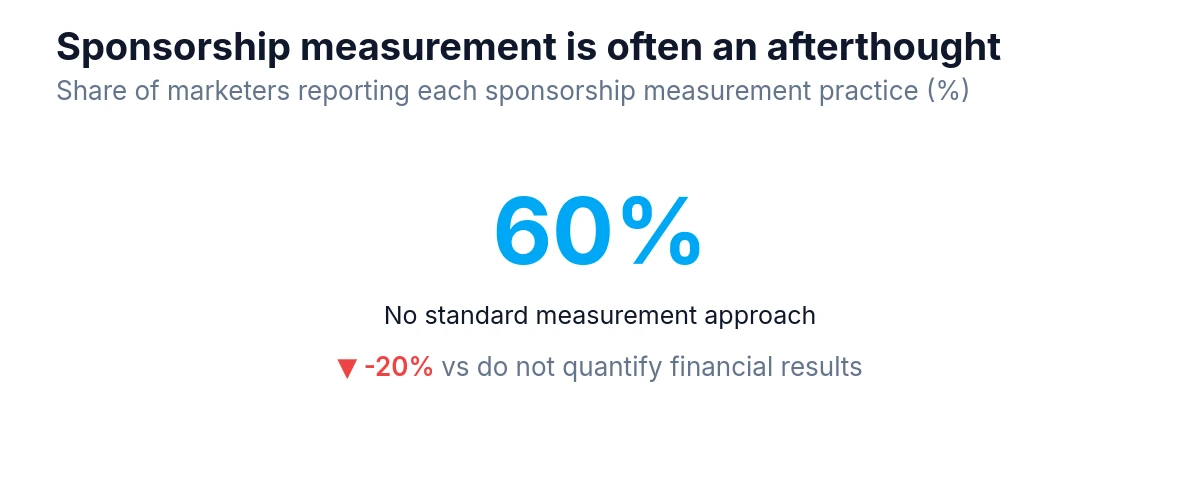
Sixty percent of marketers say there is no standard approach to measuring sponsorships, 20 percentage points lower than the share who do not quantify financial results.
This article covers how to do exactly that.
Start with Business Objectives, Not Sponsorship Objectives
The most common mistake organizations make is building their measurement framework around what the sponsorship property can measure, rather than what the business needs to know.
A sports venue can tell you how many people attended. A podcast can tell you how many downloads an episode received. A festival organizer can provide foot traffic numbers. These are useful data points, but they are the property's metrics, not yours. Keep in mind that metrics vs KPIs are not the same thing: all KPIs are metrics, but not all metrics are KPIs.
Your metrics need to connect directly to what your business is trying to accomplish. Before signing any sponsorship agreement, answer these questions:
- Are we trying to reach a new audience segment, or deepen our relationship with an existing one?
- Is the goal brand awareness, or are we trying to drive a specific action like trial, purchase, or sign-up?
- Are we defending market position against a competitor, or entering new territory?
- Is this sponsorship meant to support a sales team's relationship-building efforts?
Each of these goals requires a different set of metrics. A sponsorship designed to drive trial needs to measure trial rates, not just impressions. A sponsorship meant to support B2B relationship building needs to track meeting requests, pipeline movement, and deal velocity, not social media reach.
Getting this alignment right at the start is the single most important step in the entire process. Everything else builds from it.
The Core Metric Categories
Once you have clear business objectives, you can organize your measurement framework around four broad categories. Not every sponsorship will require all four, but understanding each one helps you choose the right tools for the job.
Reach and Exposure
These are the most commonly tracked metrics and also the most frequently misused. Reach tells you how many people potentially saw your brand. Exposure tells you how often and in what context.
Useful reach and exposure metrics include:
- Estimated audience size at the event or across broadcast/streaming
- Branded content impressions across social media
- Media mentions and earned media value
- Share of voice compared to other sponsors at the same property
- Logo placement visibility (tracked through image recognition tools in larger campaigns, where logo frequency and duration in sports videos gives sponsors an effective way to evaluate their advertising efforts)
The key word here is "potentially." Reach metrics tell you about opportunity, not outcome. A billboard seen by 100,000 people at a stadium does not mean 100,000 people noticed your brand, remembered it, or felt anything about it. Reach is a starting point, not a conclusion.
Audience Quality and Alignment
This category is where many organizations leave serious value on the table. Knowing that 50,000 people attended an event matters much less than knowing whether those 50,000 people match your target customer profile.
Before committing to a sponsorship, request audience data from the property. Reputable properties can provide demographic breakdowns, psychographic profiles, and in some cases purchase behavior data from their attendees or followers. Compare this against your own customer data.
After the sponsorship, survey a sample of attendees or audience members to validate that the actual audience matched what was promised. This also gives you a baseline for future negotiations.
Audience alignment metrics to track:
- Percentage of the property's audience that falls within your target demographic
- Overlap between the property's audience and your existing customer base
- Audience affinity scores (how closely the audience's interests align with your brand values)
Engagement and Interaction
Engagement metrics capture what people actually did in response to your sponsorship presence. This is where you start to see whether your activation strategy is working.
These metrics vary significantly depending on your activation type. A digital sponsorship with a dedicated landing page will have very different engagement signals than an on-site experiential activation. The key is to design your activation with measurement built in from the start.
Common engagement metrics include:
- Website traffic spikes during and after the sponsorship period
- Promo code redemptions tied to the sponsorship (bear in mind that promo redemption rates average 4.6% across all channels, with digital coupon strategies often reaching 7% or higher)
- Social media interactions (shares, comments, saves) on branded content
- App downloads or sign-ups attributed to the sponsorship
- On-site engagement at branded experiences (dwell time, participation rates)
- Lead capture volume at sponsored events
Brand Perception and Sentiment
This is the hardest category to measure but often the most strategically important. Sponsorships can shift how people feel about your brand, and those shifts can be durable over time.
Measuring brand perception requires survey work. The standard approach is to run a brand lift study using campaign evaluation using treatment and control groups: survey a group exposed to your sponsorship and a comparable group that was not, then compare their responses on key brand attributes. You might ask about brand awareness, brand favorability, purchase intent, or specific associations you are trying to build.
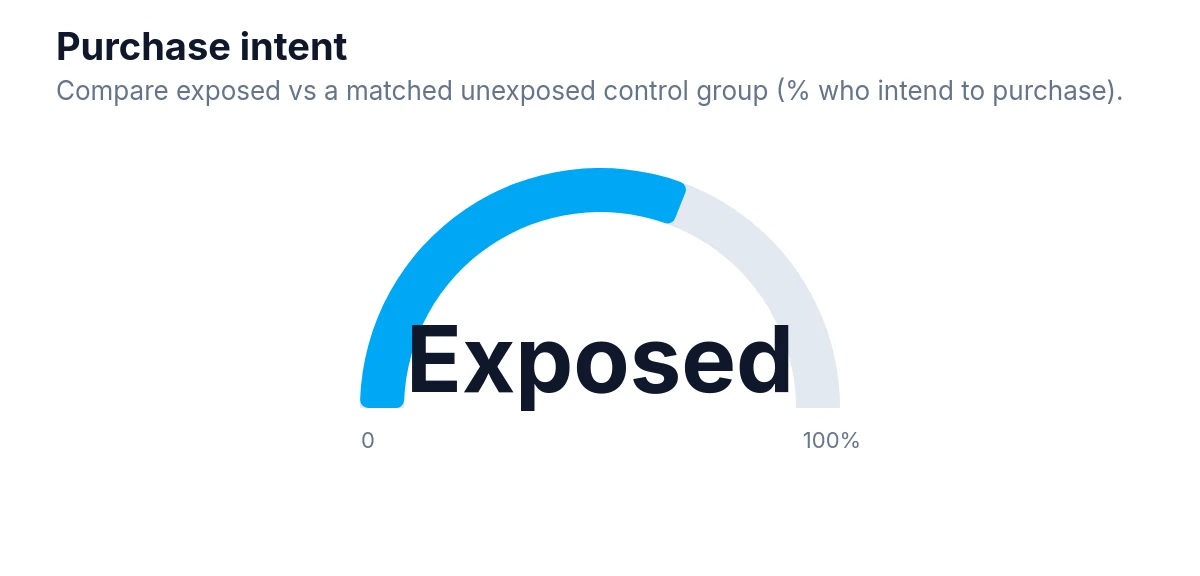
Sixty-two percent of people exposed intend to purchase, measured against a matched unexposed control group.
For ongoing sponsorship relationships, you can track these metrics over multiple periods to see whether the partnership is building cumulative brand equity or plateauing.
Building Your Measurement Infrastructure
Knowing what to measure is only half the challenge. You also need the systems in place to actually capture the data.
Establish Baselines Before the Sponsorship Begins
You cannot measure change if you do not know your starting point. Before any sponsorship activates, document your current state across every metric you plan to track. This includes:
- Current brand awareness levels in the target market (from existing survey data or a quick pulse survey)
- Website traffic from the relevant geographic region or audience segment
- Social media follower counts and average engagement rates
- Sales volume or lead volume in the relevant market
These baselines become your control data. When the sponsorship runs, you compare against them. Without baselines, you are left making claims like "we saw increased traffic" without being able to say how much or whether it was meaningful.
Create Trackable Assets
Every element of your sponsorship activation should have a way to capture data. This means:
- Dedicated landing pages with unique URLs for each sponsorship (not your homepage)
- Unique promo codes for each property or activation
- UTM parameters on all digital links shared in sponsorship contexts
- QR codes with tracking enabled at physical activations
- Separate phone numbers or email addresses for sponsorship-driven inquiries
These tools let you isolate sponsorship-driven activity from your general marketing noise. Without them, you are trying to detect a signal in a room full of static.
Decide on Attribution Models Early
Attribution is the process of crediting a marketing touchpoint for a conversion or sale. For sponsorships, this is genuinely difficult because the path from "saw your logo at a concert" to "bought your product six weeks later" is long and indirect.
A few approaches work reasonably well:
- Time-based attribution: measure sales or sign-ups during and immediately after the sponsorship period in the relevant market, compared to the same period in a control market
- Promo code attribution: directly link redemptions to the sponsorship
- Survey-based attribution: ask customers how they first heard about you or what influenced their decision
- Multi-touch attribution models: if you have sophisticated marketing analytics, assign partial credit to sponsorship touchpoints within longer customer journeys
No attribution model is perfect. The goal is to choose one before the campaign runs, apply it consistently, and be transparent about its limitations when reporting results.
Connecting Sponsorship Data to Your Broader Marketing Strategy
Sponsorship metrics become genuinely powerful when they feed into your overall marketing intelligence rather than sitting in a separate report that gets filed away.
Integrate with Your CRM and Marketing Analytics
If your sponsorship generates leads, those leads should enter your CRM with a source tag that identifies the sponsorship. Track them through the pipeline just like any other lead. Over time, you will be able to see whether sponsorship-sourced leads convert at higher or lower rates, what their average deal size looks like, and how long their sales cycles are.
This kind of data transforms sponsorship from a brand exercise into something with a measurable commercial contribution. It also helps you make smarter decisions about which properties to renew and which to drop.
Use Sponsorship Audiences to Inform Targeting
If a sponsorship's audience data reveals strong overlap with your best customers, that information is useful beyond the sponsorship itself. Feed it into your paid media targeting. Use it to refine your customer personas. Share it with your content team so they understand what this audience segment responds to.
Sponsorship research, done well, is audience research. Treat it that way.
Build a Sponsorship Scorecard
A scorecard is a standardized template that you apply to every sponsorship, making it possible to compare across properties and over time. A good scorecard includes:
- The original objectives and KPIs
- Actual results against each KPI
- A rating for audience alignment
- Cost per meaningful outcome (cost per lead, cost per trial, cost per brand lift point) - for context, the average Google Ads cost per lead in 2025 is $70.11, which gives you a useful benchmark when comparing sponsorship-driven leads to paid search
- A qualitative assessment of the partnership experience
- A renewal recommendation with rationale
When you have scorecards for ten sponsorships, you start to see patterns. You learn which types of properties consistently deliver for your brand and which ones look good on paper but underperform in practice. That institutional knowledge is genuinely valuable.
Common Measurement Mistakes and How to Avoid Them
Even organizations that take measurement seriously tend to fall into a few predictable traps.
Measuring What Is Easy Instead of What Matters
Impressions are easy to get. Promo code redemptions require setup. Brand lift studies require budget and planning. Because the easy metrics are always available, there is a temptation to lean on them even when they do not answer the real question.
If your objective is driving trial, impressions are not your metric. If your objective is building brand affinity, promo code redemptions are not your metric. Match your measurement to your objective, even when it is harder.
Confusing Correlation with Causation
Sales went up during the sponsorship period. Did the sponsorship cause that? Maybe. But sales might also have gone up because of a seasonal trend, a competitor's product recall, or a separate advertising campaign that ran at the same time.
This is why control groups and baselines matter. If sales went up by a similar amount in markets where you had no sponsorship presence, the sponsorship probably was not the driver. If the lift was concentrated in markets with sponsorship activation, you have a stronger case.
Evaluating Sponsorships in Isolation
A sponsorship rarely works alone. It typically runs alongside other marketing activity, and its effectiveness often depends on how well you activate it. A logo placement with no supporting campaign is much less effective than the same placement backed by social media content, a PR push, and an on-site experience.
When you evaluate results, account for the full activation investment, not just the rights fee. And when you compare sponsorships to other marketing channels, make sure you are comparing total investment to total return.
Waiting Until After the Event to Think About Measurement
This is the most common mistake. If you do not set up tracking infrastructure before the sponsorship activates, you will miss data that cannot be recovered retroactively. Baselines not established before the campaign are gone. Landing pages not created before the event cannot capture that traffic. Promo codes not distributed before the activation cannot be tracked.
Measurement planning belongs in the contract negotiation phase, not the post-event debrief.
Negotiating for Better Data from Sponsorship Properties
Properties vary widely in the quality and depth of data they can provide. Some have invested heavily in audience measurement and can give you detailed post-event reports. Others are working from rough estimates and historical attendance figures.
You have more leverage than you might think. When negotiating a sponsorship, ask for:
- Audience demographic data from recent events or campaigns
- Post-event attendance and reach reports
- Access to any first-party data collection opportunities (e.g., the ability to include a question in the event registration flow)
- Dedicated reporting contacts who can answer specific data questions
- Contractual commitments around minimum audience size or reach
If a property cannot or will not provide reasonable data, factor that into your decision. A sponsorship you cannot measure is a sponsorship you cannot improve.
Turning Measurement into Smarter Sponsorship Decisions
The ultimate goal of integrating sponsorship metrics into your marketing strategy is not to generate better reports. It is to make better decisions.
With a solid measurement framework in place, you can answer questions that most organizations cannot:
- Which sponsorship properties deliver the best cost per qualified lead for our business?
- Does our sponsorship investment perform better in certain geographic markets or audience segments?
- At what point does a sponsorship relationship reach diminishing returns, and when should we rotate to a new property?
- How does sponsorship compare to our other marketing channels on a cost-per-outcome basis?
- Which activation formats (experiential, digital, broadcast) drive the strongest results for our specific objectives?
These answers compound over time. Each sponsorship cycle teaches you something that makes the next one sharper. Organizations that measure consistently and rigorously build a genuine competitive advantage: they know what works for their brand, and they stop paying for what does not.
Making the Case Internally
One practical challenge that often goes unaddressed is the internal sell. Even if you have a strong measurement framework, you still need to communicate results to stakeholders who may not be familiar with how sponsorship works.
A few principles help here. First, always lead with business outcomes, not marketing metrics. "We generated 400 qualified leads at a cost comparable to our paid search campaigns" lands differently than "we achieved 2 million impressions." Second, be honest about what you can and cannot attribute directly to the sponsorship. Stakeholders respect intellectual honesty, and overclaiming tends to backfire when scrutinized. Third, present your scorecard as a decision-making tool, not just a report. Show what you learned, what you would do differently, and what your renewal recommendation is based on.
Sponsorship measurement done well does not just justify past spending. It builds the credibility to make smarter investments in the future.