Understanding Sponsorship ROI: A Guide for YouTubers
Why Most YouTubers Leave Money on the Table
Sponsorships are often the first major income stream a growing YouTube channel unlocks. A brand reaches out, offers a few hundred or a few thousand dollars, and the creator says yes, films the segment, and moves on. Simple enough.
But here is the problem: most YouTubers have no idea whether that deal was actually good for them. They know what they were paid. They do not know what they were worth. And without that knowledge, they cannot negotiate better deals, turn down bad ones, or build the kind of brand relationships that pay reliably over time.
Sponsorship ROI, return on investment, is typically framed as a metric for brands. They want to know if their spend generated sales. But creators need to think about ROI too, just from a different angle. Your investment is your audience's attention, your channel's credibility, and your production time. Understanding what you get back, and what your audience gets back, is how you build a sustainable sponsorship business instead of just cashing checks.
This guide breaks down how to evaluate sponsorship deals, what numbers actually matter, and how to position yourself to earn more from fewer, better partnerships.
What ROI Actually Means for a Creator
For a brand, ROI is straightforward: they spend money on a sponsorship and measure how much revenue comes back. They track clicks, promo code redemptions, and sometimes longer attribution windows to see if the spend was worth it.
For a YouTuber, the calculation is more layered. You have three things at stake in every sponsorship:
- Your audience's trust
- Your channel's positioning
- Your time and production resources
A deal that pays well but promotes something your audience hates can cost you subscribers, engagement, and future earning potential. A deal that pays poorly but introduces you to a great brand partner might be worth taking early on. A deal that requires 10 hours of extra production work for a flat fee might actually pay less per hour than you think.
So when you evaluate a sponsorship, you are not just asking "how much do I get paid?" You are asking:
- Is the payment fair relative to my reach and engagement?
- Does this product fit my audience well enough to perform for the brand?
- What is the reputational risk if this goes wrong?
- What does this cost me in time and creative energy?
All four questions matter. Creators who only look at the dollar amount consistently undervalue themselves or damage their channels by promoting things their viewers do not want to see.
The Core Metrics Brands Use to Value Your Channel
Before you can negotiate effectively, you need to understand how brands calculate what your channel is worth to them. They are not just looking at subscriber count.
CPM and Sponsorship Rates
CPM stands for cost per thousand views. Brands often think in CPM terms when evaluating creator deals. If a brand pays you $2,000 for a video that gets 100,000 views, that is a $20 CPM. Different niches command very different rates.
Finance, software, and business channels typically command higher rates because their audiences have higher purchasing power and the products being advertised often have high margins. Gaming, general entertainment, and lifestyle channels tend to see lower rates, though massive scale can compensate.
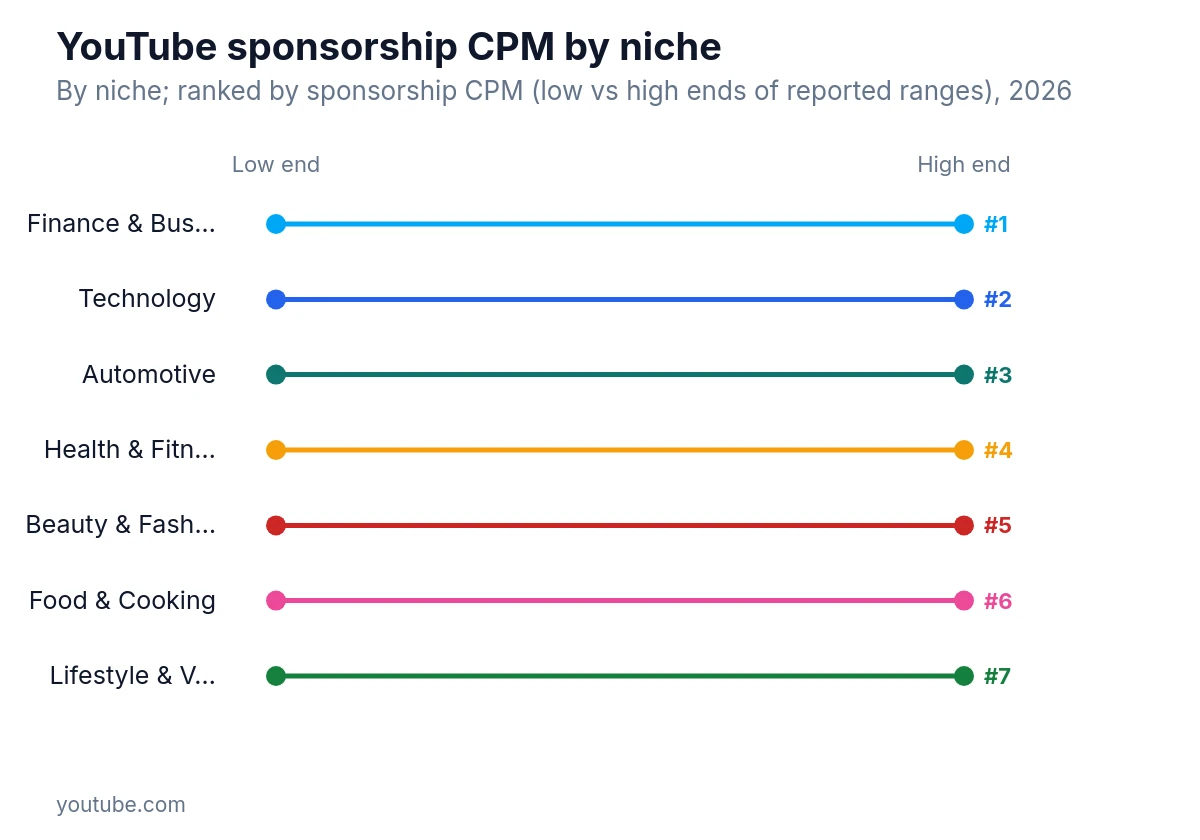
Finance & Business channels have the highest sponsorship CPMs in both the low and high reported ranges, while Lifestyle & Vlog ranks lowest.
Knowing your niche's typical CPM range helps you benchmark any offer you receive. If a brand is offering you a $5 CPM when your niche typically commands $25, you know to push back or walk away.
Engagement Rate
Subscriber count is a vanity metric for sponsorship purposes. A channel with 500,000 subscribers and a 0.5% engagement rate is worth less to a brand than a channel with 80,000 subscribers and a 6% engagement rate.
Engagement rate is calculated by dividing average interactions (likes, comments, meaningful shares) by total views or subscribers, depending on the formula used. The exact calculation varies, but the principle is consistent: brands want to reach an active audience, not a passive one.
If your engagement is strong, lead with that in negotiations. It is often more persuasive than raw subscriber numbers.
Click-Through and Conversion Data
If you have run sponsorships before and tracked results, this is your most powerful negotiating tool. Actual conversion data, how many people used your promo code or clicked your link, tells brands something no other metric can: your audience actually buys things you recommend.
Some creators are reluctant to share this data, worried it might reveal underperformance. But if your numbers are good, sharing them proactively puts you in a much stronger position. You are no longer selling potential, you are selling proof.
How to Calculate Your Own Sponsorship Floor
Your sponsorship floor is the minimum you should accept for a given deal. Anything below this number means you are either undervaluing your audience or losing money when you account for your time.
Here is a practical way to set it:
Step 1: Estimate Your Expected Views
Look at your last 10 to 15 videos and find the median view count, not the average. The median versus mean distinction matters here because a single viral video can pull your average far above what a typical upload actually earns. The median gives you a realistic baseline for what a new video will likely get.
Step 2: Apply a Niche CPM Benchmark
Research typical sponsorship CPMs for your content category. Talk to other creators in your niche, check creator communities, or look at what brands in your space typically spend. Apply that benchmark to your expected views.
If your median video gets 50,000 views and your niche benchmarks at $20 CPM, your floor for a standard mid-roll or dedicated segment is around $1,000.
Step 3: Add a Time Cost
Estimate how many hours the sponsorship will add to your production process. Writing the script for the segment, filming, editing, revisions, back-and-forth with the brand. If that adds up to 5 hours and you value your time at $100 per hour, add $500 to your floor.
Step 4: Factor in Audience Fit Risk
If a product is a stretch for your audience, you should charge more, not less. A bad fit means the ad will perform poorly for the brand (risking the relationship) and may annoy your viewers (risking your channel). Charge a premium for the risk, or decline.
This is the opposite of how many new creators think. They assume they should charge less for products they are unsure about. In practice, you should either be confident enough in the fit to charge your standard rate, or you should charge more to compensate for the uncertainty.
Reading a Sponsorship Deal: What to Watch For
Once you have your floor established, you can evaluate actual offers more clearly. But the dollar amount is only part of what you are agreeing to.
Exclusivity Clauses
Some brands include exclusivity requirements, meaning you cannot promote any competing product for a set period before or after the video goes live. A 30-day exclusivity window around a single video is common and reasonable. A 90-day window, or one that covers your entire channel rather than just the sponsored video, is a significant constraint that should be priced accordingly. One practical approach: price exclusivity fees at roughly 20-50% of your single-video rate for each month of required exclusivity.
If a brand wants broad or long-term exclusivity, that is a separate negotiation. You are giving up potential revenue from other brands, and that has a real cost.
Approval Rights and Revision Rounds
Most brands want to review the sponsored segment before the video goes live. That is standard. What is not standard is unlimited revision rounds or the right to demand changes to your non-sponsored content.
Read the contract carefully. If a brand can require you to revise the segment more than twice, you are potentially signing up for a significant time drain. Set clear limits in your counter-proposal: one round of feedback, one round of revisions, final approval within a specific number of business days.
Usage Rights
Some contracts include clauses allowing the brand to repurpose your content in their own advertising. This is worth real money. Brands that request usage rights generally drive up the cost of a deal, and rightly so: if a brand wants to run your video as a paid ad on YouTube or other platforms, they are buying media rights on top of the sponsorship. That should be a separate line item in the deal.
Performance Bonuses
A growing number of brands offer base pay plus performance bonuses tied to clicks or conversions. This structure can work in your favor if your audience converts well. If you have strong conversion data from past deals, push for a higher base with a bonus structure. If you are new to sponsorships and do not have conversion data yet, a flat fee is safer.
Protecting Your Audience Relationship
The single biggest long-term asset you have as a creator is your audience's trust. Sponsorships that erode that trust are not just bad for your viewers, they are bad for your business.
A few principles that hold up over time:
Only promote products you have actually used or would genuinely use. Audiences are good at detecting when a creator is reading from a script about something they clearly do not care about. You do not have to be obsessed with every product you promote, but you should be able to speak about it honestly.
Be transparent about the commercial relationship. This is also a legal requirement in most jurisdictions: the FTC's endorsement and testimonial standards apply to influencer marketing, and failing to disclose a paid relationship can put you in violation of federal rules. Beyond compliance, it is just good practice. Audiences who know you are being paid and still trust your recommendation are far more valuable than audiences who feel deceived when they find out later.
Limit the number of sponsorships per video. A video with three different brand integrations feels like an infomercial. Most creators find that one sponsorship per video, or at most two if they are clearly separated, keeps the viewing experience intact.
Say no more than you say yes. This is counterintuitive when you are trying to grow your income, but selectivity signals value. Creators who promote everything are trusted for nothing. Creators who are known for careful vetting can charge more and retain audience loyalty longer.
Negotiating Better Deals
Most brands expect negotiation. Agencies that place sponsorships deal with creators all day and have room in their budgets. The first offer is rarely the final offer.
A few approaches that work:
Counter with data, not feelings. "I think I deserve more" is weak. "My last three sponsorships in this category averaged a 3.8% conversion rate, and my median view count for this type of video is 65,000, which puts this offer below market rate for my niche" is strong. Bring numbers.
Bundle deliverables strategically. If a brand wants a YouTube video, offer to include a community post or a pinned comment with the link for an additional fee. This increases the total deal value without requiring significantly more work from you.
Propose a multi-video deal. Brands often prefer predictability. If you are willing to commit to three videos over six months, you can often negotiate a higher per-video rate than you would get for a single placement. The brand gets consistency; you get a reliable income stream.
Know when to walk away. If a brand will not meet your floor after negotiation, declining is a legitimate outcome. Taking a deal below your floor sets a precedent, both with that brand and with yourself. It is harder to raise rates with a brand you have already worked with at a low rate.
Tracking Results After the Deal
Your work does not end when the video goes live. Tracking the performance of each sponsorship makes you better at every subsequent negotiation.
Keep a simple record for each deal that includes:
- The brand and product category
- The fee paid
- Your video's view count at 30 days and 90 days
- Click-through data from your link or promo code (if available)
- Any audience feedback (comments, DMs about the product)
- Whether the brand reached out for a repeat deal
Over time, this data tells you which types of products resonate with your audience, which brands are worth working with again, and where your conversion rates are strongest. It also gives you the proof points you need to charge more.
Brands that come back for repeat deals are a strong signal. It means the first sponsorship performed well enough to justify another spend. That repeat interest is leverage. Use it.
Building Long-Term Brand Relationships
One-off deals are fine. Long-term partnerships are better.
A brand that sponsors you four times a year is more valuable than four different brands that each sponsor you once, even if the per-video rates are similar. Long-term partners require less negotiation time, less back-and-forth on creative approvals, and less risk of misalignment. They also tend to increase rates over time as they see consistent performance.
To build these relationships, treat every deal as an audition for the next one. Deliver what you promised, on time. Communicate proactively if something changes. Share performance data after the video goes live, even when you are not required to. Brands remember creators who make their jobs easier.
If a deal went well and the brand has not reached out for a follow-up within a few months, reach out yourself. A short email noting the performance of the previous video and expressing interest in future work is not pushy, it is professional. Most brands appreciate the initiative.
What Good Sponsorship ROI Looks Like
There is no universal number that defines a successful sponsorship. A $500 deal might be excellent for a channel with 10,000 subscribers in a high-converting niche. A $10,000 deal might be a bad outcome for a channel with 2 million subscribers if the product was a poor fit and the audience backlash cost engagement.
The clearest sign that your sponsorship strategy is working is this: your rates go up over time, your audience stays engaged, and brands come back. Those three things together mean you are pricing fairly, delivering value to brands, and protecting the trust your viewers place in you.
Creators who treat sponsorships as a serious business, tracking data, negotiating deliberately, and choosing partners carefully, consistently out-earn those who treat it as passive income that just shows up. The difference is not audience size. It is how seriously you take the work behind the deal.