What Makes a Sponsorship Campaign Successful?

The Gap Between Writing a Check and Getting Results
Most sponsorship deals fail quietly. The brand logo appears on a banner, the event happens, the banner comes down, and nobody can say with confidence whether the investment was worth it. The sponsor moves on, the rights holder loses a partner, and both sides chalk it up to "brand awareness" without examining why nothing measurable came of it.
The ones that work look completely different. They feel less like a transaction and more like a collaboration, and the difference between the two comes down to a handful of decisions made before any contract is signed.
This article breaks down what actually separates successful sponsorship campaigns from forgettable ones, covering strategy, execution, and the specific elements that determine whether a partnership generates real returns.
What a Sponsorship Strategy Actually Means
A sponsorship strategy is not a list of events you want to attach your name to. It is a deliberate plan that connects your brand's commercial goals to specific audiences, through specific partnerships, in ways that can be measured.
Without a strategy, sponsorship becomes a collection of gut-feel decisions. The CEO likes golf, so the company sponsors a golf tournament. A sales rep has a contact at a local festival, so the company buys a booth. These deals might work occasionally, but they cannot be repeated or scaled because nobody knows why they worked.
A real strategy starts with three questions:
- What do we want to achieve? (Sales, awareness, customer retention, market entry, community goodwill)
- Who do we need to reach to achieve it?
- Where does that audience already spend their attention and money?
The answers to those questions define which partnerships are worth pursuing. Everything else, including the deal structure, the activation plan, and the measurement framework, flows from there.
Aligning Sponsorship Goals with Business Goals
This sounds obvious, but it is where most brands get it wrong. Sponsorship goals and business goals are often treated as separate things. The marketing team manages sponsorships while the commercial team manages revenue targets, and the two never quite connect.
Successful campaigns close that gap. If the business goal is to enter a new geographic market, the sponsorship targets events and properties with strong reach in that region. If the goal is to shift brand perception among a younger demographic, the partnership is chosen specifically because that demographic trusts and engages with it.
The goal does not have to be sales. Sponsorship can serve recruitment goals, community relations goals, or employee engagement goals. But there has to be a goal, and the partnership has to be chosen because it serves that goal, not because it was available.
Choosing the Right Property to Sponsor
The most common sponsorship mistake is choosing a property based on reach alone. A large audience is appealing, but a large irrelevant audience produces nothing.
The better question is not "how many people will see our brand?" but "how many of the right people will see our brand, and what will they think when they do?"
Strong brand-event fit enhances consumers' brand memory and associations, which is why audience fit matters more than audience size. A regional craft beer brand sponsoring a national stadium event might get impressive impression numbers, but if most of that audience is outside the brand's distribution area, those impressions do not convert to anything. The same budget spent on a local food and drink festival with a smaller but geographically concentrated audience could generate far more actual sales.
The Four Main Types of Sponsorship
Understanding the different categories helps brands match the right type of partnership to their specific goals.
Financial sponsorship is the most straightforward: a brand provides cash in exchange for rights, visibility, and association. This is the dominant model in sports, entertainment, and large-scale events.
In-kind sponsorship involves providing products or services rather than cash. A catering company supplying food for an awards ceremony, or a car brand providing vehicles for a film production, are both in-kind arrangements. These work well when the brand's product can be demonstrated or experienced directly.
Media sponsorship involves a media company providing coverage, airtime, or promotional support in exchange for association with the event or property. This is common in broadcast partnerships where a television network co-brands a sporting event.
Promotional or contra sponsorship is a hybrid where the brand promotes the event to its own audience in exchange for rights or visibility. A retailer with a large email list might promote a festival to its customers in exchange for exclusive product placement at the event.
Most successful campaigns involve more than one of these types working together. A brand might provide financial support, supply product for sampling, and promote the event to its own customer base simultaneously.
Activation: Where Most Sponsorships Actually Fail
Signing a sponsorship deal gives you rights. Activation is what you do with those rights to create actual value.
A brand that pays for stadium naming rights but does nothing else has bought real estate. A brand that uses those naming rights as a platform for fan experiences, employee events, co-branded content, and community programs has bought a marketing engine.
Research has offered activation ratio benchmarks ranging from 1:1 up to 8:1 as the spend needed to fully reap the rewards of sponsorship. Brands that invest toward the higher end of that range tend to see much stronger returns. Those that spend the minimum on activation and expect the logo placement to do the work are usually disappointed.
What Good Activation Looks Like
Effective activation connects the brand to the audience in a way that creates a genuine experience or delivers real value, not just visibility.
Sampling programs work because they let people experience the product directly in a context they already enjoy. A sports drink brand at a marathon is not just getting logo exposure; it is putting its product in the hands of people who are actively experiencing the problem the product solves.
Exclusive access works because it creates something the audience cannot get anywhere else. A credit card brand that gives cardholders early ticket access to a concert series is not just advertising; it is delivering a tangible benefit that reinforces why the card is worth having.
Content creation works because it extends the sponsorship beyond the event itself. A brand that produces behind-the-scenes footage, athlete interviews, or documentary-style content around a sponsored property can reach audiences who were not at the event and keep the partnership alive between activations.
The common thread is that good activation gives the audience something, rather than just asking for their attention.
The Elements of a Successful Sponsorship Proposal
If you are on the rights-holder side, the quality of your proposal determines whether you attract strong partners or get ignored. If you are on the brand side, understanding what a good proposal looks like helps you evaluate opportunities more clearly.
A strong proposal is not a media kit with a price list. It is a document that makes a specific case for why this partnership makes sense for this particular sponsor.
The core elements that separate compelling proposals from forgettable ones:
- A clear description of the audience, with specific demographic and psychographic detail, not just total attendance numbers
- Evidence of audience engagement, not just audience size (social media engagement rates, return attendance figures, survey data on audience sentiment)
- A specific articulation of what problem the sponsor is trying to solve, and how this partnership addresses it
- Defined sponsorship packages with distinct value propositions at each level, rather than a generic tiered structure
- Activation ideas that show you have thought about how the sponsor can use the partnership, not just what they will receive
- Measurement commitments that specify how results will be tracked and reported
- Case studies or results from previous sponsors where available
The proposals that get funded are the ones that make the sponsor's job easy. They answer the question "why should we do this?" before it is asked.
Measurement: Knowing Whether It Worked
Sponsorship has historically been difficult to measure, and that difficulty has been used as an excuse to avoid measuring it at all. "Brand awareness" became a catch-all for results that nobody could quantify.
That approach is increasingly hard to defend. Brands with serious marketing budgets want to know what their sponsorship investment returned, and rights holders who cannot demonstrate value lose renewals.
The right sponsorship measurement framework depends on what the sponsorship was trying to achieve. Some useful approaches:
For awareness goals, brand tracking surveys conducted before and after the campaign can show whether recognition or perception shifted among the target audience. This requires planning ahead, since you need a baseline measurement before the campaign runs.
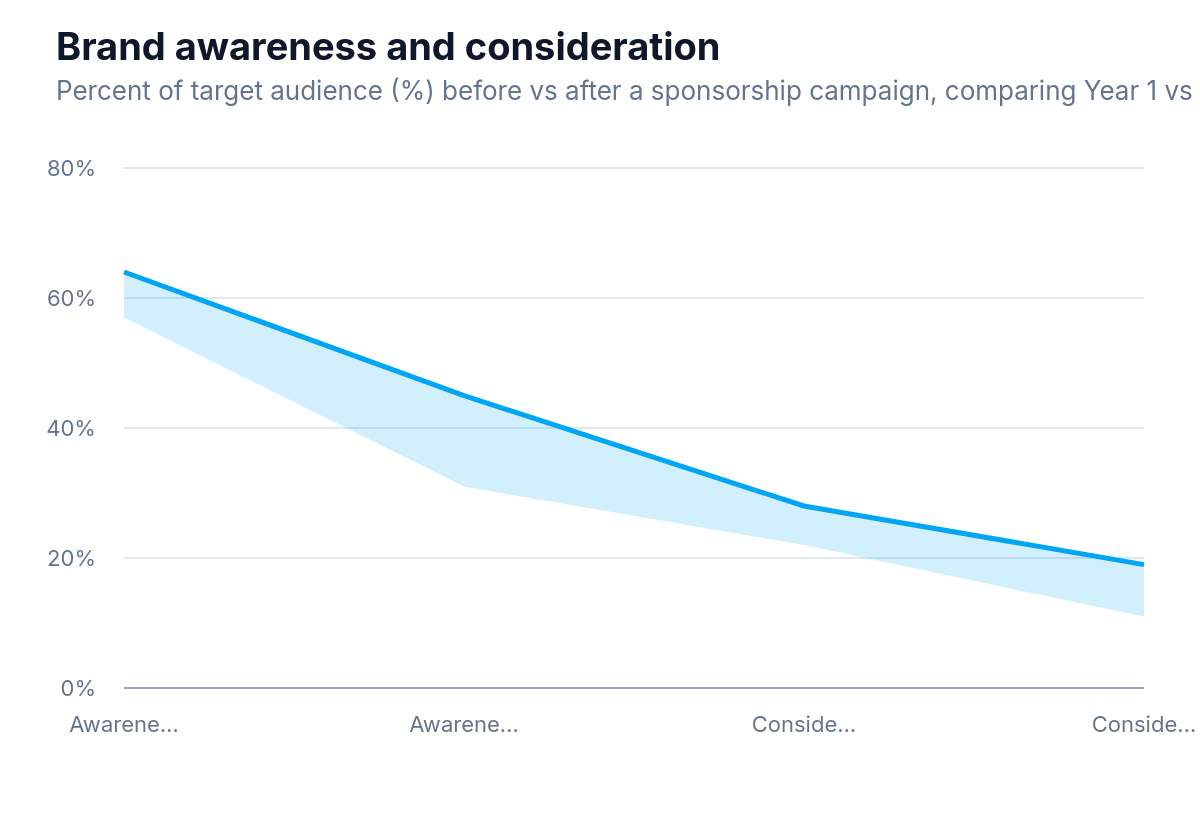
Awareness is highest among users at 64%, versus 45% for non‑users, and consideration is also higher for users (28% vs 19%).
For sales goals, promotional codes, dedicated landing pages, or geo-targeted sales data can connect sponsorship exposure to purchase behavior. Well-run promotions using discount codes can see coupon redemption rates of 5-10%, which gives a far more concrete read on conversion than impression counts alone.
For engagement goals, social listening, content performance metrics, and event participation data all provide evidence of whether the audience actually engaged with the brand or simply walked past a logo.
For relationship goals (B2B sponsorships where the aim is to build relationships with key clients or prospects), tracking meeting rates, pipeline movement, and deal closures among the target group gives a clearer picture than any media metric.
Common Mistakes That Kill Sponsorship Campaigns
Choosing Based on Personal Interest
Executives who sponsor events they personally enjoy are common. The CEO who plays golf, the CMO who loves music festivals. Personal enthusiasm is not a disqualifying factor, but it cannot be the primary reason for a sponsorship decision. The audience fit question still needs an honest answer.
Treating Sponsorship as a One-Time Transaction
Sponsorship builds value over time. A brand that sponsors an event once, sees modest results, and moves on has not given the partnership time to work. Audiences need repeated exposure to build association, and rights holders need time to integrate a brand partner meaningfully into their programming. Multi-year commitments consistently outperform one-off deals.
Neglecting Contractual Clarity
Ambiguous contracts create disputes. What exactly does "logo placement" mean? Where, at what size, in what contexts? What are the exclusivity provisions? What happens if the event is cancelled or significantly altered? What data will be shared, and when? These questions need specific answers in the contract, not assumptions.
Ignoring Category Exclusivity
Category exclusivity means the rights holder cannot sell sponsorship to a direct competitor. For many brands, this is non-negotiable. A bank that sponsors a financial literacy program does not want a competing bank to have the same rights. Failing to secure exclusivity, or failing to check whether exclusivity has already been sold to a competitor, is a costly oversight. It is also worth understanding how league-level sponsorship arrangements can complicate this: if a relevant league or association signs with a competitor of the sponsor, the team typically cannot be held responsible even if that arrangement would have violated the exclusivity had the team entered into it directly.
Underestimating Activation Costs
Brands sometimes calculate their sponsorship budget as the rights fee alone, then discover that meaningful activation requires additional spend they have not planned for. Staffing, production, content creation, hospitality, and promotional materials all add up. The total cost of a sponsorship is always higher than the rights fee.
What Brand Sponsorship Looks Like When It Works
A few patterns emerge from sponsorships that generate genuine returns.
Long-running sports partnerships where the brand becomes genuinely associated with the sport or team, rather than just appearing alongside it, tend to perform well. This happens when the brand is present consistently across multiple seasons, activates meaningfully at each event, and creates content that lives beyond match days.
Cause-related sponsorships where the brand's values and the cause's mission genuinely align can build significant goodwill, particularly when the brand's involvement goes beyond financial support to include employee volunteering, product donations, or advocacy. Research on local event sponsorship and brand image found a Pearson correlation of 0.624 between the two variables, a positive relationship that holds when the brand's involvement is authentic rather than performative. Audiences are good at detecting when a brand's involvement in a cause is performative.
Naming rights deals that include strong activation programs tend to outperform those that do not. A venue name change alone does not shift brand perception. But a naming rights deal combined with community events at the venue, exclusive experiences for customers, and content shot on location creates multiple touchpoints that compound over time.
Building a Partnership That Lasts
Renewals are the real measure of a successful sponsorship. When a brand renews a deal, it means the partnership delivered enough value to justify continued investment. When it does not renew, something failed, either the results, the relationship, or both.
The brands that renew consistently are the ones that treat the rights holder as a partner rather than a vendor. They share their marketing plans so the rights holder can integrate them into programming. They provide feedback on what worked and what did not. They give the rights holder's team access to the brand's resources, whether that is creative support, data, or distribution.
Rights holders that retain sponsors do the same in reverse. They proactively share audience data and campaign performance. They flag new opportunities that might suit the sponsor's goals. They solve problems quickly when they arise instead of waiting for the sponsor to complain.
The sponsorship relationship that functions like a genuine business partnership, where both sides are invested in each other's success, is the one that generates results worth renewing.
What Separates Campaigns That Work
Successful sponsorship campaigns share a few characteristics that have nothing to do with budget size. They start with a clear goal. They choose partners based on audience fit rather than prestige or convenience. They invest in activation rather than assuming that logo placement will do the work. They measure what matters and use that measurement to improve.
The brands that get this right tend to treat sponsorship as a long-term channel rather than a one-off experiment. They build institutional knowledge about what works for their specific goals and audience, and they apply that knowledge systematically rather than starting from scratch with each new deal.
That discipline, more than any particular tactic, is what makes the difference.