The Rise of Virtual Influencers in YouTube Sponsorships

When the Spokesperson Is Not Real
A beauty brand launches a new skincare line. The spokesperson has flawless skin, a consistent aesthetic, and never has a bad day on camera. She posts regularly, never cancels a shoot, and her audience numbers in the millions. The only catch: she does not exist.
Virtual influencers have moved from novelty to legitimate marketing channel faster than most brands anticipated. On YouTube specifically, where long-form content and dedicated sponsorship segments have driven creator economy revenue for years, computer-generated personalities are now appearing in paid partnerships, product integrations, and dedicated brand deals. The question is no longer whether virtual influencers can attract audiences. It is whether they can actually sell products, and what it means for the human creators who built this economy in the first place.
What Virtual Influencers Actually Are
The term covers a wider range than most people realize. At one end, you have fully CGI characters with elaborate backstories, distinct personalities, and social media presences managed by creative agencies or tech companies. At the other end, you have AI-generated avatars operated by real people who use the digital persona as a kind of mask, with a human voice and personality behind the rendered face.
On YouTube, this distinction matters more than on Instagram. A static post from a CGI character works fine on a photo-based platform. YouTube demands video, which means movement, voice, and extended engagement. Early virtual YouTubers, a category that became massive in Japan before spreading globally, solved this through live2D animation and motion capture technology. A real person moves and speaks, and a stylized avatar mirrors their performance in real time.
The VTuber scene, as it is commonly called, grew into a full industry. Agencies like Hololive and Nijisanji built rosters of virtual talents with dedicated fanbases, merchandise lines, and significant advertising revenue. The VTuber market size projection from QY Research puts the industry at $1.4 billion in 2024 and nearly $4 billion annually worldwide by 2030. These are not passive CGI characters. They are performers using technology to create a distinct identity, and their audiences are intensely loyal.
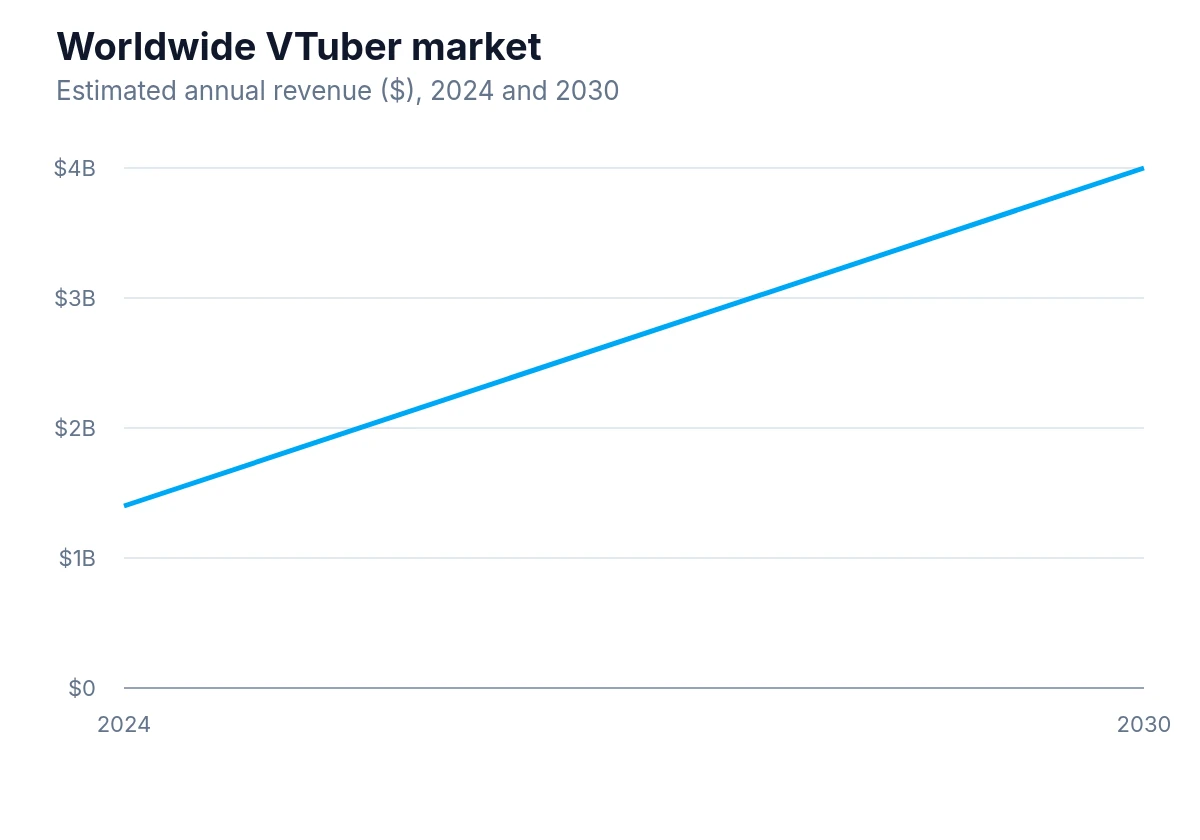
The worldwide VTuber market is estimated at about $1.4 billion in 2024 and is projected to grow to roughly $4 billion by 2030.
Fully CGI characters managed without a human performer behind them represent a different category. These are created and operated by teams, often with AI tools handling some of the content generation. Their sponsorship appeal is different: they offer maximum brand control, zero personal scandal risk, and a visual identity that can be adjusted on demand.
Why Brands Are Paying Attention
The appeal for advertisers is not hard to understand once you have watched a few high-profile influencer controversies unfold in real time.
Human creators carry personal risk. A single off-brand statement, a controversy in their personal life, or a shift in their values can damage a sponsorship relationship overnight. Brands have pulled deals from creators they had worked with for years because of something said on a podcast or a post that aged badly. Virtual influencers do not have personal lives that can leak. They do not get tired, go through breakups, or develop opinions that conflict with their sponsor's messaging.
There is also the consistency argument. A virtual influencer's appearance, tone, and posting schedule can be maintained with precision. For brands that care deeply about visual identity, working with a character whose aesthetic is entirely controlled is attractive. The product always appears in the right lighting, against the right background, with the right color palette.
On YouTube specifically, sponsorship segments in long-form videos have become a standard revenue stream. Creators typically read ad copy in their own voice, often mid-video. Virtual influencers can do the same, with the added ability to be placed in any visual environment the brand wants. A skincare product can be shown in a bathroom setting that matches the brand's own aesthetic exactly. A gaming peripheral can be demonstrated in an idealized setup.
The cost structure is also different. While producing high-quality CGI content is expensive, the character itself does not charge a talent fee, does not negotiate rates based on follower growth, and does not require exclusivity clauses that limit other brand work. For some brands running long-term campaigns, the economics can work out favorably.
The Audience Trust Problem
Here is where the picture gets more complicated.
YouTube audiences have developed sophisticated instincts about authenticity. The platform's culture grew around creators who felt like real people sharing genuine opinions. Early YouTube was explicitly anti-corporate, and even as it became a professional industry, the expectation of personal authenticity remained. When a creator recommends a product, the implicit promise is that they have used it and believe in it.
Virtual influencers break that implicit contract in ways that audiences notice. A CGI character cannot actually use a skincare product. They cannot genuinely prefer one gaming chair over another. The sponsorship becomes purely performative, which is not necessarily disqualifying, but it does change what the audience is being asked to accept.
Research into consumer behavior around virtual influencers suggests that the perceived authenticity of virtual influencers is consistently lower than that of human influencers, regardless of the type of product being promoted. When viewers know they are watching a virtual influencer and the content acknowledges this openly, engagement can remain strong, particularly where age and social media usage frequency significantly shape how audiences respond. When brands try to obscure the virtual nature of the character, the reaction tends to be more negative when the truth surfaces.
VTubers occupy an interesting middle ground here. Their audiences know there is a human performer behind the avatar, and that knowledge actually builds a different kind of trust. The character is a persona, but the person is real. When a VTuber recommends a product, the audience understands that a real human being is making that recommendation, even if they cannot see that person's face. This has made VTubers particularly effective for certain sponsorship categories, especially gaming hardware, software, and digital products.
Fully CGI characters managed by agencies face a steeper challenge. The audience knows no real person is behind the recommendation. For some product categories, this is manageable. For others, particularly health, wellness, and personal care products where authentic testimonial carries weight, the disconnect can undermine the entire campaign.
How Sponsorship Deals Actually Work
The mechanics of virtual influencer sponsorships on YouTube are still evolving, but some patterns have emerged.
For VTubers, the deal structure often mirrors standard creator sponsorships. The agency representing the talent negotiates on behalf of the virtual personality. The performer delivers the sponsorship segment in character, often with a script approved by the brand. Disclosure requirements apply just as they do for human creators: the video must be labeled as containing paid promotion. The character's established audience is the asset being sold, and rates reflect subscriber counts, average view numbers, and audience demographics.
For fully CGI characters, the deal is more like a production contract. A brand pays for the creation of content featuring the character, with the agency or studio handling all production. The character's social media presence is the distribution channel. Some brands have gone further, creating their own proprietary virtual influencers rather than working with existing ones. This gives them complete ownership of the character and eliminates any ongoing talent relationship.
YouTube's own policies treat virtual influencers the same as human ones for disclosure purposes. Paid promotions must be disclosed, regardless of whether the spokesperson is human or digital. This is a reasonable standard, though enforcement is complicated by the sheer volume of content on the platform.
One area where virtual influencers have found particular traction is in international markets. A virtual character can be adapted for different languages and cultural contexts without the awkwardness of a human spokesperson who does not share that cultural background. A CGI character's appearance, name, and personality can be adjusted for different regional campaigns in ways that would be impossible with a human creator.
The Human Creator Response
Not everyone in the creator economy is watching this development with indifference.
Some human creators have expressed concern about what widespread virtual influencer adoption could mean for their livelihoods. If brands can achieve comparable results with a virtual character that carries no personal risk and no ongoing talent cost, the argument goes, why would they continue paying human creators?
The counterargument is that human creators offer something virtual characters cannot replicate: genuine community. The parasocial relationships that drive YouTube's most successful channels are built on years of shared experience between a creator and their audience. A viewer who has watched someone grow from a bedroom setup to a professional studio, who has seen them deal with setbacks and celebrate wins, has an investment in that person that no CGI character can manufacture.
There is also the question of creative output. The most successful YouTube channels are driven by a creator's genuine curiosity, humor, or expertise. A virtual character managed by a committee produces content that is, almost by definition, optimized rather than authentic. Optimization and authenticity are not always the same thing.
What seems more likely than virtual influencers replacing human creators is that they will occupy a specific niche: brands that want maximum control, visual consistency, and zero personal risk will use virtual characters for certain campaign types. Brands that want genuine community engagement and authentic product endorsement will continue working with human creators. The two models serve different marketing goals.
Categories Where Virtual Influencers Are Gaining Ground
Not all product categories are equally suited to virtual influencer sponsorships. Some have proven more receptive than others.
Gaming and technology products are a natural fit. The audience for gaming content is already comfortable with virtual identities, digital avatars, and the idea that a persona can be separate from a physical person. VTubers have driven significant sales for gaming peripherals, software subscriptions, and digital games. The product category and the medium align.
Fashion and beauty have seen notable virtual influencer activity, particularly on platforms like Instagram. On YouTube, the results are more mixed. Beauty content relies heavily on demonstration and authentic reaction, which is harder to simulate convincingly. Some brands have used virtual influencers for brand awareness campaigns rather than direct product tutorials, which sidesteps the authenticity problem.
Entertainment and media promotion is another area where virtual influencers work well. Promoting a new animated series, a video game release, or a digital event does not require the same personal testimonial that a skincare product does. The virtual character is promoting something that exists in a similar digital space.
Financial products and services have been slower to adopt virtual influencers, partly because regulatory requirements around financial advertising demand clear disclosure and accountability. Under rules governing advertising for financial instruments, promotions must be clearly identified as such and must reference both a Key Information Document and the instrument's prospectus, creating compliance complications that most brands in this space prefer to avoid when working with a virtual character that has no legal identity.
What Comes Next
The technology driving virtual influencers is improving at a pace that will change what is possible within a few years.
Real-time AI voice synthesis and facial animation are already advanced enough to create characters that can respond dynamically in live streams, not just in pre-produced videos. This opens the possibility of virtual influencers that can interact with audiences in real time, answer questions, and adapt their content based on viewer response. Some early versions of this already exist, though the results are still noticeably artificial.
The line between a virtual influencer and an AI-powered brand assistant is going to blur. A character that can hold a live conversation with viewers about a product, answer specific questions, and maintain a consistent persona across thousands of simultaneous interactions is something qualitatively different from a CGI character in a pre-recorded video. It is closer to an interactive brand experience than traditional influencer marketing.
For YouTube specifically, the long-form video format will continue to favor creators who can sustain genuine engagement over extended periods. A ten-minute video with a mid-roll sponsorship requires the audience to trust the host enough to keep watching. That trust is easier to build with a human creator, but it is not impossible to build with a well-constructed virtual persona, particularly one with a long track record and a consistent character.
What Brands and Creators Should Take Away
The rise of virtual influencers in YouTube sponsorships is not a single story. It is several overlapping developments happening at different speeds in different parts of the market.
Brands considering virtual influencer partnerships should be clear about what they are actually buying. If the goal is brand control and visual consistency, a fully CGI character managed by a professional studio can deliver that. If the goal is genuine audience engagement and product credibility, a human creator with an established community will almost always outperform a virtual character, regardless of how polished the production is.
Human creators should understand that virtual influencers are not going to make them obsolete. They will, however, compete for certain types of brand budgets, particularly from companies that have had difficult experiences with creator controversies or that operate in highly regulated industries where message control is critical.
The audience, as always, will make the final call. YouTube viewers have shown repeatedly that they can tell the difference between content that feels genuine and content that feels manufactured. Virtual influencers that acknowledge their nature, build real community, and deliver consistent entertainment will find audiences. Those deployed purely as risk-free advertising vehicles, with no genuine personality behind them, will struggle to hold attention in a platform environment where the competition for viewer time has never been more intense.
The technology is real. The business case exists. But the creator economy was built on connection, and connection is still the hardest thing to fake.