How VR is Shaping the Future of Video Content Creation

The Shift That Snuck Up on Creators
Most conversations about virtual reality still center on headsets and gaming. That framing misses what is actually happening. Across film production, live events, journalism, and branded content, VR is quietly changing how video gets made, not just how it gets watched.
The change is not sudden. It has been building through a series of practical shifts: cheaper 360-degree cameras, more accessible editing pipelines, and a growing audience that has at least tried a headset once. What started as a novelty format has matured into a genuine production discipline with its own grammar, tools, and creative logic.
For video creators, that matters. VR is no longer a side experiment reserved for tech companies with large budgets. It is becoming part of the broader toolkit, and understanding how it works, where it fits, and what it demands is increasingly useful knowledge.
What VR Actually Changes About Video Production
Traditional video production is built around a frame. The director decides what the audience sees, when they see it, and from what angle. Every cut, every camera move, every lighting decision is a form of control. The viewer is a passenger.
VR removes that frame. In a 360-degree or fully immersive environment, the viewer can look anywhere. That single fact rewrites most of the assumptions that underpin conventional filmmaking.
Directing Without a Frame
When you cannot control where the viewer looks, you have to think differently about storytelling. You cannot rely on a close-up to signal emotion or a cutaway to build tension. Instead, you design an environment and then use sound, movement, and spatial cues to guide attention.
This is harder than it sounds. Many early VR films failed because their creators applied conventional cinematic logic to a format that does not support it. Talking heads staring into a camera, dramatic cuts between scenes, narration over static footage - these techniques either feel wrong in VR or simply do not translate.
What works instead is spatial storytelling: placing the viewer inside a moment rather than showing them one. A documentary about a refugee camp becomes more affecting when you are standing in it than when you are watching it. A live concert feels different when you are on stage rather than in a seat. The medium's strength is presence, and good VR content is built around that.
The Production Pipeline Looks Different
Shooting in 360 degrees changes almost every stage of production. Camera placement matters in new ways because the camera is always visible to itself in a sense - crew, rigs, and equipment cannot hide off-frame. Many productions use remote-controlled cameras or shoot with minimal crew in the space.
Editing is also different. The 360° video post-production challenges are real: objects too close to the camera that move between seamlines can take considerably more time to fix, and stitching multiple camera feeds into a seamless spherical image requires dedicated software and careful attention to seams, exposure matching, and spatial audio. Post-production timelines are often longer than comparable flat video projects.
Spatial audio is one of the most underappreciated elements of VR production. Sound in VR needs to behave the way sound behaves in the real world: a voice coming from your left should feel like it is coming from your left, and it should shift as you turn your head. Getting this right requires binaural audio techniques and specialized mixing tools. When it works, it contributes enormously to the sense of presence. When it does not, the whole experience feels off.
Tools and Software Shaping VR Content Creation
The software side of VR production has matured considerably. A few years ago, creators were stitching footage together with clunky workflows and limited options. The current generation of tools is more capable and, in many cases, more integrated with existing production software.
Stitching and Processing
For 360-degree video, stitching is the process of combining footage from multiple camera lenses into a single spherical image. Software like Mistika VR and DaVinci Resolve (with its built-in 360 tools) handles this well for professional work. For creators working with consumer-grade cameras like the Insta360 or GoPro Max, the accompanying apps do most of the stitching automatically.
Editing
Most major editing platforms now support 360-degree video natively. Adobe Premiere Pro has had VR editing tools for several years, including a VR headset preview mode that lets editors review footage as it will actually appear. DaVinci Resolve offers similar capabilities. These integrations mean creators do not need to leave their existing workflow entirely, though some specialized tasks still require dedicated tools.
Real-Time Engines
This is where VR content creation gets genuinely interesting. Unreal Engine and Unity, both originally built for games, have become serious production tools for VR video content. They allow creators to build fully interactive virtual environments, render photorealistic scenes in real time, and create experiences that respond to viewer input.
Productions using virtual production stages - LED walls displaying real-time rendered environments - are already common in film and television. VR extends this further, allowing creators to build environments that exist only digitally but feel physically real to the person inside them.
AI-Assisted Tools
Newer tools are starting to use AI to speed up parts of the VR production process. Automatic seam detection, depth estimation for 3D spatial video, and AI-driven spatial audio processing are all areas where the tooling is improving quickly. Recent research into panoramic depth estimation shows meaningful gains in accuracy and reduction of geometric distortion, though these capabilities are not yet fully mature. They are reducing the technical barrier for smaller teams.
Where VR Video Content Is Actually Being Used
The most useful way to understand VR's role in video creation is to look at where it is producing real results, not where it is being hyped.
Documentary and Journalism
Several major news organizations have produced VR documentaries that place viewers inside conflict zones, natural disasters, and humanitarian crises. The argument for this format is that presence creates empathy in ways that conventional footage does not. Whether that argument holds up empirically is still debated, but the format has produced genuinely affecting work.
The New York Times, The Guardian, and various independent documentary makers have all released notable VR pieces. The production challenges are significant - shooting in difficult or dangerous environments with 360-degree cameras requires careful planning - but the results can be powerful.
Training and Simulation
This is arguably where VR video content has the clearest practical value. Medical training, emergency response simulation, military preparation, and corporate safety training all use VR video to put trainees in realistic scenarios without real-world risk.
The video content here is often a hybrid of recorded footage and interactive elements. A trainee might watch a realistic scenario unfold and then be asked to make decisions that affect the outcome. VR education outcomes measured across studies show significantly improved knowledge scores, faster skill performance, and higher satisfaction and confidence compared with traditional methods. This format is more engaging than conventional training video and produces better retention in most contexts.
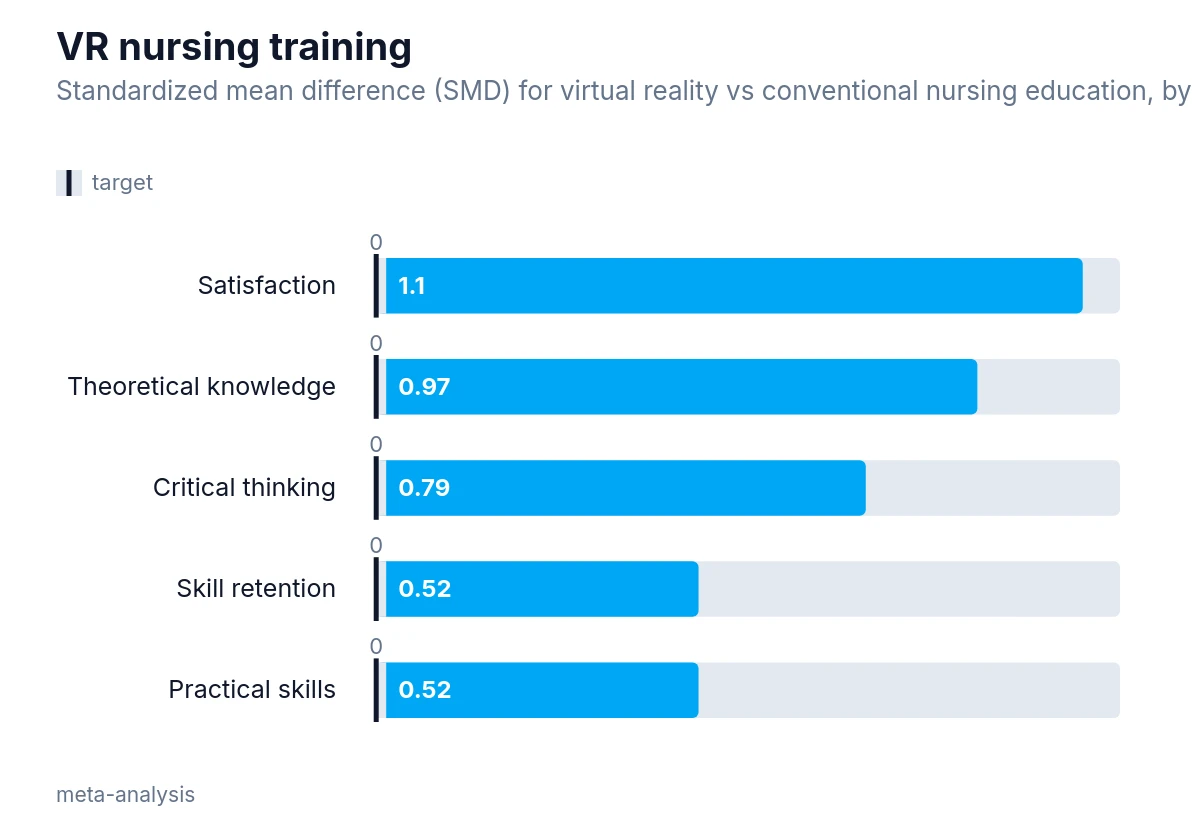
VR nursing training showed positive effects over conventional education across all five outcomes, with the largest improvement in satisfaction (SMD 1.14) and smaller gains in knowledge, critical thinking, retention, and practical skills (SMDs 0.97–0.52).
Live Events and Sports
360-degree live streaming of concerts, sports events, and performances has been technically possible for several years. The execution has been inconsistent, partly because the production requirements are demanding and partly because the distribution infrastructure (fast enough connections, widespread headset ownership) has lagged behind the ambition.
That is changing. The 360° video bandwidth requirements are steep - roughly 200 Mbps for a 4K stream across eight tiles, compared to about 25 Mbps for a traditional 4K video - but as headsets become more common and streaming technology improves, live VR broadcasts are becoming more viable. Sports leagues and music promoters are paying attention, because VR offers something conventional broadcast cannot: the feeling of being there.
Branded Content and Marketing
Brands have been experimenting with VR content since the mid-2010s. Early efforts were often gimmicky. More recent work tends to be more purposeful, using VR to let customers experience products or places before committing to a purchase. Real estate tours, travel previews, and automotive test drive simulations are all formats that have found genuine audiences.
The Honest State of the Medium
VR has been declared both the future of everything and a dying format, sometimes in the same year. Neither extreme is accurate.
The medium has real limitations. Consumer VR headset ownership sits at around 19 percent of consumers surveyed, up from 16 percent in 2019, which is still modest compared to smartphones or televisions. Long sessions in a headset are physically uncomfortable for many people - motion sickness in VR affects between 40 and 70 percent of users after just 15 minutes with commercially available systems. The production costs for high-quality VR content remain higher than equivalent flat video. And distribution is still fragmented across platforms that do not always talk to each other well.
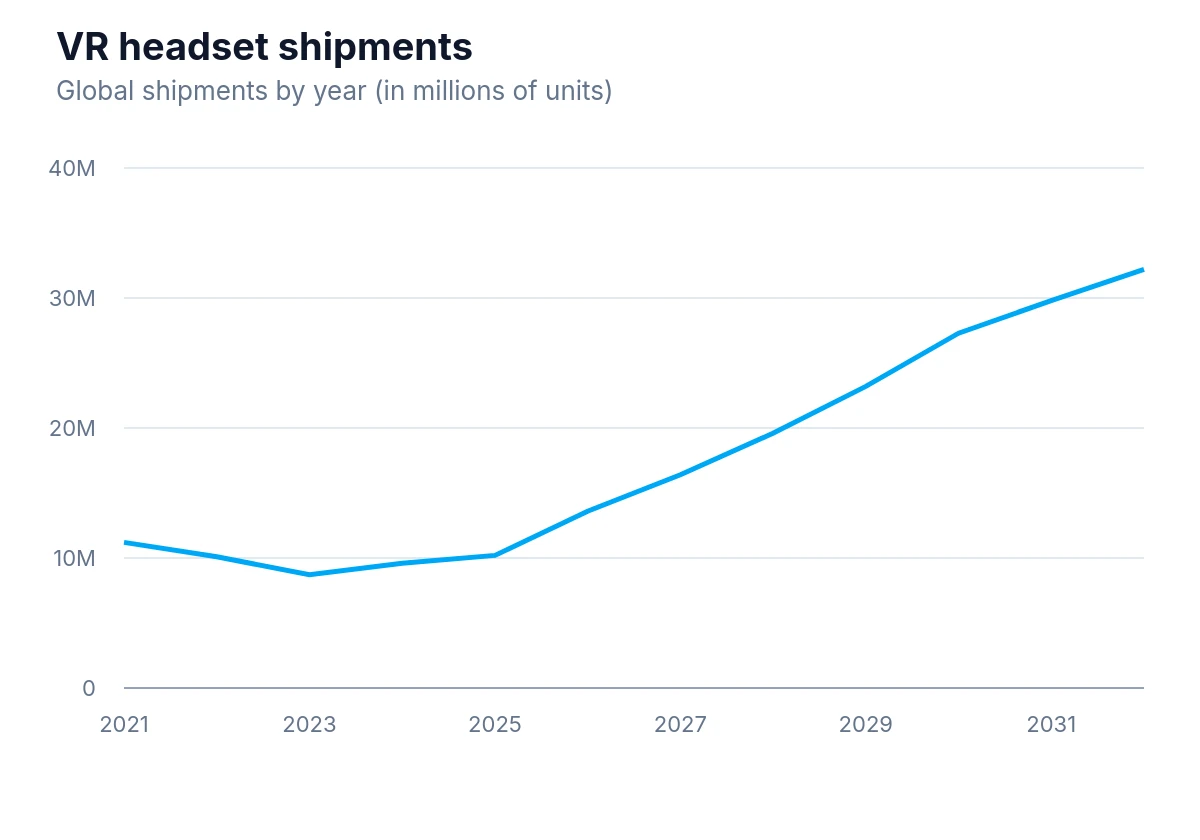
After dipping through 2023, global VR headset shipments rebound and grow to 32.2 million units by 2032.
At the same time, the trajectory is clear. Headsets are getting lighter and cheaper. The content library is growing. Platforms like YouTube and Meta have invested heavily in 360-degree and spatial video infrastructure. Apple's entry into the spatial computing market with Vision Pro has pushed other manufacturers to improve their hardware.
The more useful question is not whether VR is alive or dead, but what it is good at and where it fits in a creator's toolkit. The answer is specific: VR is good at presence, at placing viewers inside experiences, and at creating emotional or physical engagement that flat video cannot replicate. It is not a replacement for conventional video - it is a different tool for different jobs.
Getting Started with VR Video Production
For creators who want to experiment with the format, the entry point is lower than it used to be.
Starting with 360-Degree Video
Consumer 360-degree cameras like the Insta360 X4 or the Ricoh Theta series cost a few hundred dollars and produce footage that can be edited in standard software and uploaded directly to YouTube or Vimeo as 360-degree video. This is the most accessible starting point. The quality ceiling is lower than professional rigs, but the learning curve is manageable.
The key skills to develop early are:
- Thinking spatially about composition, since there is no frame to hide behind
- Working with spatial audio, even at a basic level
- Understanding how to guide viewer attention without cuts or close-ups
Moving into Interactive VR
If you want to create fully interactive VR experiences rather than passive 360-degree video, you will need to learn a real-time engine like Unreal or Unity. Both have extensive free learning resources, and both have active communities of creators working in VR.
This is a bigger investment of time and requires some comfort with 3D concepts, but it opens up a much wider range of creative possibilities. Interactive VR experiences can respond to the viewer, branch based on choices, and create a sense of agency that passive video cannot.
Distribution
The main platforms for VR video content are YouTube (which supports 360-degree video natively), Meta's Quest platform (for interactive experiences), Vimeo (which has strong 360-degree support), and WebXR (which allows VR experiences to run in a browser without a dedicated app). Each has different technical requirements and different audiences.
What This Means for Video Creators
VR is not going to replace conventional video production. The two formats serve different purposes and reach audiences in different ways. But VR is changing what is possible in video content creation, and creators who understand the format will have options that those who ignore it will not.
The most significant shift is conceptual. Learning to think spatially, to design for presence rather than for the frame, and to use environment as a storytelling tool changes how you approach video production generally. Many creators who have worked seriously in VR report that it changed how they think about conventional filmmaking too.
The tools are good enough now. The distribution infrastructure is functional. The audience, while still developing, is real. For creators willing to invest time in learning a new discipline, VR video production offers genuine creative territory that is still relatively open.
Where the Format Goes From Here
The next few years will likely determine whether VR video becomes a mainstream production discipline or remains a specialized niche. Several factors will shape that outcome.
Headset adoption is the most obvious variable. If lightweight, affordable headsets reach a large enough audience, the economic case for producing VR content becomes much stronger. The hardware is improving faster than most people realize.
Spatial video, a format that creates a 3D effect viewable on headsets, is a middle ground that may prove important. Apple's iPhone and Vision Pro support spatial video capture and playback, and the format is simpler to produce than full 360-degree VR. It may serve as an on-ramp that brings more creators and viewers into the broader VR ecosystem.
AI tools will continue to reduce the technical complexity of VR production. Automatic stitching, AI-generated spatial audio, and depth estimation from standard cameras are all areas where the tooling will improve. As the technical barriers drop, more creators will experiment with the format.
The creative language of VR is still being developed. The filmmakers and creators working in the format today are, in a real sense, figuring out what VR storytelling is. That is a genuinely open creative space, and for creators who find that kind of frontier interesting, it is a good time to be paying attention.