Understanding YouTube's Ad Revenue Model: A Deep Dive
The Gap Between Views and Money
Most people assume YouTube pays per view. Watch a video, the creator gets a fraction of a cent. Simple. But that mental model explains almost nothing about why one creator earns $2 per thousand views while another earns $25 for the same number.
The actual system is an advertising auction, and the creator is not really selling views. They are selling audience attention to advertisers who bid against each other in real time. Understanding that distinction changes how you read every revenue figure you see quoted online.
This article breaks down how the money actually flows, what determines how much of it reaches a creator, and what realistic earnings look like at different scales.
How the Auction Works
When a viewer loads a YouTube video, an automated auction runs in milliseconds. Advertisers have set bids and targeting parameters in advance through Google Ads. The auction determines which ad appears, and at what price.
The price advertisers pay is called the CPM, or cost per mille, meaning cost per thousand impressions. A $10 CPM means an advertiser spent $10 to show their ad to a thousand people. That number is set by advertiser demand, not by YouTube or the creator.
The creator revenue share for long-form videos is 55%, with YouTube keeping the remaining 45%. So a $10 CPM translates to about $5.50 in creator earnings per thousand monetized views. This creator-side figure is often called RPM, or revenue per mille.
The distinction between CPM and RPM matters because not every view generates an ad impression. A viewer who uses an ad blocker generates no revenue. A viewer who skips a skippable ad before five seconds generates no revenue. A viewer who closes the tab in the first two seconds generates no revenue. Across a typical channel, only a portion of total views actually result in a paid ad impression.
What Drives CPM Up or Down
CPM is almost entirely determined by who is watching, not how many people are watching. Advertisers pay a premium to reach specific audiences, and they pay very little to reach audiences they do not want.
Niche and Audience Intent
A video about personal finance software attracts viewers who are actively thinking about money. Software companies, banks, and financial services firms want those viewers badly, and they bid accordingly. CPMs in personal finance, investing, and business content regularly run several times higher than CPMs in entertainment or gaming.
A gaming video attracts a large audience, but that audience is often younger, often using ad blockers, and often not in a purchasing mindset. Advertisers pay less for that attention.
Other high-CPM categories include real estate, legal services, insurance, B2B software, and health and wellness. Low-CPM categories tend to include general entertainment, music reaction videos, and content aimed at children (which faces additional restrictions on ad targeting).
Geography
Where viewers are located has an enormous effect on CPM. Advertisers in the United States, United Kingdom, Canada, and Australia pay significantly more per impression than advertisers targeting viewers in Southeast Asia, Latin America, or Africa. This is not a value judgment about audiences. It reflects the purchasing power in those markets and the advertiser budgets allocated to them.
A channel with a primarily American audience and a channel with a primarily Indian audience can have identical view counts and wildly different revenue. The difference can be a factor of five to ten times.
Time of Year
Ad spending follows a predictable seasonal pattern. The fourth quarter, particularly November and December, sees the highest CPMs of the year. Advertisers are competing aggressively for attention during the holiday shopping season, and that competition drives bids up. The YouTube CPM range (Q4 2022–Q4 2023) ran from $13.03 to $15.34, a swing of $2.31. January typically sees a sharp drop as ad budgets reset. Creators who track their analytics often notice this swing clearly.
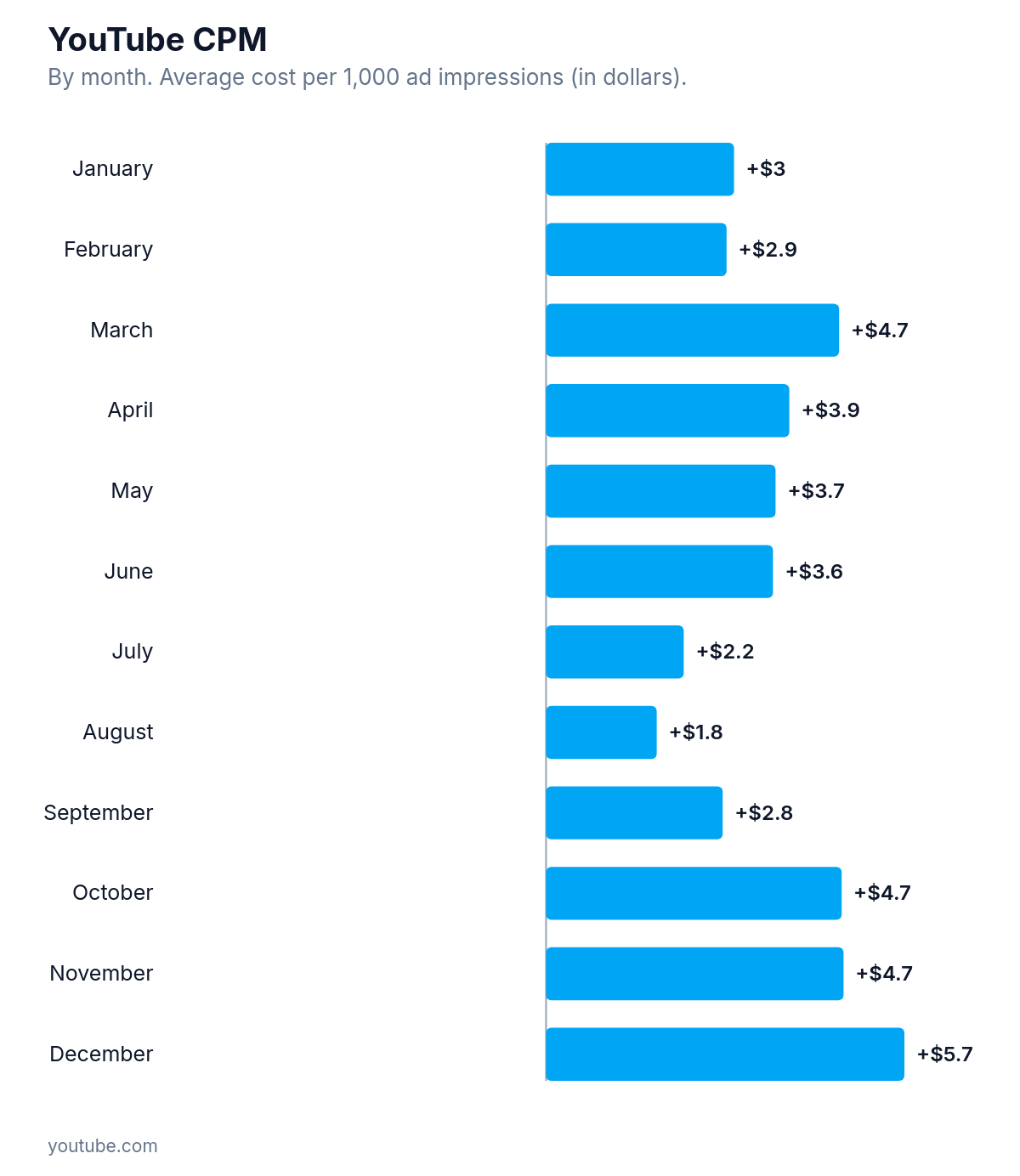
YouTube CPM peaks at $5.70 in December (about $4.73 in November) and then drops sharply to $2.99 in January as advertisers reset budgets.
Ad Format
YouTube serves several types of ads. With CPV billing for skippable in-stream ads, advertisers pay when a viewer watches 30 seconds of the video (or the full duration if it is shorter than 30 seconds) or interacts with it, whichever comes first. Non-skippable ads pay on impression. Bumper ads are short non-skippable clips. Display ads appear alongside the video. Each format has different CPM rates, and the mix a channel receives depends on advertiser preferences and the content itself.
The RPM Reality
Because of the gap between total views and monetized views, and because YouTube takes its cut, the RPM a creator actually receives is usually well below the CPM advertisers pay.
A channel might have a $15 CPM but an RPM of $6 or $7 after accounting for ad blockers, skipped ads, and YouTube's share. Some channels run closer to $3 RPM. Channels in premium niches with engaged, ad-blocker-free audiences might see $12 to $15 RPM.
This is why view-count-to-income calculations are so unreliable when stated without context. "YouTube pays $X per view" is meaningless without knowing the niche, the audience geography, the ad format mix, and the channel's specific metrics.
What Different Income Levels Actually Require
With RPM in mind, it becomes possible to reason about what different income targets require in terms of views. But the range is wide enough that any single number is misleading.
At a $3 RPM (a realistic floor for general content), earning $2,000 per month requires roughly 667,000 monetized views per month. At a $10 RPM (achievable in mid-tier niches with good audience demographics), the same $2,000 requires about 200,000 monetized views. At $15 RPM, it drops to around 133,000.
Scale that up: reaching $10,000 per month at $3 RPM requires over 3 million monthly views. At $10 RPM, it requires around 1 million. At $15 RPM, closer to 670,000.
These are not small numbers. A channel generating 1 million views per month is a substantial operation. Most channels that reach that scale have been publishing consistently for several years.
The math for $1,000,000 in ad revenue alone is sobering. Even at a generous $10 RPM, that requires 100 million monetized views. Very few channels ever reach that in a single year from ad revenue alone, which is exactly why most creators who earn at that level are not relying on ads as their primary income.
The YouTube Partner Program: Getting In the Door
Before any of this applies, a channel needs to qualify for the YouTube Partner Program (YPP). The YPP eligibility requirements are at least 1,000 subscribers and either 4,000 valid public watch hours in the past 12 months or 10 million valid public Shorts views in the past 90 days.
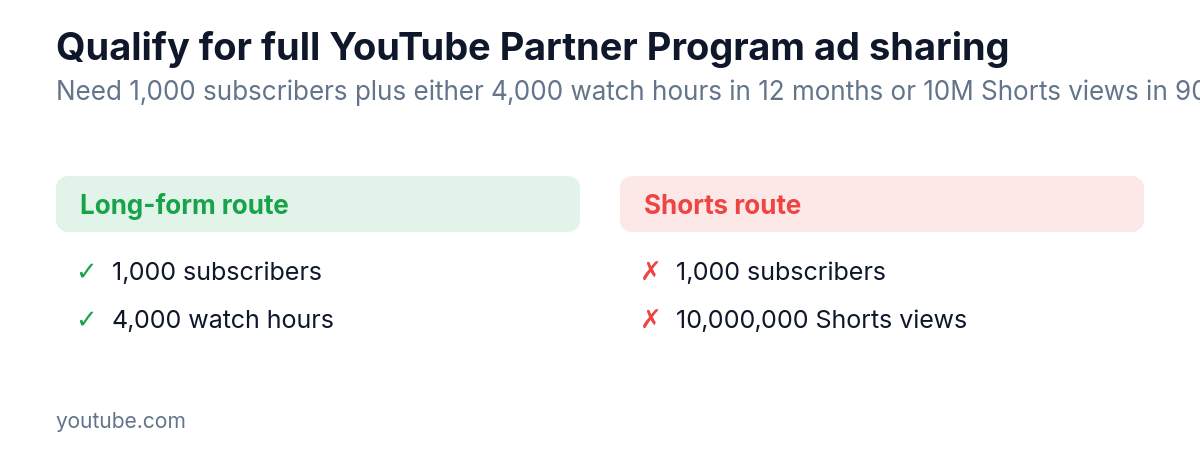
To get full YouTube Partner Program ad sharing, creators need 1,000 subscribers plus either 4,000 watch hours in the past 12 months or 10 million Shorts views in 90 days.
These thresholds exist to filter out inactive or low-effort channels. They are not particularly high bars for a channel with consistent output, but they do mean that brand-new channels earn nothing from ads regardless of view counts.
Once accepted, creators gain access to ad revenue sharing, channel memberships, Super Chat, and other monetization features. The ad revenue piece is just one part of the program.
Can Ad Revenue Alone Support a Living?
For most creators, the honest answer is: not easily, and not quickly.
The channels that earn full-time income from YouTube ads alone tend to share a few characteristics. They publish frequently, often multiple times per week. They operate in niches with strong advertiser demand. They have built audiences over years, not months. And they have reached view counts that most channels never approach.
A more realistic path to sustainable YouTube income combines ad revenue with other streams. Sponsorships often pay more per video than the ads running against it. Merchandise, courses, memberships, and affiliate links all add revenue that does not depend on view counts. Many creators find that ad revenue is the smallest piece of their income by the time they are earning enough to live on.
That said, ad revenue has one significant advantage: it is passive. Once a video is published and ranking, it can generate income for years without additional work. A library of well-performing videos can produce a meaningful baseline income even when a creator takes time off.
What Creators Can and Cannot Control
Creators have almost no control over CPM. They cannot negotiate ad rates, choose which advertisers appear on their videos, or influence the auction in any direct way.
What they can influence is RPM indirectly, through content decisions. Publishing in a higher-CPM niche, building an audience in high-value geographies, and creating content that attracts engaged viewers rather than passive ones all push RPM upward over time. These are slow levers, not quick fixes.
Creators can also influence the ratio of monetized views to total views by encouraging viewers to watch without ad blockers, though this is a difficult ask. More practically, enabling mid-roll ads on longer videos increases the number of ad impressions per view, which raises effective RPM.
Video length matters here. Mid-roll ad eligibility kicks in at eight minutes, so a ten-minute video can carry two or three ad breaks while a five-minute video carries only pre-roll ads. This is one reason many creators aim for videos in the ten-to-fifteen minute range.
Reading Your Own Analytics
YouTube Studio provides both CPM and RPM data in the Revenue tab. Creators can see how these figures change by video, by time period, and by traffic source.
A few patterns worth watching:
- RPM tends to be higher on videos that attract search traffic than on videos that go viral through recommendations. Search viewers are often in a specific mindset, which advertisers value.
- Longer watch times correlate with higher ad revenue because more ad breaks complete.
- YouTube Shorts RPMs are consistently below $0.20, compared to average long-form RPMs of $3 to $6, according to creators who have reported their figures to Digiday. Shorts monetization exists but operates under a different revenue-sharing structure.
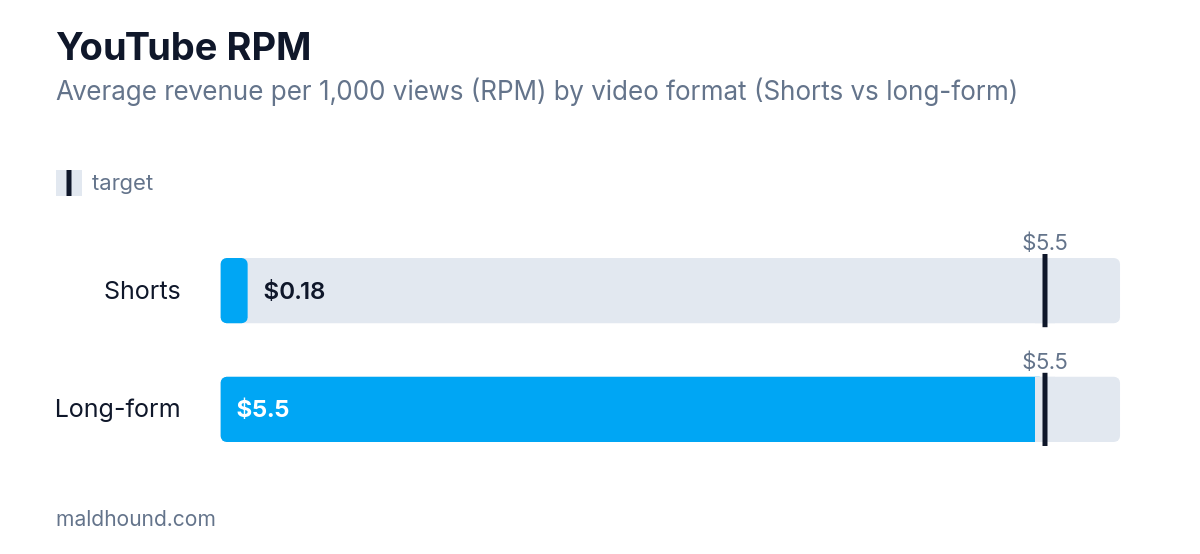
YouTube Shorts earn about $0.18 per 1,000 views, far less than long‑form videos at about $5.50 per 1,000 views because Shorts use a different revenue‑sharing structure.
Tracking these numbers over time reveals which content types actually generate revenue versus which generate views. The two are not always the same channel.
The Bigger Picture
YouTube's ad model rewards creators who build specific, engaged audiences in categories advertisers care about. It does not particularly reward raw popularity. A channel with 500,000 subscribers in a finance niche can out-earn a channel with 5 million subscribers in general entertainment.
This means the strategic question for any creator thinking about revenue is not just "how do I get more views" but "what kind of views am I getting, and who is watching?" Those questions shape everything downstream: the niche, the content format, the audience geography, and ultimately the RPM.
Ad revenue is real money, and for channels that have built substantial libraries in the right categories, it can be significant. But it is one piece of a larger system, and understanding how it actually works is the first step toward building something sustainable around it.