How to Monetize Your YouTube Channel in 2025: Every Revenue Stream Explained
The creator economy has shifted. Five years ago, most YouTube creators relied almost entirely on AdSense revenue. Today, according to 1of10, top creators typically earn from 4-7 different monetization methods simultaneously. Some mid-sized creators now make more money in a single two-hour live stream than from an entire month of ads.
This guide breaks down every monetization path available to YouTube content creators in 2025. Whether you are just starting or looking to diversify your income, you will learn the requirements, earning potential, and practical strategies for each revenue stream.
The YouTube Partner Program: Your Foundation
The YouTube Partner Program (YPP) unlocks most platform-native monetization features. Understanding the requirements and what you gain access to is the first step.
Standard YPP Requirements
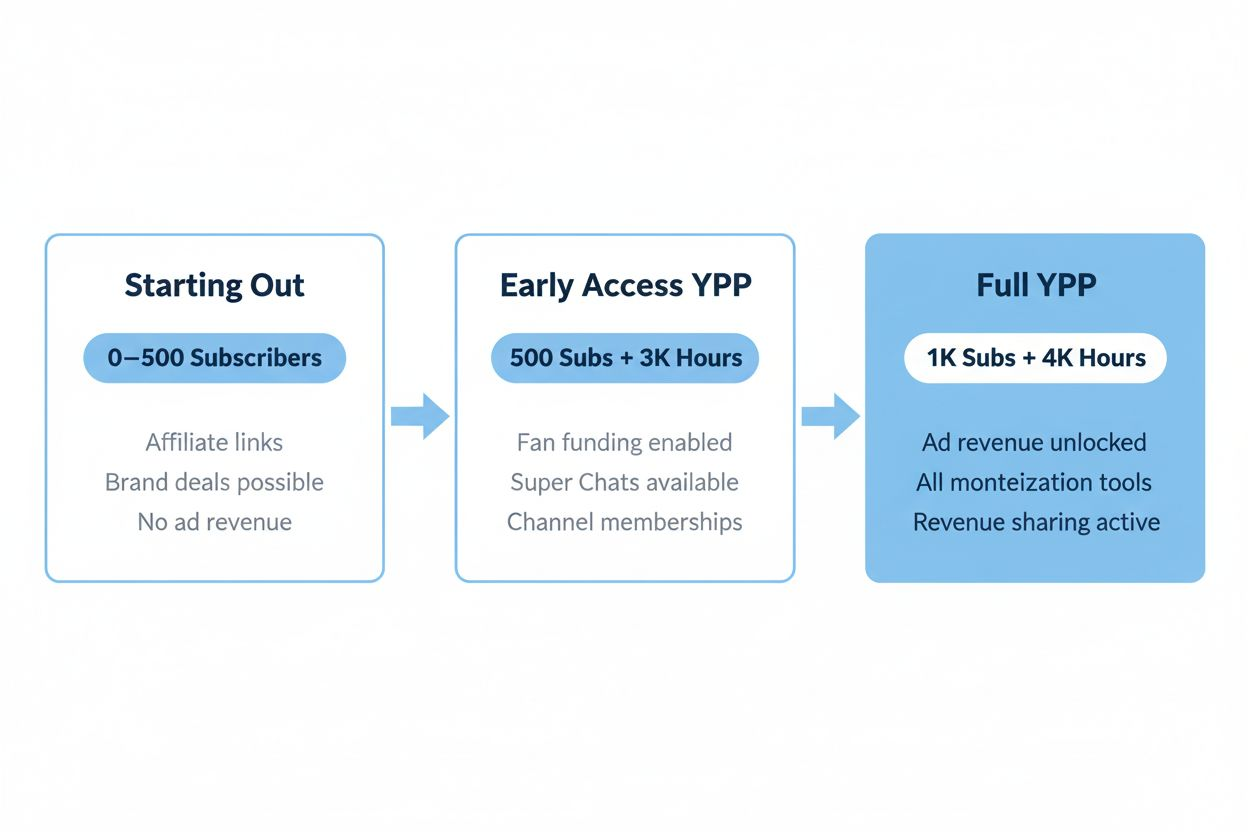
According to Influencer Marketing Hub, to qualify for YPP in 2025 you need at least 1,000 subscribers and either 4,000 watch hours in the past 12 months or 10 million Shorts views in 90 days. You also need to follow YouTube's monetization policies and live in a country where YPP is available.
Once accepted, you gain access to ad revenue, channel memberships, Super Chat, Super Thanks, and YouTube Premium revenue. The revenue split is straightforward: creators keep 55%, YouTube takes 45% of ad revenue, according to 1of10.
Early Access Tier
YouTube introduced a lower entry point. Onewrk reports that the early-access YPP tier requires only 500 subscribers plus 3,000 watch hours or 3 million Shorts views. This tier gives access to limited features like Super Chat, Super Thanks, and channel memberships, but not full ad revenue.
This creates a path for smaller creators to start earning while building toward full YPP status.
What Ad Revenue Actually Pays
Expectations need to match reality. InVideo notes that YouTube pays creators between $2-$12 per 1,000 views depending on niche and audience location. Finance, business, and technology channels typically earn on the higher end. Gaming and entertainment often fall lower.
YouTube Shorts pay significantly less. According to InVideo, YouTube Shorts RPM ranges from $0.01 to $0.16 per 1,000 views. Generally, around 500,000 views are needed to earn $1,000 from a YouTube channel.
The math is simple but sobering. A channel getting 100,000 views per month at $5 CPM earns $500 from ads. That is why diversification matters.
Brand Sponsorships: The Highest-Earning Revenue Stream
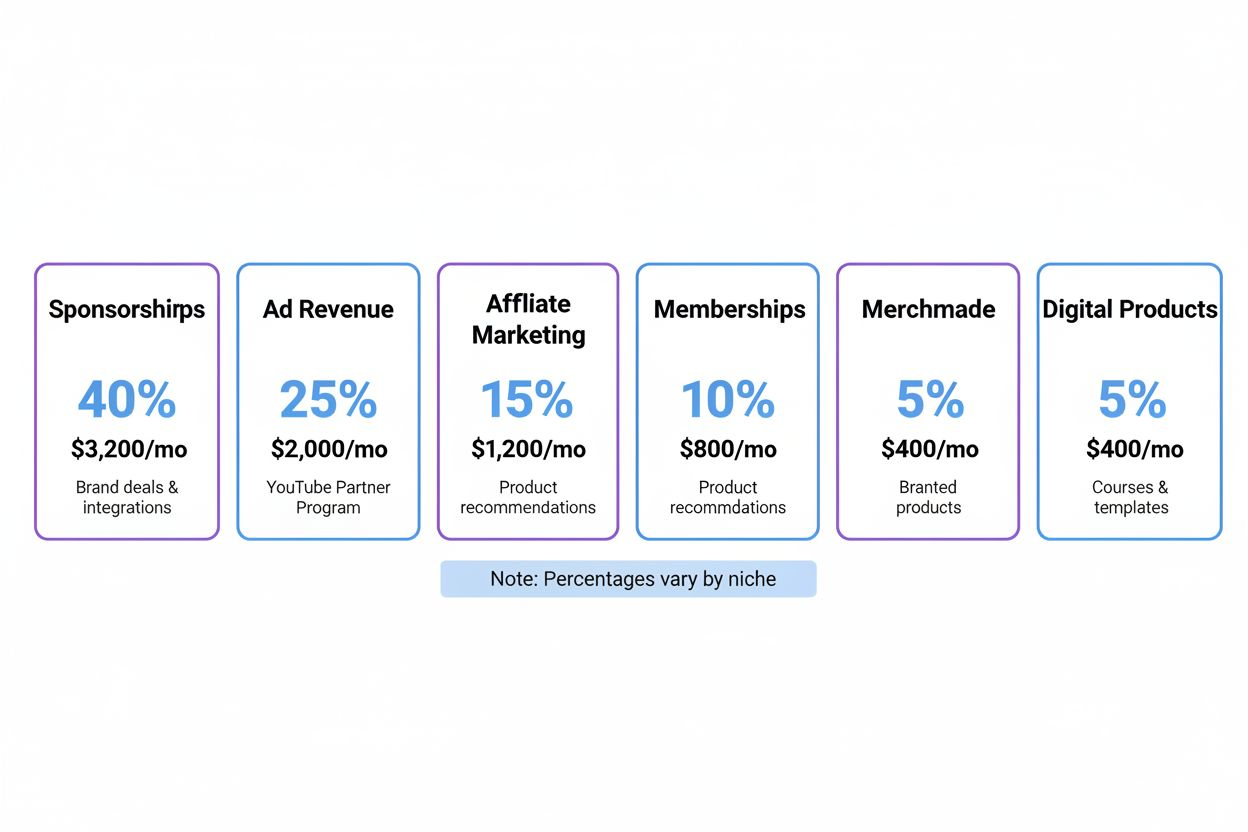
For most creators with engaged audiences, sponsorships outpace ad revenue significantly. A single sponsored video can earn what a month of ads pays.
How Sponsorships Work
Brands pay creators to feature their products or services in videos. Payment structures vary: flat fees per video, affiliate commissions, or hybrid models combining both.
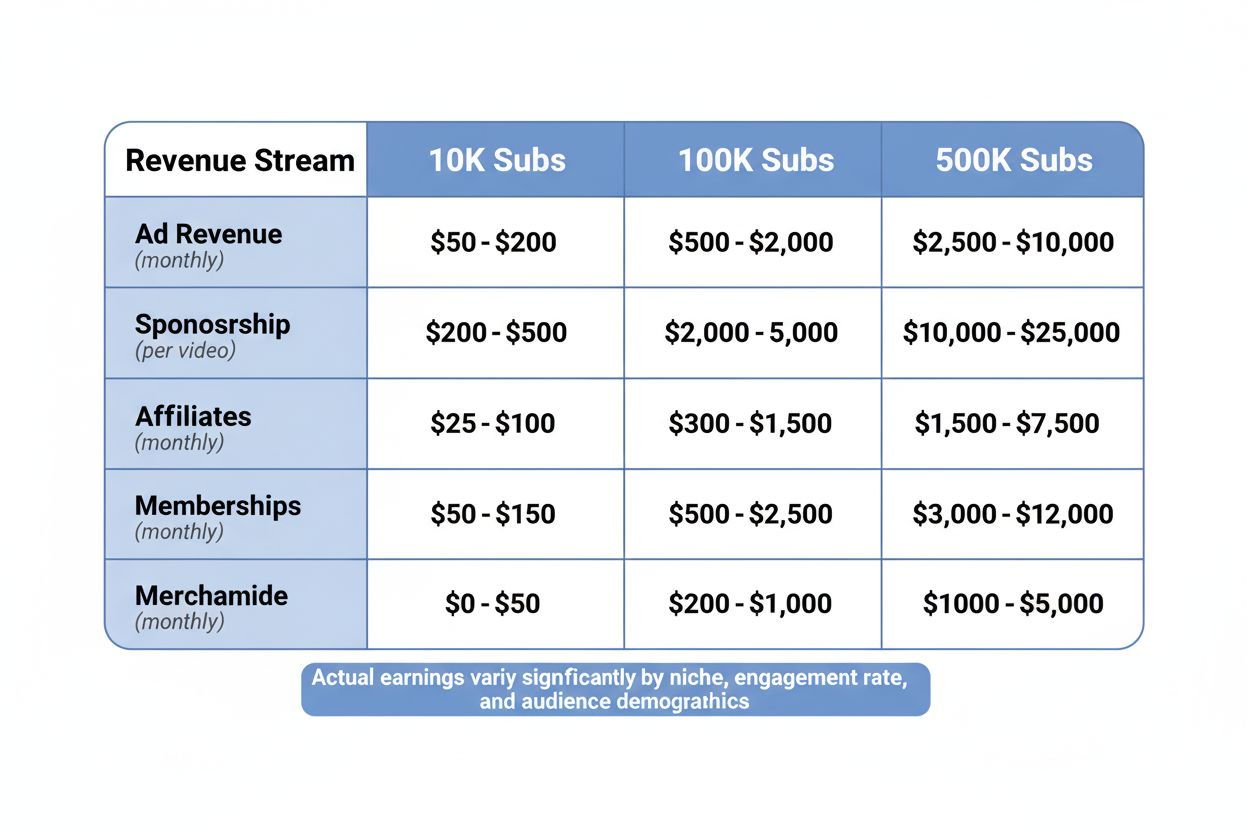
Rates depend on your niche, engagement rate, and audience demographics. A creator with 50,000 subscribers in a high-value niche like personal finance might charge $2,000-$5,000 per integration. A creator with 500,000 subscribers in a lower-value niche might charge the same or less.
Finding Sponsors
Three main approaches work:
Direct outreach to brands you already use and genuinely like produces the most authentic partnerships. Create a media kit with your channel stats, audience demographics, and past performance data. Email brands explaining why your audience would value their product.
Sponsorship platforms like Grapevine, AspireIQ, and FameBit connect creators with brands actively seeking partnerships. These platforms handle contracts and payments but take a commission.
Inbound requests happen once you reach a certain size. Brands will email you directly. Vet these carefully. Some are legitimate, others are scams or offer terrible rates.
Making Sponsorships Work
Disclose all sponsorships clearly. Say "This video is sponsored by X" at the beginning. Use YouTube's paid promotion disclosure feature.
Only promote products you have tested and would recommend without payment. Your audience trusts you. One bad sponsorship can damage that trust permanently.
Negotiate usage rights carefully. Brands often want to repurpose your content for their own marketing. Charge extra for this or limit how they can use your footage.
Affiliate Marketing: Passive Income That Compounds
Affiliate marketing pays you commissions when viewers buy products through your links. Unlike sponsorships, you do not need brand approval upfront.
How Affiliate Programs Work
You join an affiliate program, get a unique tracking link, and share it in video descriptions or pinned comments. When someone clicks your link and makes a purchase, you earn a percentage.
Amazon Associates is the most common starting point. Commissions range from 1-10% depending on product category. Electronics pay 1-2%, luxury beauty pays 10%.
Higher-paying programs exist in specific niches. Web hosting affiliates often pay $50-$200 per signup. Software companies pay 20-30% recurring commissions for subscription products. Financial services pay $100+ for qualified leads.
Strategic Affiliate Integration
Product reviews and comparison videos convert well. Viewers watching these videos are already in buying mode. A detailed, honest review of a $1,000 camera that drives 50 sales at 3% commission earns $1,500.
Tutorial videos where you use specific tools create natural affiliate opportunities. A video teaching Photoshop techniques can link to Adobe's affiliate program. A cooking video can link to the exact ingredients and equipment used.
Resource lists and "tools I use" videos provide ongoing value. Create a video showing your entire content creation setup with affiliate links for each item. This video earns commissions for years.
Disclosure and Trust
Always disclose affiliate relationships. Add "Links in the description may be affiliate links" to your standard description template.
Only recommend products you have used. Promoting junk for commissions destroys credibility faster than anything else.
Track which products and video types convert best. Double down on what works.
Channel Memberships: Recurring Revenue from Your Biggest Fans
Channel memberships let viewers pay a monthly fee for perks like custom badges, emojis, members-only posts, and exclusive content.
Membership Requirements and Setup
You need to be in the YouTube Partner Program to offer memberships. YouTube takes 30% of membership revenue, you keep 70%.
Set up membership tiers with different price points and perks. Common structures:
- $4.99/month: Badge, custom emojis, members-only community posts
- $9.99/month: Everything above plus early access to videos
- $24.99/month: Everything above plus monthly members-only live streams
What Makes Members Join
Exclusive content is the strongest draw. Behind-the-scenes footage, extended cuts, or members-only videos give people a reason to pay.
Community access matters for some audiences. Members-only posts and live chats create a VIP space.
Supporting the creator directly appeals to your most engaged viewers. Some people join just to help you keep making content.
Realistic Membership Numbers
Expect 1-3% of your regular viewers to become members. A channel with 50,000 subscribers and 20,000 regular viewers might have 200-600 members.
At $4.99/month, 400 members generate $2,000 monthly revenue before YouTube's cut. After the 30% fee, you keep $1,400.
Retention is harder than acquisition. You need to consistently deliver value to keep members subscribed.
Super Chat, Super Thanks, and Live Stream Monetization
Live streams open additional revenue opportunities through real-time viewer contributions.
Super Chat and Super Stickers
During live streams, viewers can pay to have their messages highlighted in the chat. Messages stay pinned for different durations based on payment amount, from $1 (pinned briefly) to $500 (pinned for hours).
Super Stickers work similarly but use animated images instead of text.
YouTube takes 30%, you keep 70%. Some creators earn hundreds or thousands of dollars during a single live stream from Super Chats alone.
Super Thanks
Super Thanks lets viewers tip on regular uploaded videos, not just live streams. A "Thanks" button appears below the video. Viewers can choose to pay $2, $5, $10, or $50. They get a highlighted comment in return.
This works well for tutorial content, helpful guides, or any video that provides significant value. Viewers who solve a problem using your video often want to say thanks with money.
Maximizing Live Stream Revenue
Stream consistently on a schedule. Regular viewers show up and are more likely to contribute.
Acknowledge contributions immediately. Thank people by name when they send Super Chats. This encourages others to participate.
Create interactive content. Q&A sessions, live reactions, and collaborative activities keep viewers engaged longer.
According to 1of10, some mid-sized creators now make more money in a single two-hour live stream than from an entire month of ads. This happens when you build an engaged community that values real-time interaction.
YouTube Premium Revenue: Passive Income from Subscribers
YouTube Premium subscribers pay for an ad-free experience. YouTube distributes part of their subscription fees to creators based on watch time.
You earn Premium revenue automatically once you are in YPP. No setup required.
The amount varies but typically exceeds what you would have earned from ads on those views. Premium subscribers tend to watch more content, increasing your total Premium revenue.
This is truly passive. You create content, Premium subscribers watch it, you get paid. The revenue appears in your YouTube Studio analytics alongside ad revenue.
Merchandise and Product Sales
Selling physical or digital products directly to your audience keeps 100% of the profit margin after production costs.
YouTube Shopping Integration
Onewrk notes that YouTube has partnered with Shopify and other e-commerce platforms for deeper shopping integrations. You can tag products directly in videos, and a shopping shelf appears below your content.
This works for physical merchandise (t-shirts, hoodies, mugs), digital products (presets, templates, courses), or products you create related to your niche.
What Sells Well
Niche-specific products outperform generic merchandise. A woodworking channel selling custom-designed woodworking templates will do better than selling generic t-shirts with their logo.
Products that extend your content perform well. A fitness creator selling workout programs, a photographer selling Lightroom presets, a musician selling sample packs.
Limited editions and drops create urgency. Release new designs quarterly rather than having everything available all the time.
Production and Fulfillment
Print-on-demand services like Printful, Printify, or Teespring handle production and shipping. You upload designs, they handle everything else. Profit margins are lower but you have no upfront costs or inventory risk.
Manufacturing your own products gives higher margins but requires upfront investment and inventory management. This makes sense once you have proven demand.
Digital products have the best margins. A $50 Lightroom preset pack costs nothing to produce after the initial creation. Every sale is nearly pure profit.
Courses, Coaching, and Digital Products
If your channel teaches skills or knowledge, courses and coaching can become your primary revenue source.
Online Courses
Create a comprehensive course teaching what your channel covers in depth. A YouTube channel about graphic design might offer a $200 course teaching complete beginners how to become freelance designers.
Host courses on platforms like Teachable, Thinkific, or Kajabi. These platforms handle payment processing, content delivery, and student management.
Promote your course in relevant videos. A video about logo design tips can end with "If you want to learn my complete logo design process, check out my course linked below."
One-on-One Coaching
Coaching works well for channels in business, fitness, music, or any skill-based niche. Charge $100-$500+ per hour depending on your expertise and results you help people achieve.
Limit coaching spots to maintain quality and create scarcity. Offering 5 coaching slots per month at $300 each adds $1,500 monthly revenue.
Digital Downloads
Templates, presets, stock footage, music, worksheets, or any digital asset your audience needs can be sold as one-time purchases.
Price these lower than courses ($10-$50) but sell them to a larger percentage of your audience. A $20 template pack that 100 people buy monthly generates $2,000.
Crowdfunding and Direct Support
Platforms like Patreon, Ko-fi, and Buy Me a Coffee let viewers support you directly with monthly subscriptions or one-time payments.
Patreon Strategy
Patreon works best when you offer exclusive content or perks that YouTube memberships cannot provide. Extended videos, patron-only podcasts, monthly video calls, or input on future content.
Tier your offerings. A $5 tier with basic perks, a $15 tier with more access, a $50 tier with significant benefits.
Patreon takes 5-12% depending on your plan, plus payment processing fees. You keep roughly 85-90% of patron payments.
A creator with 200 patrons averaging $10 each earns $2,000 monthly before fees, around $1,700 after.
Ko-fi and Buy Me a Coffee
These platforms focus on one-time tips rather than recurring subscriptions, though they support both models.
They work well for creators who want to accept support without the pressure of maintaining exclusive content for subscribers.
Fees are lower than Patreon. Ko-fi charges 0% platform fees on one-time donations (only payment processing fees of about 3%).
Building a Diversified Income Strategy
The creators earning sustainable full-time income rarely rely on a single revenue stream.
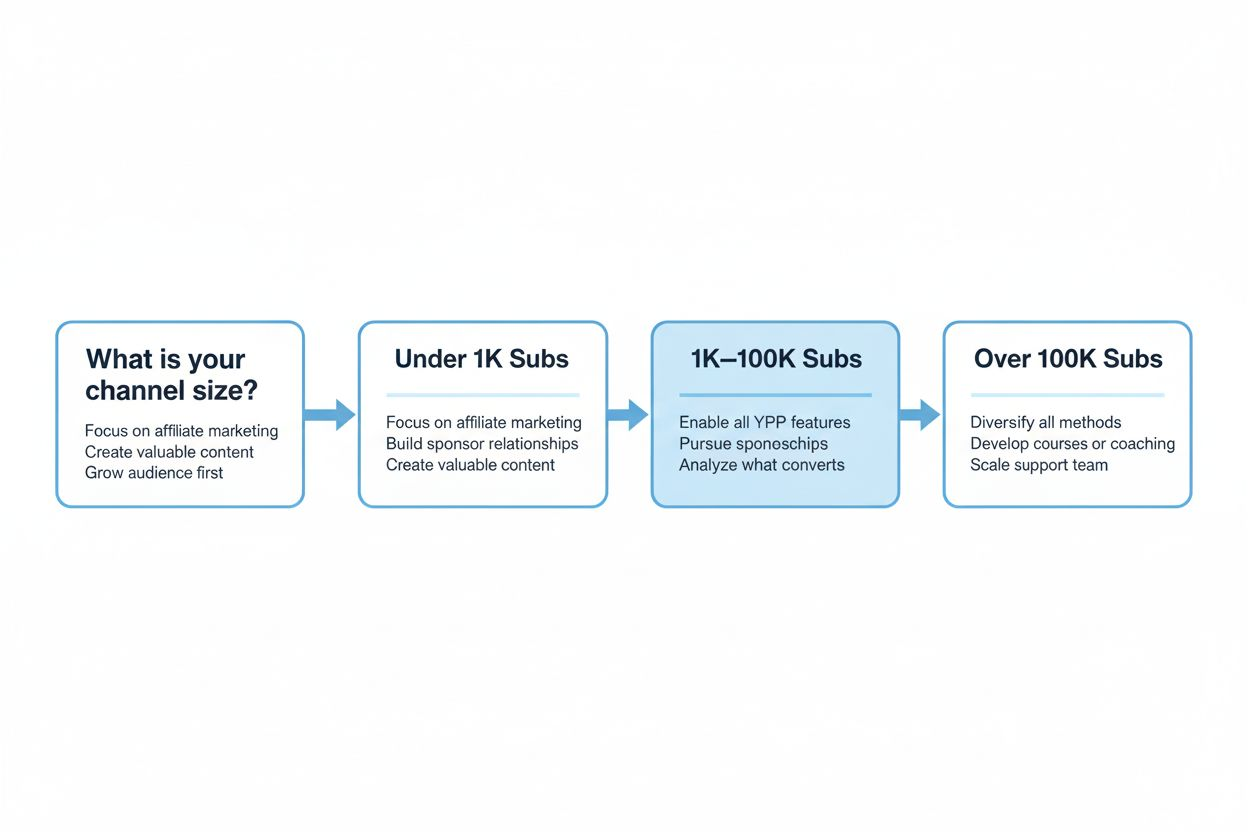
Start with What You Can Control
Before you qualify for YPP, focus on affiliate marketing and building relationships with potential sponsors. These do not require YouTube's approval.
Create valuable content that solves problems. This positions you for sponsorships and makes affiliate recommendations more effective.
Add Revenue Streams as You Grow
Once you hit YPP requirements, enable all available features. Ads, memberships, Super Thanks. More options mean more ways for viewers to support you.
Test merchandise once you have an engaged audience of at least 10,000 subscribers. Start with one or two designs to gauge interest.
Develop courses or coaching once you have proven expertise and people asking how to learn from you directly.
The Long-Term Value of YouTube Content
According to 1of10, unlike TikTok or Instagram, YouTube videos keep earning for years after upload. A tutorial video you create today can generate ad revenue, affiliate commissions, and course sales for the next five years.
This compounding effect makes YouTube uniquely valuable for creators. Every video becomes a long-term asset.
Understanding Your Niche and Audience Value
Not all views are equal. Where your audience lives and what topics you cover dramatically impact earnings.
High-Value Niches
Finance, business, technology, and B2B software channels earn the highest ad rates. Advertisers in these spaces pay more because their customers are worth more.
A personal finance channel might earn $15-$25 per 1,000 views from ads. The same view count on a gaming channel might earn $2-$4.
Audience Location Matters
Views from the United States, Canada, United Kingdom, and Australia pay significantly more than views from other countries. Advertisers pay more to reach these audiences.
A channel with 80% U.S. viewers will earn substantially more than a channel with 80% viewers from countries with lower advertising rates.
Engagement Over Raw Views
A channel with 50,000 highly engaged subscribers in a valuable niche can earn more than a channel with 500,000 disengaged subscribers in a low-value niche.
Comments, likes, shares, and watch time signal engagement. Engaged audiences buy products, join memberships, and support creators directly.
The Business Side: Taxes, Contracts, and Legal Protection
Earning money from YouTube means running a business. Handle it professionally from the start.
Business Structure
Decide whether to operate as a sole proprietor or form an LLC. An LLC provides legal protection and can offer tax benefits. Consult with an accountant familiar with creator businesses.
Track Everything
Use accounting software like QuickBooks or Wave to track all income and expenses. Equipment, software subscriptions, props, travel for content, home office space - all are potentially deductible business expenses.
Set aside 25-30% of your income for taxes if you are in the United States. YouTube does not withhold taxes. You are responsible for quarterly estimated tax payments.
Sponsorship Contracts
Always get sponsorship agreements in writing. The contract should specify deliverables, payment amount, payment timeline, usage rights, and exclusivity terms.
Never give brands unlimited usage rights to your content without significant additional payment. Your content has value beyond the single sponsored video.
Review contracts carefully. If a brand wants you to sign away your right to work with competitors for a year, that exclusivity should cost extra.
Protect Your Channel
Enable two-factor authentication on your Google account. Channels get hacked and held for ransom.
Back up your video files. Do not rely solely on YouTube's servers.
Understand copyright. Use only music and footage you have rights to. A copyright strike can demonetize your channel or get it terminated.
The Reality of Making Money on YouTube in 2025
The opportunity is real but the path is not easy or quick.
According to Influencer Marketing Hub, 65.1% of marketers plan to increase their YouTube budgets in 2025. Brands are investing more in creator partnerships. The platform continues evolving with new features like Shorts, Shopping Collections, and improved monetization tools.
But most creators never reach monetization thresholds. Of those who do, most earn modest supplemental income, not full-time salaries.
The creators who succeed treat YouTube as a business from day one. They focus on providing value, building genuine audience relationships, and diversifying income streams.
They understand that the first 1,000 subscribers take longer than the next 10,000. They know that their first sponsored deal will pay less than their tenth. They accept that some videos flop and others unexpectedly succeed.
Your Next Steps
If you are not yet monetized, focus on creating the best content you can in a specific niche. Consistency and quality beat sporadic viral attempts.
Study channels similar to yours that are successfully monetized. What topics do they cover? How do they structure videos? What monetization methods do they use?
If you are newly monetized, enable every YPP feature immediately. Test what works for your specific audience.
If you are established, audit your revenue streams. Are you leaving money on the table by ignoring sponsorships, affiliates, or products? Could you earn more by focusing on your highest-performing revenue source?
The YouTube creator economy in 2025 offers more monetization paths than ever before. The question is not whether you can make money, but which combination of methods works for your channel, your audience, and your goals.