YouTube Shorts vs Long-Form Video: Which Format Grows Your Channel Faster in 2025

You have 20 hours a week to create YouTube content. Should you spend it making three polished 15-minute videos or cranking out 30 Shorts? The answer determines whether you gain 100 subscribers this month or 1,000.
The format war between YouTube Shorts and long-form video is not about which one is "better." It is about which one matches your growth goals, audience behavior, and production capacity. The data from 2024 and early 2025 reveals patterns that most creators miss when choosing where to invest their time.
The Raw Numbers: Shorts Dominate Views, Long-Form Dominates Watch Time
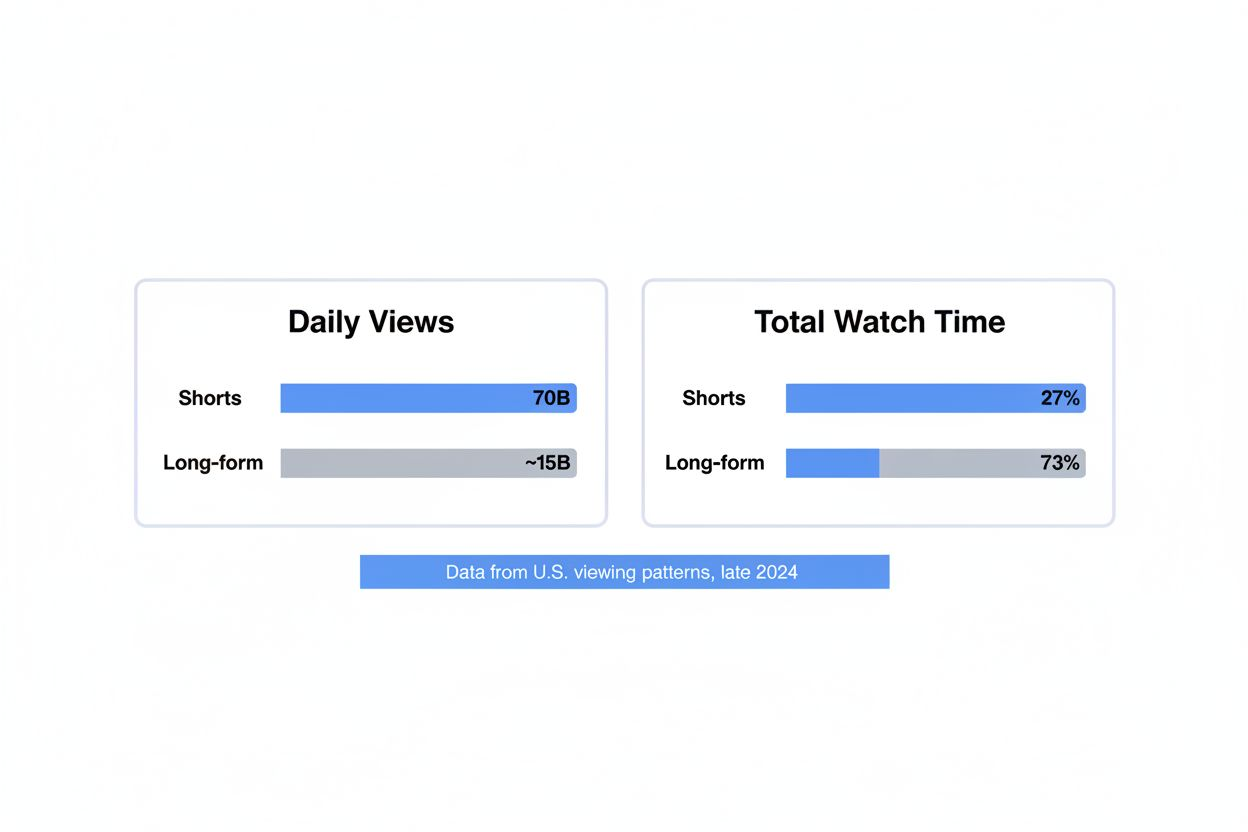
According to Magic Hour, YouTube Shorts averaged over 70 billion daily views in 2024. That number dwarfs the view counts on traditional videos. But views alone do not tell the complete story.
The same research shows that longer content (30+ minutes) accounted for 73% of overall viewing time on YouTube in the U.S. toward the end of 2024. This creates a paradox: Shorts get clicked more often, but long-form videos keep people watching.
The engagement rate data adds another layer. Magic Hour reports that YouTube Shorts has an average engagement rate of 5.91%, outperforming TikTok (5.75%) and Instagram Reels (5.53%). For creators focused on likes, comments, and shares per view, Shorts deliver better percentages.
But engagement rate measures interactions divided by views. A Short with 100,000 views and 5,910 engagements has a strong rate. A long-form video with 10,000 views and 400 engagements has a weaker rate (4%) but might convert more viewers into subscribers who actually watch your future content.
How Each Format Affects Subscriber Growth
Half of marketers reported gaining new subscribers from YouTube Shorts, according to Magic Hour. That sounds promising until you examine what type of subscribers Shorts attract.
Linkin Tech SEO notes that Shorts are excellent for discoverability but their audience often has a shorter attention span. A viewer who subscribes after watching a 45-second Short may never watch your 20-minute tutorials. They subscribed on impulse, not commitment.
Long-form content attracts fewer subscribers per view, but those subscribers tend to be more engaged. Someone who watches 18 minutes of your 22-minute video before subscribing has demonstrated genuine interest in your topic and presentation style. They are more likely to watch your next upload.
This creates two distinct growth paths:
Shorts path: High volume of subscribers, lower percentage who watch future content, requires constant production to maintain momentum
Long-form path: Lower volume of subscribers, higher percentage who become regular viewers, builds a more stable audience base over time
Your choice depends on whether you want a large audience with shallow engagement or a smaller audience with deep engagement. Neither is wrong, but they require different content strategies and production schedules.
The Algorithm Treats These Formats Differently
YouTube's 2025-2026 algorithm updates emphasized viewer retention over raw watch time, according to InfluenceFlow. This shift affects how each format gets recommended.
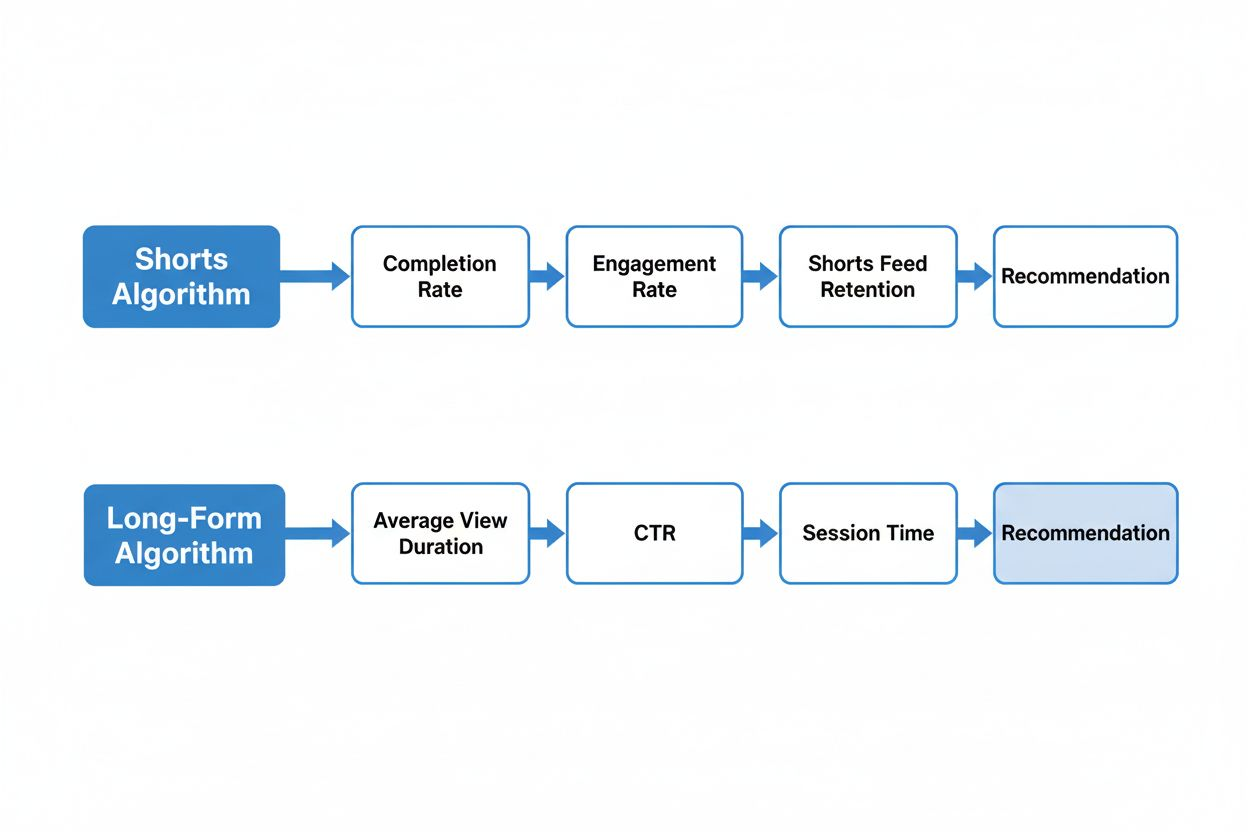
For Shorts, the algorithm looks at completion rate (did viewers watch all 60 seconds?), engagement rate, and whether viewers watch multiple Shorts in a row. A Short that keeps viewers in the Shorts feed for 10 more videos performs better than one that sends them back to the home page.
For long-form content, the algorithm examines average view duration, click-through rate from thumbnails, and whether viewers watch another video from your channel afterward. A 30-minute video where viewers watch 12 minutes on average signals quality content worth recommending.
The keyword strategies differ too. InfluenceFlow found that YouTube Shorts require different keywords than long-form content. Shorts rank based on audio, hashtags, and hashtag-search combinations. Long-form videos rank based on titles, descriptions, and traditional SEO signals.
Yet 67% of creators use identical keyword strategies for both Shorts and long-form, according to the same source. They waste optimization potential by treating fundamentally different formats the same way.
Traffic Generation: Where Shorts Actually Win
One in three marketers saw a 15%-25% boost in web traffic from YouTube Shorts, while half reported gaining new subscribers, according to Magic Hour. This makes Shorts particularly effective for driving viewers to external websites, landing pages, or product pages.
The mechanism is simple: Shorts get more views, and even a low conversion rate (1-2% of viewers clicking your link) generates significant traffic when you are getting 50,000 views per Short.
Long-form videos convert viewers at higher rates (3-5% might click a link in the description), but they get fewer total views. The math often favors Shorts for raw traffic volume, especially in the first 48 hours after posting.
InfluenceFlow notes that 35% of YouTube traffic still originates from search queries. Long-form videos dominate search results because they can target specific, detailed queries. A 15-minute video titled "How to Fix Error Code 0x80070057 in Windows 11" will rank for that search. A 60-second Short will not.
This creates a strategic split: use Shorts for immediate traffic spikes and brand awareness, use long-form for sustained search traffic over months or years.
Production Time vs. Output: The Real Cost Comparison
A quality 10-minute YouTube video requires:
- 2-3 hours of scripting and research
- 1-2 hours of filming
- 3-5 hours of editing
- 30 minutes for thumbnail creation
- Total: 7-11 hours per video
A quality 60-second Short requires:
- 15-30 minutes of concept development
- 30-60 minutes of filming (often multiple takes)
- 1-2 hours of editing
- Total: 2-3.5 hours per Short
With 20 hours of production time per week, you could create:
- Two long-form videos
- Six to seven Shorts
- One long-form video and three Shorts (hybrid approach)
The hybrid approach is what Linkin Tech SEO recommends: use Shorts as a top-of-funnel tool to introduce your brand, then drive viewers to long-form content. This strategy captures the discoverability advantage of Shorts while building the engaged audience that long-form content creates.

Business Type Matters: B2C vs. B2B Content Strategies
According to Magic Hour, 30% of B2C businesses use short-form video as part of their content strategy, and 19% leverage long-form video. This split reflects the different goals and audience behaviors in consumer markets.
B2C brands often prioritize:
- Brand awareness over education
- Impulse engagement over considered decisions
- Entertainment value over information depth
- Viral potential over search rankings
These goals align naturally with Shorts. A fashion brand showing a 30-second outfit transformation, a food company sharing a quick recipe, or a fitness app demonstrating a single exercise all work better in short-form.
B2B brands typically need:
- Detailed explanations of complex products
- Trust-building through demonstrated expertise
- SEO rankings for industry-specific searches
- Lead generation from engaged, qualified viewers
These goals favor long-form content. A SaaS company explaining their workflow automation, a consulting firm breaking down industry regulations, or a B2B service provider showing case study results all require more than 60 seconds.
Your business model should influence your format choice more than generic advice about "what works on YouTube."
The Hybrid Strategy: How to Use Both Formats Together
The most effective approach treats Shorts and long-form as complementary, not competing formats. Here is how to structure a hybrid strategy:
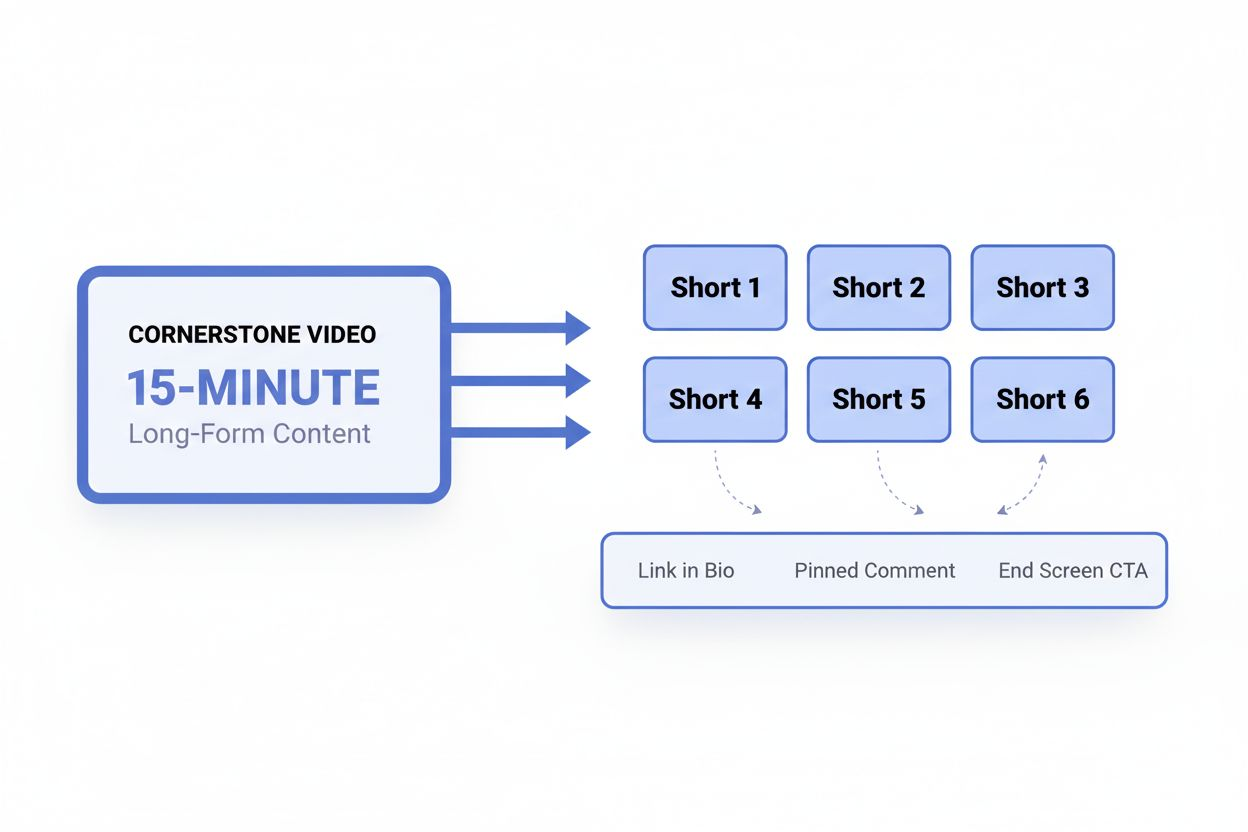
Step 1: Create your long-form cornerstone content
Film a comprehensive 15-25 minute video on your main topic. This becomes your SEO asset and authority piece. Optimize it for search with detailed titles, descriptions, and timestamps.
Step 2: Extract 5-8 Shorts from that long-form video
Identify the most engaging 45-60 second segments: surprising statistics, controversial opinions, quick tips, common mistakes, or emotional moments. Edit these as standalone Shorts with hooks that work without context.
Step 3: Use Shorts to drive traffic to the long-form version
In your Short's description or pinned comment, reference the full video: "This is from my complete guide to [topic]. Link in bio." Some viewers will want the full context.
Step 4: Post Shorts on a different schedule
Upload your long-form video on your regular schedule (e.g., Wednesdays). Release the extracted Shorts throughout the week (Monday, Thursday, Saturday). This maintains consistent posting without doubling your production time.
Step 5: Track which Shorts convert viewers
YouTube Analytics shows you which Shorts send viewers to your channel page and which videos they watch next. Double down on the Short topics that successfully convert casual viewers into engaged subscribers.
This approach gives you the discoverability of Shorts (70 billion daily views) and the watch time of long-form content (73% of total viewing time). You are not choosing between formats; you are using each for what it does best.
When to Go All-In on One Format
Some channels should focus exclusively on one format, at least initially.
Go all-in on Shorts if:
- You are building brand awareness from zero
- Your content is inherently visual and does not require explanation (dance, art, quick transformations)
- You can produce high volumes of content quickly
- Your monetization comes from sponsorships or external products, not ad revenue
- Your audience is under 25 and consumes content primarily on mobile
Go all-in on long-form if:
- You are monetizing through YouTube ad revenue (longer videos = more ad placements)
- Your topic requires detailed explanation or demonstration
- You are building authority in a professional field
- You want to rank in YouTube search for specific queries
- Your audience actively searches for solutions to problems
The algorithm heavily favors content that keeps viewers on the platform, according to Linkin Tech SEO. Both formats can achieve this, but through different mechanisms. Shorts keep viewers in the Shorts feed. Long-form keeps viewers watching one video for an extended period.
Measuring Success: Different Metrics for Different Formats
Stop comparing Shorts and long-form videos using the same metrics. They serve different purposes and should be measured differently.
For Shorts, track:
- Total views (volume matters)
- Engagement rate (likes, comments, shares per view)
- Shorts feed retention (how many Shorts viewers watch in sequence)
- Profile visits (how many viewers check out your channel)
- Conversion to long-form (how many watch a full video afterward)
For long-form, track:
- Average view duration (not just percentage, but actual minutes)
- Watch time contribution (total minutes generated)
- Subscriber conversion rate (subscribers per 1,000 views)
- Search traffic percentage (how many viewers found you through search)
- Revenue per video (if monetized)
A Short with 100,000 views and 2% engagement that drives 50 profile visits is successful. A long-form video with 5,000 views and 45% average view duration that generates 3,750 minutes of watch time is also successful. They are achieving different goals.
The 2025 Reality: Shorts Are Not Optional Anymore
Whether you focus primarily on long-form or not, ignoring Shorts entirely puts you at a disadvantage. YouTube Shorts averaged over 70 billion daily views in 2024, according to Magic Hour. That is where a massive portion of new viewers discover channels.
Even channels known for long-form content (educational, documentary-style, in-depth reviews) now post Shorts regularly. They use them as trailers, teasers, or standalone quick tips that complement their main content.
The creators growing fastest in 2025 are not choosing between Shorts and long-form. They are strategically using both, understanding that Shorts bring viewers in and long-form keeps them engaged.
Your production schedule should reflect your capacity and goals, but completely ignoring either format means missing opportunities. Start with one format to build momentum, then gradually incorporate the other as your production process improves.
Making Your Decision: A Framework
Ask yourself these questions:
What is your primary goal right now?
- Brand awareness and reach: Shorts
- Monetization through ads: Long-form
- Building an engaged community: Long-form
- Driving traffic to a website: Shorts
How much production time do you have weekly?
- Under 10 hours: Focus on Shorts
- 10-20 hours: Hybrid approach
- Over 20 hours: Prioritize long-form with Shorts support
What does your audience actually want?
- Quick entertainment: Shorts
- Detailed information: Long-form
- Both (most audiences): Hybrid
What can you consistently produce?
- High volume, lower production value: Shorts
- Lower volume, higher production value: Long-form
- Balanced output: Hybrid
Your answer to these questions matters more than generic statistics about what format is "winning" in 2025. The format that you can execute consistently and that serves your specific audience will always outperform the format that theoretically gets more views.
The data is clear: Shorts get more views and higher engagement rates, but long-form generates more watch time and deeper audience connections. The fastest-growing channels in 2025 are not picking sides. They are using each format for what it does best, creating a content ecosystem that captures attention with Shorts and builds loyalty with long-form videos.