Pros and Cons of YouTube Memberships vs. Patreon
Two Platforms, One Decision That Shapes Your Revenue
Every creator who builds an audience eventually faces the same question: how do I turn this into something sustainable? Ads help, but they are unreliable, algorithm-dependent, and pay fractions of a cent per view. Merchandise requires inventory and logistics. Sponsorships demand constant outreach. That leaves direct fan support, and two platforms dominate that space: YouTube Memberships and Patreon.
They look similar on the surface. Both let fans pay a monthly fee in exchange for exclusive content and perks. But the similarities end there. The fee structures, audience reach, content tools, and creator control differ in ways that matter enormously depending on what kind of creator you are and what you want to build.
This article breaks down both platforms honestly, including the parts that promotional comparisons tend to skip.
How Each Platform Actually Works
YouTube Memberships
YouTube Memberships are built directly into the YouTube platform. Viewers can join a channel by clicking the "Join" button that appears on your channel page or below your videos. Membership tiers can be set at several price points, and YouTube provides a default structure with suggested price levels (typically starting around $0.99 and going up through $4.99, $9.99, $19.99, and beyond, though creators can customize these).
Perks available to members include custom emoji for live chat, loyalty badges that appear next to their name in comments, members-only posts in the Community tab, and members-only live streams or video content. The experience lives entirely within YouTube. Members do not need to create a new account or visit a separate website.
YouTube takes 30% of membership revenue, and separately allocates revenue from subscriptions like YouTube Premium through a YouTube Premium creators' revenue pool that distributes 30% of net Premium revenue (or 60% for Premium Lite) to creators. On mobile (iOS and Android), Apple and Google take their own platform cut first, which means the effective revenue share for creators can be even lower on those transactions.
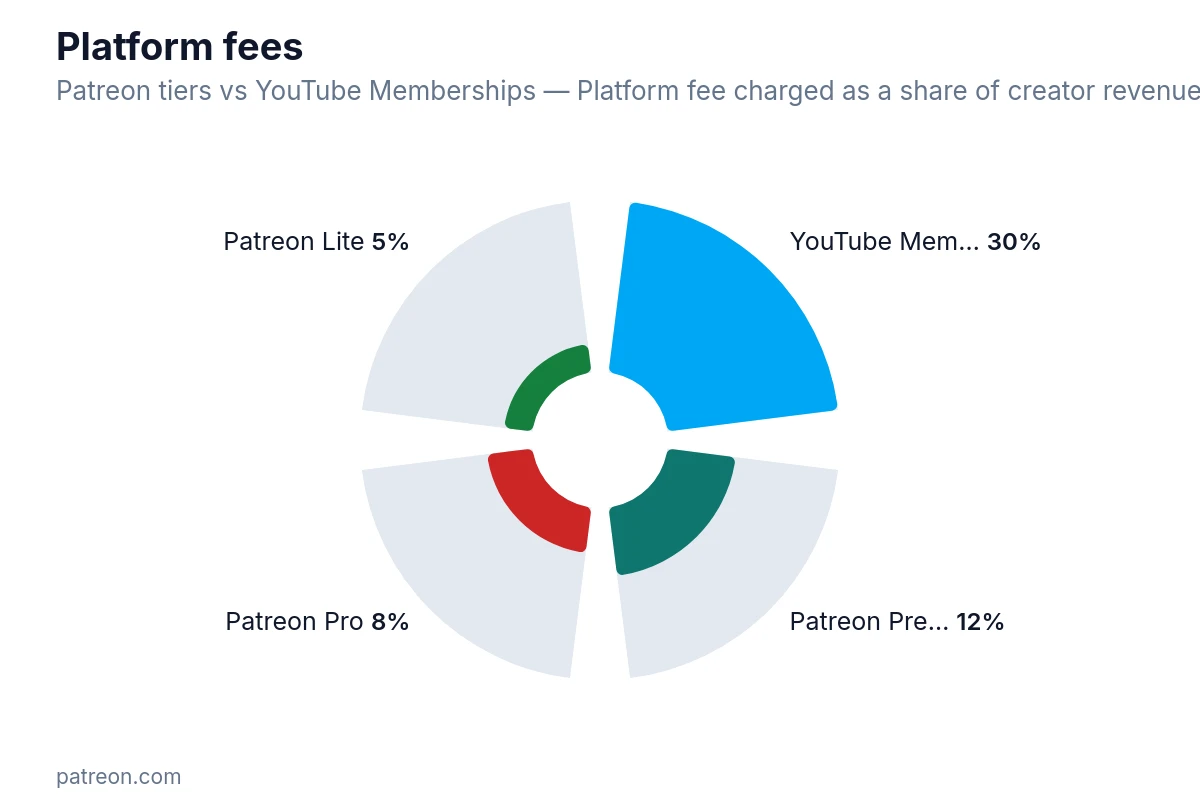
YouTube Memberships take a 30% platform fee, while Patreon’s fees are lower, ranging from 5% for Lite to 12% for Premium before payment processing.
Patreon
Patreon operates as a standalone subscription platform. Creators build a separate page, set their own tiers (called "tiers" or sometimes "membership levels"), and direct their audience there to sign up. Patrons pay monthly or per-creation, depending on how the creator structures it.
The perks on Patreon are more flexible. Creators can offer early access to content, exclusive podcast feeds, Discord server access, physical merchandise, one-on-one calls, downloadable files, written posts, and more. Patreon supports a wide range of content types beyond video.
Patreon's fee structure has changed over the years. Currently, Patreon takes between 5% and 12% of revenue depending on which plan the creator chooses (Lite, Pro, or Premium). Payment processing fees apply on top of that. The Pro plan, which most serious creators use, sits at 8% plus payment processing.
The Discovery Problem (and Why It Matters More Than You Think)
This is the most underappreciated difference between the two platforms.
YouTube Memberships benefit from being embedded in the platform where your audience already watches your content. A viewer finishes a video, sees the "Join" button, and can become a paying member in seconds without leaving YouTube. That friction reduction is significant. Research on checkout abandonment finds that 17% of US online shoppers have abandoned an order because the checkout process was too long or complicated, and the same principle applies to membership sign-ups. Impulse conversions happen because the path from "I like this creator" to "I am paying this creator" is short.
Patreon requires you to drive traffic yourself. You mention it in videos, put it in descriptions, post about it on social media. Your audience has to decide to leave YouTube, go to a different website, create or log into a Patreon account, and then subscribe. Each additional step loses a percentage of potential patrons.
For established creators with highly engaged audiences who actively seek out ways to support them, this friction matters less. For creators still building that level of loyalty, it matters a great deal.
The flip side: Patreon has its own discovery features, including a browse section where potential patrons can find new creators. This is a minor traffic source for most creators, but it exists. YouTube Memberships have no equivalent. If someone is not already watching your channel, they will not find your membership through YouTube's membership system.
Revenue Share: What You Actually Keep
The fee difference between platforms is real, but it requires some context to understand properly.
YouTube's 30% cut is fixed. There is no negotiation, no tier system, no way to reduce it. On top of that, mobile transactions through the App Store or Google Play add another layer of platform fees before YouTube takes its share, meaning the creator's effective cut on some transactions can drop below 50%.
Patreon's fees are lower in percentage terms, but the structure is more complex. The Lite plan (5%) limits what features you can access. The Pro plan (8%) is where most creators land. The Premium plan (12%) is aimed at larger operations that want dedicated support and advanced features. Payment processing adds roughly 2-3% on top, varying by transaction size and currency.
For a creator earning $1,000 per month from memberships:
- YouTube Memberships: roughly $700 after the 30% cut (less on mobile transactions)
- Patreon Pro: roughly $870-880 after the 8% platform fee and processing
That gap compounds over time. At $5,000 per month, the difference is several hundred dollars every month. At $10,000 per month, it becomes a meaningful annual income difference.
Content Flexibility and What You Can Actually Offer
Patreon was built to support many types of creators: musicians, writers, podcasters, visual artists, video creators, and more. The platform reflects that. You can post written updates, audio files, image galleries, video content, downloadable PDFs, and links to external content. You can create tiers that offer physical rewards. You can run polls, send messages to patrons, and integrate with tools like Discord to give patrons access to private servers.
YouTube Memberships are more constrained. Your perks are essentially limited to what YouTube's platform supports: custom emoji, loyalty badges, members-only posts in the Community tab, and members-only video content. If your exclusive content strategy involves anything outside of video and text posts, YouTube Memberships cannot deliver it natively.
For video-first creators whose exclusive content is primarily more video, this limitation may not matter much. For a musician who wants to offer stems, sheet music, and early audio releases, or a writer who wants to share chapters and behind-the-scenes notes, Patreon's flexibility is hard to replace.
Audience Ownership: The Long-Term Risk
This is the issue that experienced creators take most seriously, and it often gets buried under discussions of fee percentages.
With YouTube Memberships, YouTube owns the audience relationship. You cannot export a list of your members, their email addresses, or their payment information. If YouTube changes its policies, reduces your revenue share, demonetizes your channel, or shuts down the membership feature, you have no recourse and no way to contact your members directly.
Patreon gives creators more access to patron data. You can export a list of your patrons including their email addresses (with their consent under Patreon's terms). That means if you ever leave Patreon, you can reach out to your patrons and invite them to follow you elsewhere. You have a relationship with your audience that exists independently of the platform.
This distinction matters most in worst-case scenarios, but worst-case scenarios do happen. Channels get wrongly flagged or demonetized. Platform policies change. Features get discontinued. A creator who has spent years building a YouTube Membership base with no patron email list has built on ground they do not control.
The Patreon Controversies Worth Knowing About
Patreon has had a turbulent history that some creators cite when deciding whether to trust the platform.
The most significant controversy came in 2017 when Patreon announced a change to its fee structure that would have shifted payment processing costs from creators to patrons. Patreon's proposed per-pledge surcharge was 35 cents plus 2.9 percent, which would have increased the cost for patrons making small pledges significantly. The backlash was immediate and severe. Many patrons cancelled subscriptions in protest. Patreon reversed the change within days, but the episode damaged trust.
More recently, Patreon has faced criticism over content moderation decisions, specifically cases where creators were removed from the platform for content that some argued did not violate stated policies. These cases became flashpoints in broader debates about platform power and creator rights. Several high-profile creators left Patreon voluntarily in response, some starting competing platforms.
Patreon has also been criticized for slow product development and for not doing enough to help creators grow their patron base.
None of this means Patreon is a bad choice. The platform remains widely used and continues to process substantial amounts of creator revenue. But the history is worth knowing before you build your entire direct-support business on it.
Who Is Still Using Patreon?
Despite the controversies and the rise of alternatives, Patreon remains one of the largest creator subscription platforms. As of March 2022, Patreon creators and patrons numbered over 250,000 and more than 8 million respectively, spread across 200+ countries. Podcasters use it heavily, particularly those running independent shows without major network backing. Podcaster revenue on Patreon hit $629 million in 2025, a 33% year-over-year increase. Many use it to offer ad-free feeds, bonus episodes, and early access. Writers use it to share work in progress, essays, and fiction chapters. Visual artists use it to share process videos, high-resolution files, and tutorials.
The creator types who tend to get the most out of Patreon are those whose content does not live primarily on YouTube, or those who produce content that YouTube's monetization system undervalues. A political commentator whose content gets demonetized by YouTube's ad system, for example, may find Patreon essential. More than 47,000 podcasters on Patreon currently earn income from fans there, and the platform counts 7.6 million paid memberships in its podcasting category alone, which helps explain why creators with no YouTube presence at all have no reason to consider YouTube Memberships.
The platform is also popular with creators who prioritize community over content delivery. Patreon's messaging tools and Discord integrations make it easier to build a tight-knit group of supporters who feel genuinely connected to the creator.
When YouTube Memberships Make More Sense
YouTube Memberships work best under specific conditions.
If your audience is primarily on YouTube and you have strong viewership numbers, the built-in discovery and low-friction joining process can generate meaningful membership revenue without requiring you to constantly redirect people to another platform. For large channels with millions of subscribers, even a small percentage of viewers converting to members adds up.
Live streaming creators benefit particularly from YouTube Memberships. The custom emoji and loyalty badges are visible during live chats, which creates a visible status distinction that some viewers find motivating. Members-only live streams give paying supporters something genuinely exclusive.
YouTube Memberships also make sense as a secondary revenue stream alongside Patreon rather than a replacement for it. Some creators run both simultaneously, using YouTube Memberships for lower-tier perks and Patreon for more substantial exclusive content.
When Patreon Makes More Sense
Patreon is the better choice when your content strategy goes beyond video, when you want to own your audience relationship, or when you are building a business that might not always live on YouTube.
It is also better suited to creators who are willing to put in the work to promote it. Patreon does not bring you patrons. You bring patrons to Patreon. Creators who mention their Patreon consistently, explain the specific value of supporting it, and update patrons regularly tend to do well. Creators who set it up and hope people find it tend to be disappointed.
For creators in niches where YouTube ad revenue is low or unreliable (education, politics, religion, mental health), Patreon provides a revenue stream that is not subject to YouTube's advertiser-friendliness standards.
Running Both at Once
Many creators do not choose between these platforms. They run both.
A common structure: YouTube Memberships handle the entry-level tier, offering emoji and badges for a few dollars a month. Patreon handles higher-tier support with more substantial perks like exclusive content, community access, and direct interaction. This lets creators capture the impulse conversions that YouTube's built-in system generates while also building the deeper patron relationships that Patreon enables.
The downside is complexity. Managing two membership programs means creating content and perks for both, communicating with two separate groups of supporters, and tracking revenue across two platforms. For solo creators without a team, this overhead is real.
If you run both, be clear with your audience about what each offers and why. Confusion about where to support you, or feeling like one option is clearly inferior, can reduce conversions on both platforms.
Making the Call
The honest answer is that neither platform is universally better. The right choice depends on where your audience lives, what kind of exclusive content you can realistically produce, how much you value audience ownership, and whether you are willing to actively promote a separate platform.
YouTube Memberships are the path of least resistance for established YouTube creators. Lower effort to set up, built-in discovery, and frictionless joining. The trade-off is a higher revenue cut, less flexibility, and no ownership of your member list.
Patreon requires more work and more trust from your audience, but it pays more per dollar earned, supports more content types, and gives you something that YouTube does not: a direct relationship with your supporters that you can take with you if the platform ever stops working for you.
For most creators, that last point is the one worth sitting with longest.