YouTube Shorts vs Long-Form in 2026: Which Format Should Creators Bet On?
You have 10 hours a week to make content. Do you spend it on three Shorts or one 15-minute video? The answer used to be obvious. Now it is not.
YouTube changed the rules in late 2024 and early 2025. The platform split its recommendation systems, rewrote how it measures success, and shifted how it distributes views. Creators who bet everything on one format are finding their channels stuck. Those who understand the new dynamics are growing faster than ever.
This is not about which format is "better." It is about which format does what, how the YouTube platform treats each one differently, and how to use both without burning out.
The Numbers That Changed Everything
According to Global Media Insight, YouTube Shorts generate between 70-90 billion views daily as of early 2025. That is up from 30 billion in 2021. The format has more than 2.0 billion monthly active users.
Those numbers sound like Shorts won. But raw views do not tell the full story.
Long-form content drives different metrics. Hashmeta reports that long-form conversation content over 30 minutes is seeing 35-45% better promotion in 2025 compared to 2024. The YouTube platform adjusted its algorithm specifically to favor podcast-style content.
The split happened because YouTube realized it was running two different products under one roof. Shorts compete with TikTok and Instagram Reels. Long-form competes with Netflix and traditional TV. Trying to rank both formats with the same system was breaking recommendations for both.
In late 2025, OutlierKit confirmed that YouTube fully decoupled the Shorts recommendation engine from long-form video. They now operate as separate ecosystems with separate rules.
How YouTube Ranks Shorts in 2025
Shorts are not mini YouTube videos. They are swipe content.
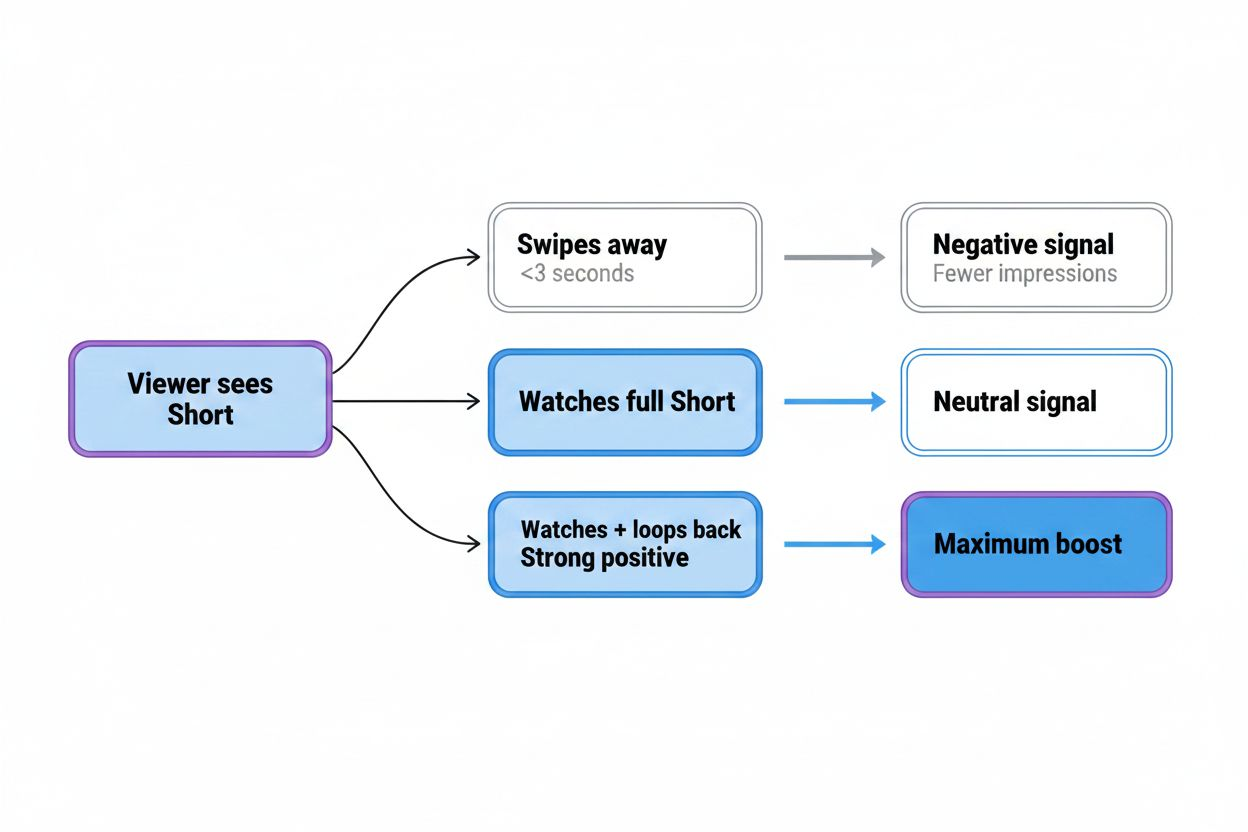
According to OutlierKit, Shorts are now ranked based on swipe-through rate, loop rate, shares, and engagement within the first few seconds. Watch time matters less than whether viewers stay or swipe away.
The first three seconds determine everything. If someone swipes past your Short in two seconds, that is a negative signal. If they watch it twice (loop rate), that is a strong positive signal. If they share it, even better.
Global Media Insight found that Shorts engagement rate stands at 5.91%, higher than TikTok and Facebook Reels. That metric includes likes, comments, and shares relative to views. Shorts audiences engage more actively than on competing platforms.
The format also expanded. On October 15, 2024, YouTube increased the maximum length for Shorts from 60 seconds to 3 minutes. This change blurred the line between Shorts and traditional videos, but the algorithm still treats them differently based on how viewers find and watch them.
What works for Shorts:
- Hook in the first second, not the first three
- Vertical framing optimized for mobile (75%+ of YouTube watch time is mobile according to Hashmeta)
- Content that benefits from rewatching (tutorials, jokes with punchlines, satisfying loops)
- Clear visual storytelling without relying on audio (many viewers watch muted)
- Ending with a question or call-to-action that prompts comments
What does not work:
- Treating Shorts as cut-down versions of long videos
- Slow builds or context-heavy openings
- Horizontal framing with black bars
- Expecting Shorts viewers to subscribe and watch your long content (they usually do not)
How YouTube Ranks Long-Form in 2025
Long-form content is judged by satisfaction, not just watch time.
OutlierKit reports that long-form content satisfaction surveys and post-watch behavior now outweigh raw watch time as the primary ranking signal. A shorter video that leaves viewers satisfied will outperform a longer video that viewers abandon.
YouTube asks viewers directly: "Did this video meet your expectations?" It also tracks what viewers do after watching. Do they search for more on the topic? Do they watch another video from the same creator? Do they close YouTube entirely?
This change killed the "make it longer to game the algorithm" strategy. A 20-minute video where viewers watch 15 minutes and leave satisfied beats a 40-minute video where viewers watch 20 minutes but feel frustrated or bored.
The algorithm also started favoring specific long-form styles. Hashmeta found that long-form conversation content over 30 minutes is getting a 35-45% promotion boost. Interview formats, podcast-style discussions, and deep-dive explanations are seeing more reach than they did in 2024.
Another shift: broader topic recommendations. Hashmeta notes that creators are reporting 20-40% increases in non-subscriber views from unrelated topics due to AI-driven cross-pollination. If you make tech reviews, YouTube might show your video to cooking channel viewers if the AI detects overlapping interests.
What works for long-form:
- Clear value proposition in the first 30 seconds (what will viewers learn or experience?)
- Pacing that matches content depth (do not stretch or rush)
- Chapters and timestamps for viewers who want to jump around
- Ending that delivers on the opening promise
- Content that benefits from length (detailed tutorials, storytelling, interviews, analysis)
What does not work:
- Padding to hit arbitrary time targets
- Burying the main point 10 minutes in
- Assuming viewers will stick around out of loyalty (they will not)
- Ignoring mobile viewers (75%+ of watch time according to Hashmeta)
The Subscriber Problem
Shorts bring views. Long-form brings subscribers. But Shorts views do not convert to long-form viewers.
This is the biggest frustration for creators in 2025. You can get millions of Shorts views and see almost no growth in your long-form audience. The YouTube platform treats them as separate content streams, and viewers treat them as separate experiences.
Someone who discovers you through a Short is in "swipe mode." They are looking for quick hits, not 20-minute commitments. Even if they subscribe, they subscribed for more Shorts, not for your main content.
The reverse is also true but less painful. Long-form subscribers might not watch your Shorts, but at least they are engaged with your primary content.
Some creators solve this by running two channels: one for Shorts, one for long-form. Others accept that Shorts are a separate audience and optimize each format independently. A few have found ways to bridge the gap by using Shorts to tease long-form content, but conversion rates stay low.
The data is clear: if you want to build a loyal, engaged audience, long-form does that better. If you want raw reach and virality, Shorts deliver that better. Expecting one format to do the job of the other leads to disappointment.
Revenue Reality Check
Shorts pay less per view than long-form. Much less.
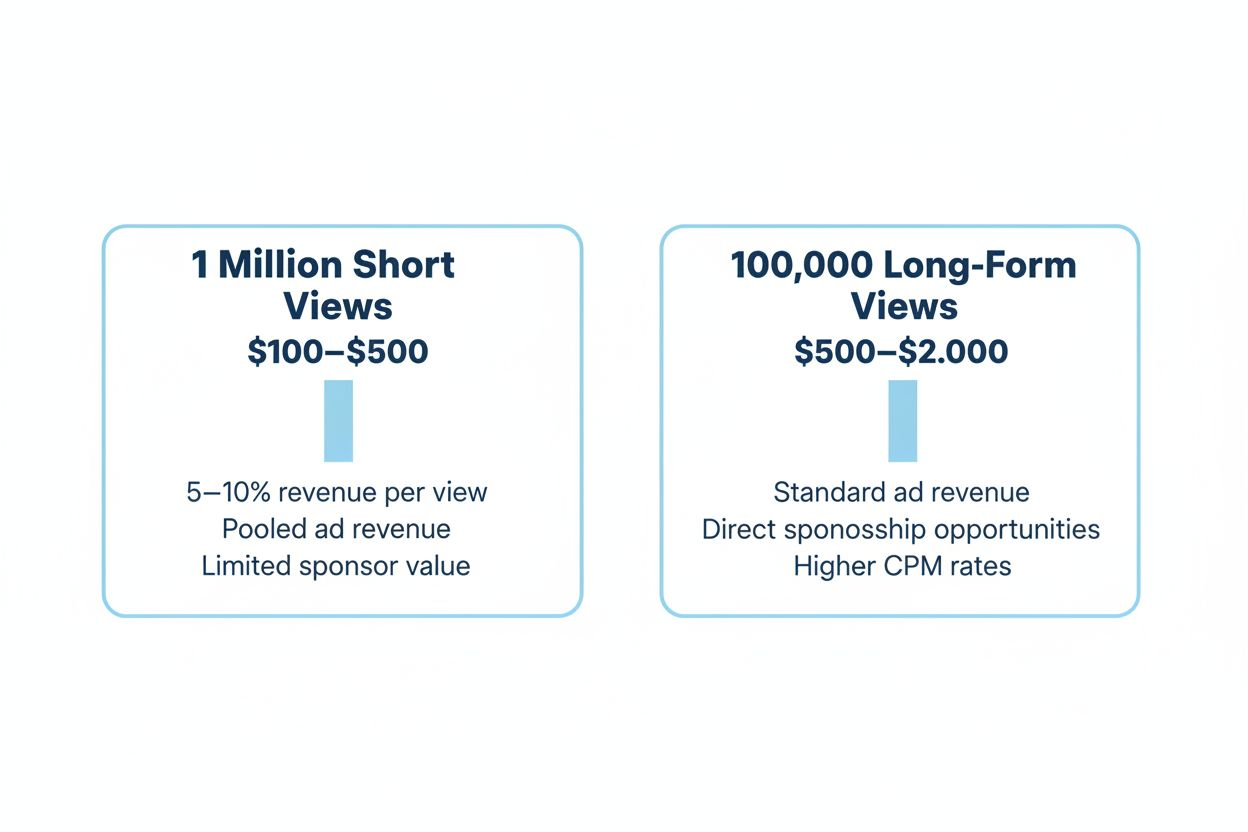
YouTube splits Shorts ad revenue differently than long-form. Shorts revenue gets pooled and distributed based on your share of total Shorts views and music licensing costs. Long-form revenue comes from ads shown directly on your videos.
Creators report that Shorts generate roughly 5-10% of the revenue per view compared to long-form. A Short with 1 million views might earn $100-$500. A long-form video with 100,000 views might earn $500-$2,000, depending on niche and CPM rates.
Sponsorships follow the same pattern. Brands pay more for long-form integrations because viewers spend more time with the content and sponsors get more messaging space. A 60-second Short does not give you room for a meaningful product demonstration or story.
If your goal is to make money from YouTube, long-form is the better bet. Shorts can supplement income and bring visibility, but they will not replace long-form revenue unless you are getting hundreds of millions of Shorts views per month.
Time and Burnout Math
Shorts demand volume. Long-form demands depth. Both demand time.
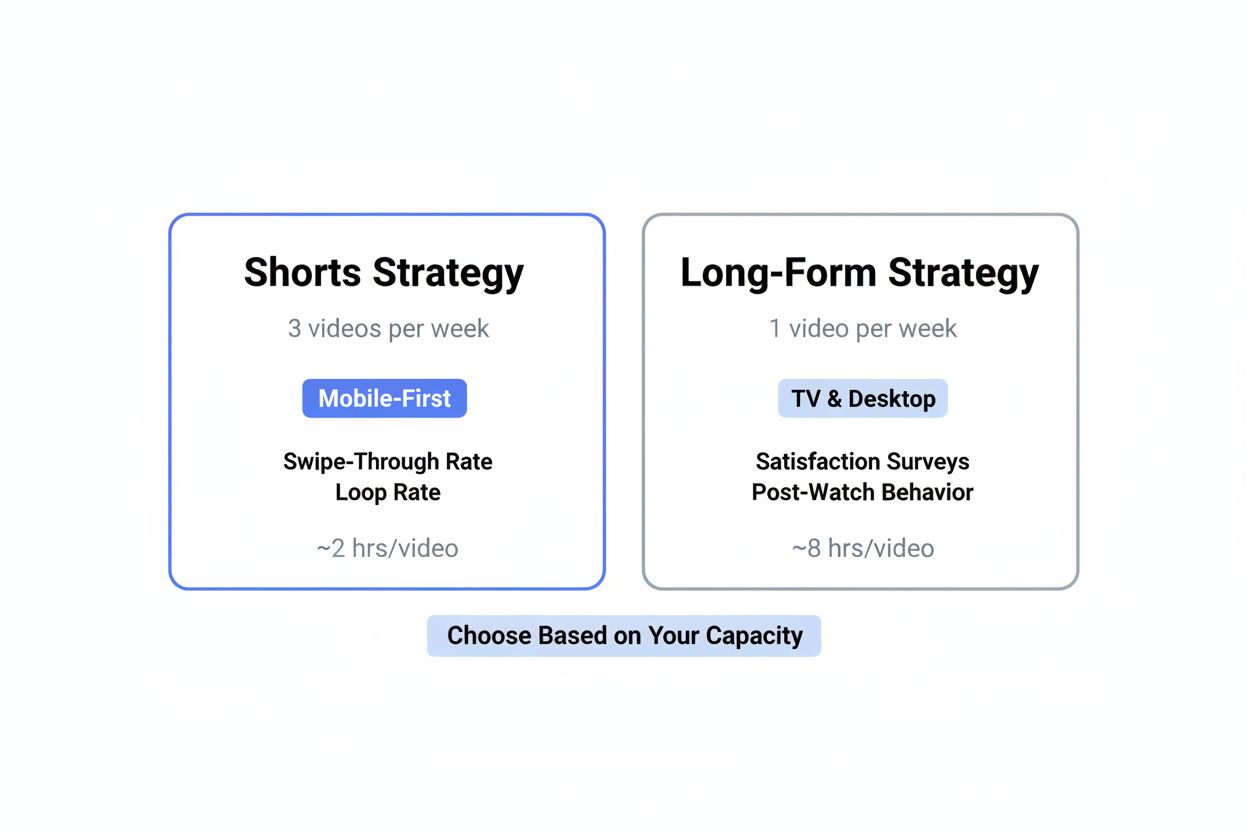
To succeed with Shorts, you need consistent output. Three to seven Shorts per week is the baseline for growth. Each Short takes 1-3 hours to produce if you are doing it well (scripting, shooting, editing, optimizing).
That is 3-21 hours per week on Shorts alone.
Long-form videos take longer per video but require fewer uploads. One strong long-form video per week is enough to grow. Depending on complexity, that is 5-15 hours of work.
The burnout risk is real. Creators who try to do both at high volume report exhaustion within months. You end up making mediocre Shorts and mediocre long-form instead of excelling at one.
The math matters:
- 5 Shorts per week at 2 hours each = 10 hours
- 1 long-form video per week at 8 hours = 8 hours
- Doing both well = 18 hours per week minimum
If you have a full-time job, family, or other commitments, 18 hours per week is not sustainable. Something breaks.
Successful creators in 2025 are making hard choices. Some go all-in on Shorts and accept lower revenue in exchange for faster audience growth. Others focus on long-form and ignore Shorts entirely. A few batch-produce Shorts from long-form content (pulling out clips), but this rarely performs as well as native Shorts.
The worst strategy is half-doing both. Pick your priority based on your goals, available time, and content strengths.
What the Algorithm Wants From Each Format
YouTube's decoupled systems mean you need to think about each format separately.
For Shorts, the algorithm wants:
- High completion rates (viewers watch the whole thing)
- Replays (loop rate)
- Shares and saves
- Fast engagement (likes and comments within seconds)
- Content that keeps viewers in the Shorts feed (not sending them away to long-form)
For long-form, the algorithm wants:
- Viewer satisfaction (measured through surveys and behavior)
- Session time (do viewers keep watching YouTube after your video?)
- Click-through rate on thumbnails and titles
- Audience retention that matches video length (a 10-minute video with 60% retention is better than a 20-minute video with 40% retention)
- Content that answers the query or promise in the title
These are different success criteria. A video that works as a Short will fail as long-form and vice versa.
Example: A 45-second cooking hack works perfectly as a Short. Viewers watch it, maybe loop it to catch the steps, and share it. The same content stretched to 10 minutes with filler would frustrate viewers and tank in long-form recommendations.
Example: A 25-minute deep dive into how a specific algorithm works would bore Shorts viewers who want quick hits. But it satisfies long-form viewers looking for detailed explanations.
Understanding what each algorithm optimizes for helps you create content that works with the system instead of against it.
Mobile Optimization Is Not Optional
Hashmeta confirms that mobile now represents 75%+ of YouTube watch time, and the algorithm prioritizes mobile-optimized content more heavily.
This affects both formats but in different ways.
For Shorts, mobile optimization means:
- Vertical framing (9:16 aspect ratio)
- Large, readable text (viewers watch on small screens)
- Clear visuals without tiny details
- Audio that enhances but is not required (many viewers watch muted)
For long-form, mobile optimization means:
- Thumbnails that read clearly on small screens
- Titles that make sense when truncated to 40 characters
- Chapters for easy navigation
- Visual clarity (avoid tiny text, complex graphics, or details that disappear on mobile)
- Audio quality that works with phone speakers or cheap earbuds
Creators who still design for desktop viewing are losing reach. The algorithm sees when viewers abandon videos or skip content, and mobile viewers abandon faster when content is not optimized for their screens.
Test your content on a phone before publishing. If you cannot read the text, neither can your viewers. If the thumbnail looks cluttered, it will perform poorly. If the pacing feels slow on mobile, it is too slow.

Strategy Frameworks for Different Creator Goals
Your format choice depends on what you are trying to accomplish.
If your goal is rapid audience growth:Shorts are faster. You can go from zero to 100,000 subscribers in months with viral Shorts. Long-form takes longer to build the same subscriber count. But remember: Shorts subscribers do not convert to long-form viewers.
If your goal is revenue:Long-form wins. Better ad rates, better sponsorship opportunities, better revenue per view. Shorts can supplement but will not replace long-form income unless you are getting massive view counts.
If your goal is authority and expertise:Long-form establishes you as an expert better than Shorts. Viewers spend more time with you, you can explain complex topics, and brands see you as more credible. Shorts can show personality but not depth.
If your goal is virality and reach:Shorts are built for virality. Global Media Insight reports that Shorts generate 70-90 billion views daily. The format spreads faster and reaches more people. Long-form rarely goes viral in the same way.
If your goal is building a community:Long-form creates stronger community bonds. Viewers who watch 20-minute videos feel more connected to you than viewers who watch 60-second clips. Comments on long-form tend to be more thoughtful. Shorts comments are often just emojis.
If your goal is testing content ideas:Shorts are faster to produce and test. You can try 10 different content angles in the time it takes to make one long-form video. Use Shorts to find what resonates, then expand successful concepts into long-form.
The Hybrid Approach That Actually Works
Most creators should not try to do both formats equally. But there is a hybrid approach that works without causing burnout.
Primary format + supplementary format.
Choose one format as your main focus. Spend 70-80% of your time and energy there. Use the other format to support it, spending only 20-30% of your effort.
Option 1: Long-form primary, Shorts supplementaryMake one strong long-form video per week. Pull 2-3 short clips from that video and post them as Shorts. This repurposes existing content and takes minimal extra time. The Shorts bring new viewers who might check out your long-form content.
Option 2: Shorts primary, long-form supplementaryPost 5-7 Shorts per week. Once a month, make a long-form video that compiles your best Shorts, adds context, or goes deeper on your most popular Short topic. This gives your Shorts audience an option to go deeper without requiring weekly long-form production.
Option 3: Separate but parallelRun both formats but treat them as separate content streams with separate goals. Shorts are for reach and virality. Long-form is for revenue and community. Do not expect crossover. Optimize each format independently.
The key is accepting that one format will be your priority. Trying to give both formats equal attention leads to mediocre results in both.
What to Do Right Now
The YouTube platform will keep changing. The algorithm will keep adjusting. But the fundamentals are clear for 2025.
Start by auditing your current content. Look at your analytics for the past 90 days. Which format is actually working for you? Where are you getting views, engagement, and subscriber growth? Double down on what is working instead of forcing what is not.
If you are new to YouTube, pick one format based on your goals and available time. Do not try to master both at once. Get good at one format first, then expand if it makes sense.
If you are burned out trying to do both, cut one. Your mental health and content quality matter more than covering every format. A creator who posts one great long-form video per week will outperform a creator who posts mediocre Shorts and mediocre long-form.
Test mobile optimization today. Pull up your last five videos on a phone. Can you read the text? Does the thumbnail work? Is the pacing right for mobile viewing? Fix what is broken.
The creators who win in 2025 are not the ones doing everything. They are the ones doing one thing really well, understanding how the YouTube platform treats that format, and optimizing for the specific algorithm that ranks their content.
Pick your format. Learn its rules. Make great content for that format. Everything else is distraction.