Maintaining Authenticity in the Age of YouTube Sponsorships
The Deal That Changes Everything
You have spent two years building an audience. They trust your opinions on gear, software, skincare, or whatever niche you have carved out. Then a brand emails you offering more money than you made in the last three months, and suddenly you are faced with a question that has no clean answer: do you take it?
YouTube sponsorships have become the financial backbone of the creator economy. For many channels, they are the difference between making content full-time and going back to a day job. Among creators' main sources of income, brand partnerships stand out: nearly a third of creators report that they account for 50% or more of their revenue. But they also carry a cost that is harder to measure than a CPM rate. Every sponsored segment is a moment where your audience watches you closely, wondering whether you actually believe what you are saying.
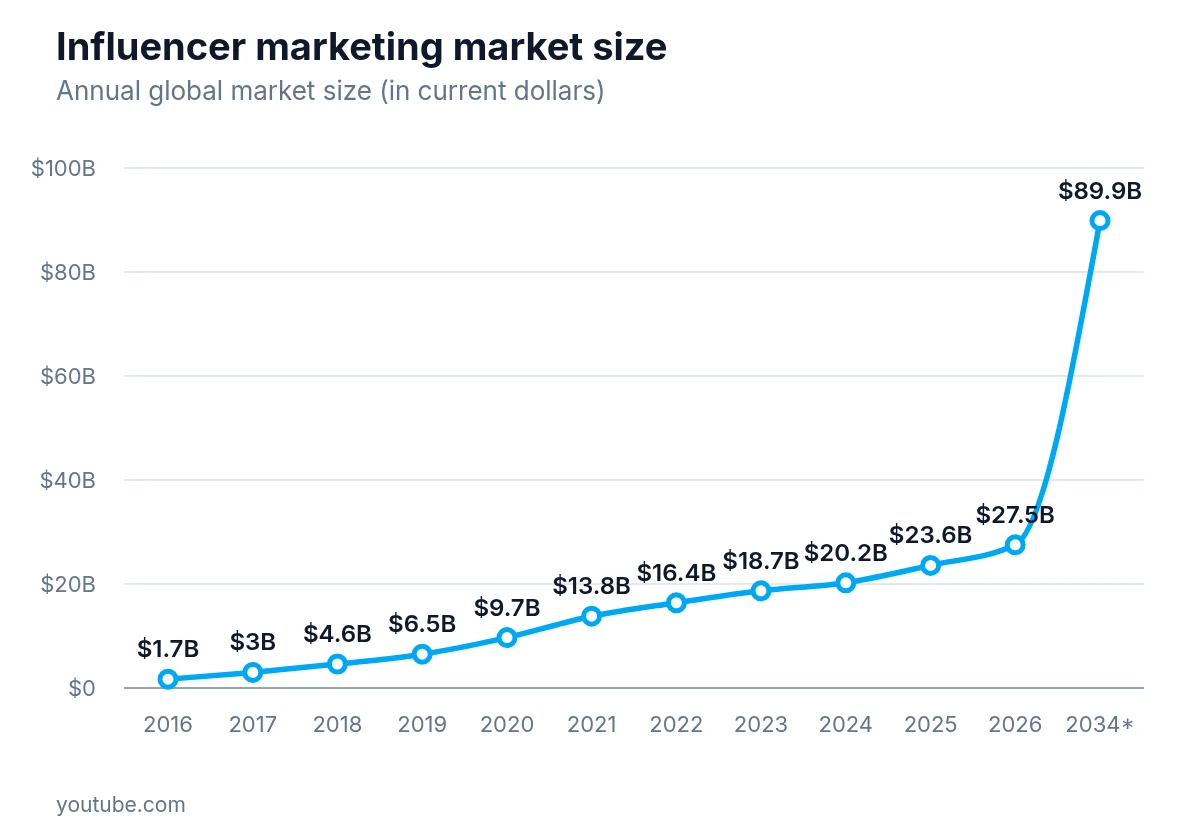
The global influencer marketing market grew from $1.7 billion in 2016 to $27.5 billion in 2026 and is projected to reach $89.9 billion by 2034.
The creators who handle this well do not just survive sponsorships. They build something more durable: an audience that trusts them even when money is clearly on the table. The ones who handle it badly often do not notice the damage until their engagement numbers tell the story.
This article is about how to take brand deals without losing the thing that made your channel worth sponsoring in the first place.
Why Authenticity Matters More on YouTube Than Anywhere Else
Television audiences expect commercials. Radio listeners expect ads. But YouTube built its audience on a fundamentally different promise: real people, talking directly to you, without a network filter.
That intimacy is the product. When a creator looks into a camera and says "I use this every day," it carries weight that a billboard never could. Viewers have spent hours with that person. They know their sense of humor, their opinions, their past mistakes. The relationship feels personal, even when the audience numbers in the millions.
This is exactly why a bad sponsorship hits differently on YouTube than a bad ad on television. Nobody feels betrayed when a TV commercial turns out to be exaggerated. But when a creator they have followed for years promotes something that turns out to be garbage, the betrayal is real. Comments sections fill up. Trust erodes. And unlike a TV spot that disappears after a campaign ends, the video stays on the channel forever.
The math here is not complicated. Research on trust and purchase intention links audience trust in influencer-created brand content directly to brand awareness and purchase intention, which means your credibility is not just a soft value but a measurable commercial one. Damage the trust, and you damage the asset. Protect the trust, and sponsorships can actually strengthen your relationship with viewers by showing that brands want to be associated with you.
What "Authenticity" Actually Means in This Context
The word gets used so often it has started to lose meaning. Creators talk about staying authentic while reading from a script they were handed by a marketing team. Brands ask for "authentic content" and then send a 12-page brief with mandatory talking points.
Authenticity in sponsorships is not about being spontaneous or unscripted. It is about alignment. Specifically, three kinds of alignment:
Product alignment: Does the product fit your channel's subject matter and your actual life? A camping gear brand sponsoring an outdoor adventure channel makes sense. The same brand sponsoring a coding tutorial channel does not, regardless of how much the creator personally enjoys camping.
Value alignment: Does the brand's behavior and reputation match what you stand for? A creator who has built an audience around sustainable living should think carefully before promoting a fast fashion brand, even if the product itself is fine.
Experience alignment: Have you actually used the product? Can you speak to it honestly? This is where many sponsorships fall apart. Creators who have never touched the product they are promoting tend to sound exactly like that.
None of this means you can only sponsor products you would have bought yourself. It means the gap between your genuine experience and your promotional claims should be as small as possible.
How to Evaluate a Brand Deal Before You Say Yes
Most creators who lose audience trust do not do it with one catastrophic sponsorship. They do it gradually, by saying yes to deals they should have declined, until their channel starts to feel like a shopping channel.
A useful filter before accepting any deal:
Would you mention this product without being paid?
Not necessarily in a dedicated segment, but would you bring it up naturally in conversation? If the honest answer is no, that is worth sitting with. It does not automatically mean you should decline, but it means you will need to work harder to make the segment feel genuine.
Do you know enough to be honest about the downsides?
The most credible sponsored segments are the ones where the creator mentions what the product does not do well. "I love this for X, but if you need Y, look elsewhere." That kind of honesty signals that the creator has actually used the thing and is not just reading copy. Brands that forbid any mention of limitations are often selling products that cannot withstand honest scrutiny.
What happens if the product disappoints your audience?
This is a risk calculation, not a reason to avoid all sponsorships. But if the product is in a category where quality is hard to verify before purchase, or where the brand has a history of complaints, you are putting your reputation on the line for something you cannot fully control.
Is the money worth the audience signal it sends?
Every sponsorship tells your audience something about you. A gaming channel that sponsors a VPN is sending a different signal than one that sponsors a mechanical keyboard company. Neither is inherently wrong, but the second one says "this person knows what their audience actually cares about." Over time, that matters.
Negotiating the Deal Without Killing the Authenticity
Many creators treat brand deals as take-it-or-leave-it offers. They are not. The terms you negotiate before signing determine how much creative control you retain, and creative control is directly tied to how genuine the segment will feel.
Push for product access before committing
Before you agree to anything, ask for the product. Use it. If the brand will not send you a sample before you sign, that tells you something. Brands confident in their product are usually happy to let creators experience it first. Worth noting: influencer compensation types vary widely, with 41.6% of influencers paid in cash, 29.5% receiving free products, and smaller shares getting store discounts or giveaway entries, so product access as part of a deal is entirely standard to request.
Negotiate talking points, not scripts
There is a significant difference between a brand providing key messages ("please mention the 30-day trial and the discount code") and a brand providing a word-for-word script. The first gives you room to speak naturally. The second turns you into a voice actor reading copy. Push back on scripts. Most brands will accept talking points if you explain that your audience responds better to natural delivery.
Retain the right to honest commentary
This is harder to get in writing, but worth raising. Some creators include language in their contracts that allows them to share their genuine experience, including limitations, as long as the core claims are accurate. Brands that refuse this outright are often hiding something.
Understand the approval process
Many brand deals include a review period where the brand approves your content before it goes live. This is standard and not inherently a problem. The problem arises when brands use this review to strip out anything that sounds human and replace it with corporate language. Know the approval timeline and know what they can and cannot change.
Delivering the Segment Without Losing Your Voice
Even with a good product and a fair contract, the actual delivery of a sponsored segment is where many creators stumble. The shift in tone is audible. The pacing changes. The eye contact with the camera becomes slightly more intense. Audiences pick up on this faster than creators expect.
A few things that help:
Place the segment where it fits naturally. Mid-roll sponsorships that interrupt a video's momentum feel more intrusive than pre-roll or post-roll segments. Some creators do their best sponsored content at the beginning of videos, framed as "before we get into it." Others save it for the end. The worst placement is usually in the middle of a complex explanation.
Write your own transition. The moment you move from your regular content into a sponsored segment is the most important sentence you will say. A clumsy transition ("Okay so this video is sponsored by...") signals to viewers that you are about to read from a script. A natural transition connects the product to whatever you were just talking about.
Talk about your actual experience, not the product's marketing copy. If you have been using a project management tool for three weeks, talk about the specific thing it helped you with last Tuesday. That specificity is what separates a genuine recommendation from a commercial.
Keep it proportional. A two-minute sponsored segment in a twelve-minute video is different from a two-minute segment in a four-minute video. If the sponsorship is taking up more than roughly fifteen to twenty percent of your video's runtime, it starts to feel like the video was made for the brand, not the audience.
Disclosing Sponsorships the Right Way
This is not optional. In most countries, paid promotions require clear disclosure, and the rules have tightened considerably as regulators have paid more attention to the creator economy.
Beyond the legal requirement, sponsorship disclosure is also a trust signal: an online experiment found that it increased trust toward the endorser, which in turn led to more positive product attitudes and higher purchase intentions. Audiences are not naive. They know creators get paid. What they want is honesty about when that is happening.
Effective disclosure is:
- Stated verbally at or near the start of the sponsored segment, not just in the description
- Clear enough that someone watching at 1.5x speed would catch it
- Not buried in a wall of text in the video description
The FTC Endorsement Guides, revised in 2023, and equivalent bodies in other countries have published guidelines on this. On disclosure format guidance, the FTC's position is that visual claims should carry at least a visual disclosure, audible claims should carry at least an audible disclosure, and a simultaneous audio-visual disclosure is most likely to be clear and conspicuous. Following these rules is not just about avoiding fines. It is about treating your audience like adults.
When You Get It Wrong
Every creator who has been doing this for a while has a sponsorship they regret. A product that turned out to be worse than expected. A brand that behaved badly after the video went live. A segment that felt off even as they were filming it.
How you handle these moments matters as much as the original mistake.
Some creators address it directly. A short video or community post acknowledging that a product they promoted did not live up to what they said. This is uncomfortable but often strengthens audience trust rather than damaging it further. It signals that the creator's relationship with their audience matters more to them than protecting their reputation with brands.
Others quietly stop working with a brand and never mention it again. This is sometimes the right call, particularly if the issue was minor and the audience largely moved on.
What does not work is defensiveness. Creators who respond to audience criticism about a sponsorship by explaining how much research they did or how the brand seemed legitimate at the time tend to make things worse. The audience is not interested in your process. They are interested in whether you take their trust seriously.
Building a Sponsorship Strategy That Protects Your Channel Long-Term
The creators who handle sponsorships best tend to treat them as a deliberate part of their channel strategy rather than a series of individual decisions made when an email arrives.
This means a few things practically:
Develop a short list of categories you will and will not sponsor. This is not about being precious. It is about knowing your limits before you are looking at a contract with a number on it. Decisions made in advance of financial pressure are almost always better than decisions made under it.
Build relationships with brands you actually like. Inbound brand deals are rarely the best ones. Creators who reach out to brands they genuinely use, before those brands come to them, often end up with better terms and more creative freedom.
Limit the number of sponsors per month. There is no universal right number, but most creators who maintain strong audience trust are selective about frequency. When every other video has a different sponsor, the channel starts to feel transactional.
Track audience response to sponsored content. Watch your comments, your retention graphs, and your like-to-view ratios on sponsored videos versus non-sponsored ones. The data will tell you whether your audience is tolerating your sponsorships or genuinely not minding them. That feedback should inform your next deal.
The Long Game
There is a version of this that is purely cynical. Take every deal, maximize short-term revenue, and accept that the audience will eventually move on. Some creators make that calculation explicitly. More make it gradually, one compromise at a time, until they look up and realize their channel no longer sounds like them.
The alternative is not refusing all sponsorships. It is treating the audience's trust as the actual asset, not just a means to attract sponsors. Creators who do this well tend to find that brands want to work with them more, not less, because their endorsements actually move product. An audience that trusts a creator buys what that creator recommends. An audience that has learned to skip the sponsored segments is worth considerably less to everyone involved.
The deal that changes everything does not have to change it for the worse. But that depends almost entirely on what you decide before the money is on the table.