YouTube Is Used for Making Money: 11 Ways Creators Actually Get Paid in 2025

YouTube stopped being just a video platform years ago. Today, it functions as a complete business infrastructure where creators build six and seven-figure incomes. The platform hosts over 125 million paying subscribers across Music and Premium services, processes billions in ad revenue annually, and supports an ecosystem of sponsorships, memberships, and merchandise sales that dwarf traditional media opportunities.
If you upload videos hoping to eventually make money, you need to understand the full revenue picture. Ad revenue is just one piece. This guide breaks down every monetization method available to YouTube creators in 2025, with specific numbers, requirements, and strategies for each.
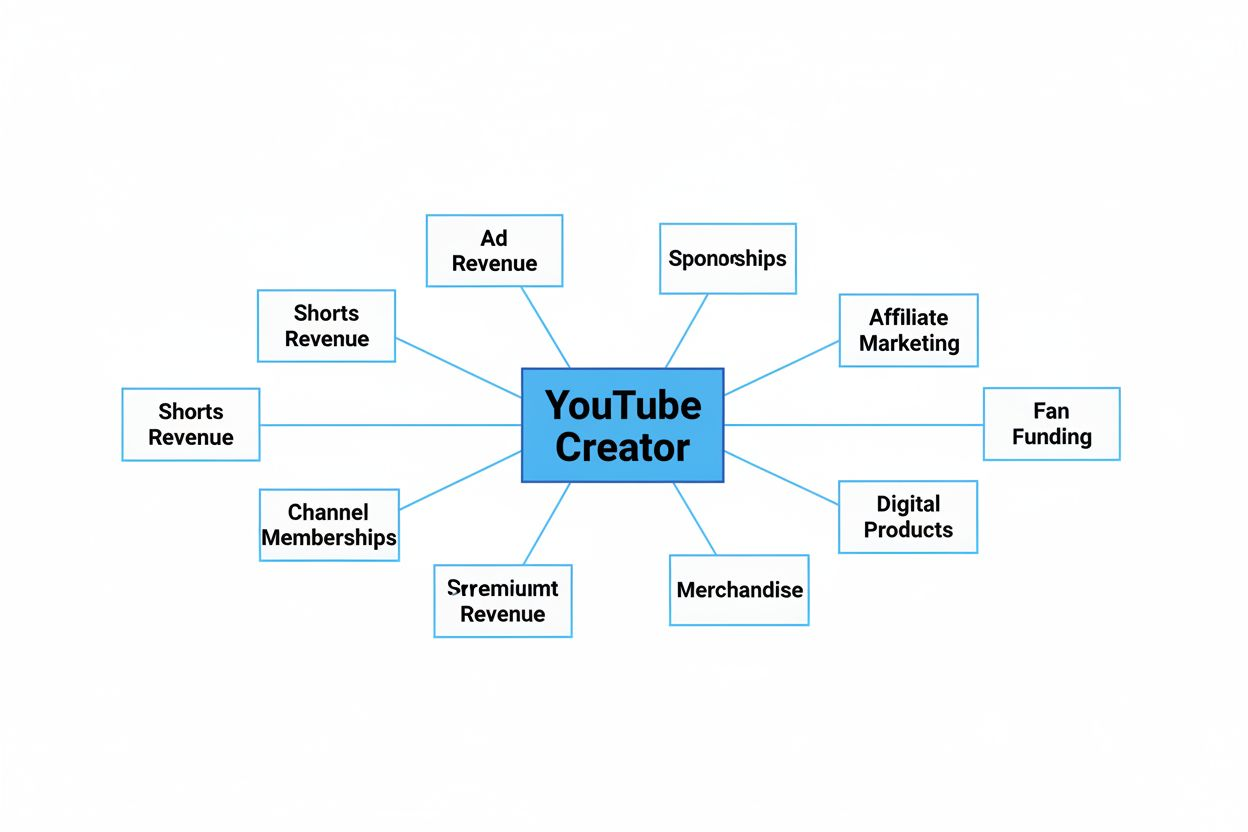
Ad Revenue: The Foundation Most Creators Start With
Ad revenue remains the most common entry point for YouTube monetization. According to Backlinko, creators in the YouTube Partner Program earn 55% of advertising revenue, while YouTube takes a 45% cut. This split applies to ads shown on your videos, including pre-roll, mid-roll, and display ads.
The actual earnings vary wildly based on your niche, audience location, and video length. Backlinko reports that channel owners can earn between $1.61 and $29.30 for every 1,000 video views. A finance channel targeting viewers in the United States might hit the high end of that range, while a gaming channel with a global audience might sit closer to the bottom.
To join the YouTube Partner Program and access ad revenue, you need:
- 1,000 subscribers
- 4,000 valid public watch hours in the past 12 months (or 10 million valid public Shorts views in the past 90 days)
- An AdSense account
- Compliance with all YouTube monetization policies
According to vidIQ, most creators reach monetization within 12 to 24 months of consistent posting. The timeline depends heavily on your niche, content quality, and upload frequency.
How CPM and RPM Actually Work
CPM (cost per mille) represents what advertisers pay per 1,000 impressions. RPM (revenue per mille) shows what you actually earn per 1,000 views after YouTube takes its cut. Your RPM will always be lower than your CPM because of the revenue split and because not every view shows an ad.
High-CPM niches include finance, business, technology, insurance, and real estate. These topics attract advertisers willing to pay premium rates because viewers have high purchasing power. Entertainment, gaming, and vlog content typically earn lower CPMs because the audience is broader and less targeted.
Video length matters too. Videos over 8 minutes allow mid-roll ads, which significantly increase revenue per view. A 15-minute video with three mid-roll ad breaks will almost always earn more than a 5-minute video with just a pre-roll ad, even if both get the same view count.
Shorts Revenue: Lower Rates, Higher Volume
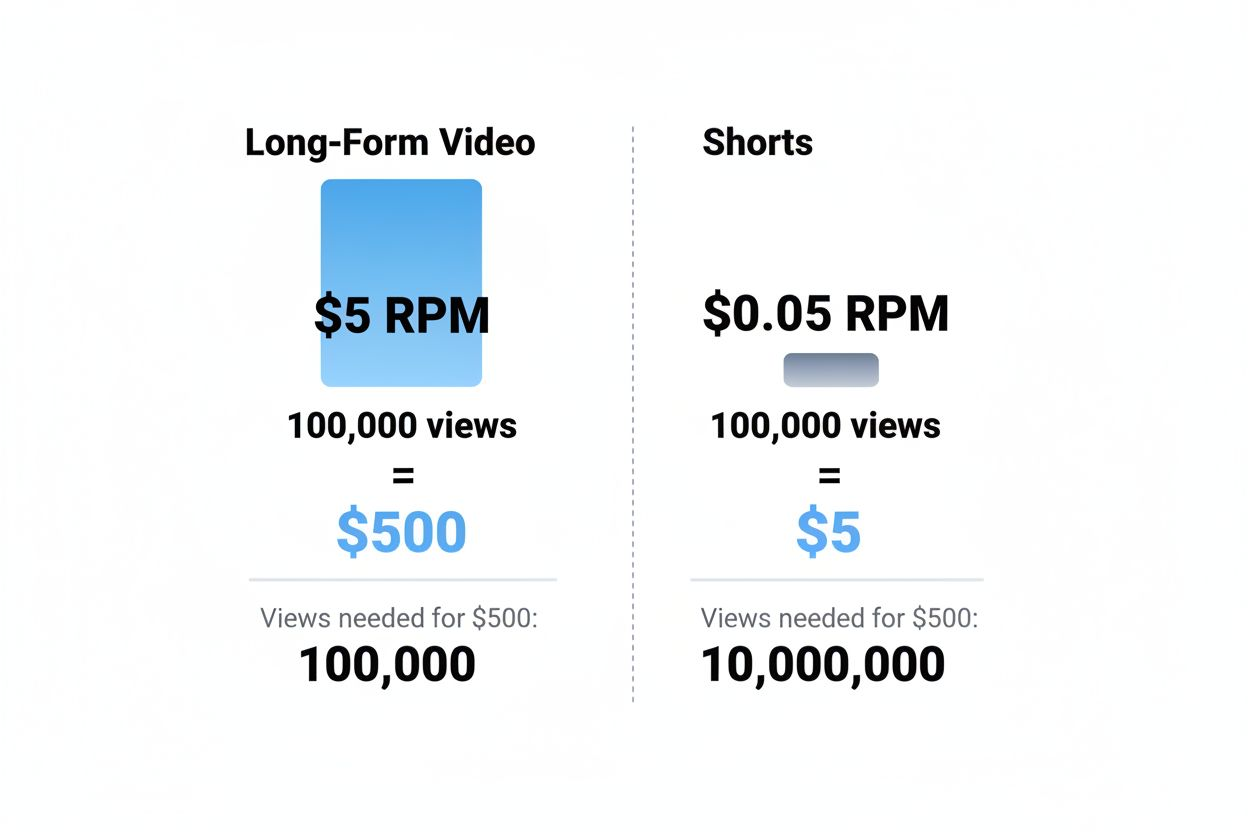
YouTube Shorts operates on a completely different revenue model. According to Learning Revolution, partners earn 45% of the revenue allocated based on their share of views from the Shorts Creator Pool. This pool is funded by ads shown between Shorts in the feed.
The catch? vidIQ reports that Shorts RPM is dramatically lower, around $0.03 to $0.07 per 1,000 views. That means you need massive view counts to generate meaningful income from Shorts alone.
A creator earning $5 RPM on long-form videos would need roughly 100 times more views on Shorts to match the same revenue. If your long-form video gets 100,000 views and earns $500, you would need 10 million Shorts views to earn the same amount.
Despite the lower rates, Shorts serve strategic purposes beyond direct revenue. They drive subscribers to your channel, where you can convert them to long-form viewers. They help you test content ideas quickly. They keep your channel active between longer uploads. Many successful creators use Shorts as a funnel rather than a primary revenue source.
Channel Memberships: Recurring Revenue From Your Biggest Fans
Channel memberships let viewers pay a monthly fee (typically $4.99, $9.99, or $24.99) for perks you define. These might include custom badges, exclusive emojis, members-only posts, early access to videos, or bonus content.
To offer memberships, you need:
- 30,000 subscribers (or 1,000 for gaming channels)
- YouTube Partner Program eligibility
- No active Community Guidelines strikes
The revenue split is the same as ads: you keep 55%, YouTube takes 45%. If you charge $4.99 per month and have 100 members, you earn roughly $274.45 monthly before taxes.
Memberships work best when you have a highly engaged community. A channel with 50,000 subscribers and 2% membership conversion (1,000 paying members at $4.99) generates $2,744.50 monthly, or $32,934 annually, from memberships alone. That assumes consistent value delivery and active member engagement.
The key is offering perks that feel valuable without creating unsustainable workload. A weekly members-only Q&A or behind-the-scenes video is manageable. Promising personalized video responses to every member is not.
Super Chat, Super Thanks, and Super Stickers: One-Time Tips
These features let viewers pay to highlight their messages during live streams (Super Chat and Super Stickers) or leave a tip on uploaded videos (Super Thanks).
Super Chat amounts range from $1 to $500. The higher the amount, the longer the message stays pinned in the live chat. Super Thanks offers preset amounts ($2, $5, $10, $50) and displays a colorful animation on the video.
Revenue split: you keep 70%, YouTube takes 30%. This is more favorable than ad revenue or memberships.
These features work best for creators who:
- Stream regularly and interact with chat actively
- Have an engaged community willing to support directly
- Create content where viewer participation adds value (gaming, commentary, Q&A sessions)
A creator hosting weekly live streams might earn $50 to $500 per stream from Super Chats, depending on audience size and engagement level. That adds up to $2,400 to $24,000 annually from this single feature.
YouTube Premium Revenue: Getting Paid When Ad-Free Viewers Watch
YouTube Premium subscribers pay for ad-free viewing, background play, and YouTube Music access. Backlinko reports that YouTube has 125 million Music and Premium subscribers worldwide as of 2025.
When Premium members watch your content, you still earn money. YouTube distributes a portion of their subscription fee to creators based on watch time. The exact rate per view is not public, but creators report it is often comparable to or slightly higher than ad revenue.
You do nothing extra to earn Premium revenue. If you are in the Partner Program, you automatically receive it when Premium members watch your videos. It shows up as a separate line item in your YouTube Studio analytics.
This matters more as Premium membership grows. If 10% of your audience uses Premium, that is 10% of your views generating revenue without ads, which means no ad blockers, no skipped ads, and consistent payment per view.
Sponsorships: Where Most Full-Time Creators Make Real Money
Sponsorships often generate more income than ad revenue once your channel reaches a certain size. Brands pay you directly to feature their product or service in your video. According to vidIQ, sponsorships generate income independently of ad revenue, meaning you earn from both the sponsor and YouTube ads on the same video.
Typical sponsorship rates range from $10 to $50 per 1,000 views, though rates vary based on niche, engagement, and audience demographics. A creator with 100,000 views per video might charge $1,000 to $5,000 per sponsorship.
Channels with 50,000 to 100,000 subscribers can start landing consistent sponsorship deals. Smaller channels sometimes secure sponsors too, especially in high-value niches like finance, B2B software, or professional development.
Finding sponsors:
- Join creator marketplaces (Grapevine, AspireIQ, Creator.co)
- Reach out to brands directly via email
- Add business contact info to your About page
- Create a media kit with your stats and audience demographics
The best sponsorships align with your content naturally. A cooking channel promoting kitchen equipment makes sense. The same channel promoting VPN services feels forced and damages trust.

Affiliate Marketing: Earning Commissions on Products You Recommend
Affiliate marketing means earning a commission when viewers purchase products through your unique link. You recommend a product, include your affiliate link in the description, and earn a percentage of each sale.
Amazon Associates is the most common starting point, offering 1% to 10% commission depending on product category. Other programs like ShareASale, CJ Affiliate, and Impact offer higher rates for specific products.
Tech reviewers, beauty creators, and tutorial channels benefit most from affiliate marketing. A camera review video might include affiliate links for the camera, lenses, memory cards, and accessories. If 1,000 viewers click through and 50 purchase a $1,000 camera with a 3% commission, you earn $1,500 from that single video.
According to vidIQ, affiliate marketing generates income independently of ad revenue, making it a reliable supplemental income stream.
Best practices:
- Only promote products you actually use and trust
- Disclose affiliate relationships clearly (YouTube requires this)
- Focus on products relevant to your content
- Create genuine reviews, not sales pitches
Merchandise: Selling Physical Products to Your Audience
Once you have 10,000 subscribers, you can sell merchandise directly through YouTube's merch shelf, which appears below your videos. You can also sell through your own website or platforms like Teespring, Spreadshop, or Shopify.
Merchandise works best when:
- You have a strong brand identity or catchphrases
- Your audience feels like part of a community
- You create designs people actually want to wear or use
Profit margins vary. Print-on-demand services handle production and shipping but take a larger cut (you might earn $5 to $10 per $25 t-shirt). Manufacturing your own inventory offers higher margins but requires upfront investment and storage.
A channel with 100,000 subscribers might convert 1% to 2% of their audience into merchandise buyers. If 1,500 people buy a $25 shirt with $8 profit margin, that is $12,000 in merchandise revenue.
Courses and Digital Products: Selling Your Expertise
If your channel teaches something, you can package that knowledge into paid courses, ebooks, templates, or other digital products. This works especially well for channels covering:
- Business skills (marketing, sales, entrepreneurship)
- Creative skills (video editing, graphic design, music production)
- Technical skills (coding, data analysis, software tutorials)
- Personal development (productivity, fitness, finance)
Digital products have high profit margins because there is no per-unit cost. Create it once, sell it indefinitely. A $97 course that sells 100 copies generates $9,700 in revenue, minus payment processing fees and platform costs.
Platforms like Teachable, Thinkific, Gumroad, and Kajabi handle hosting, payment processing, and delivery. You promote the course in your videos, link it in descriptions, and mention it occasionally without being pushy.
The challenge is creating a product that delivers more value than your free content. Your course needs to be more structured, more comprehensive, or more actionable than what viewers can piece together from your videos.
Licensing Your Content: Getting Paid When Others Use Your Videos
News outlets, TV shows, and other media companies sometimes want to use viral or newsworthy YouTube footage. If you own the rights to your content, you can license it for a fee.
Licensing works best for:
- Viral moments or breaking news you captured
- High-quality B-roll footage (nature, cityscapes, time-lapses)
- Unique perspectives or rare events
Platforms like Jukin Media, ViralHog, and Newsflare help creators license their content to media buyers. You submit your video, they handle licensing negotiations, and you split the revenue (typically 50/50 or 60/40 in your favor).
A single viral clip licensed to major news networks might earn $500 to $5,000 or more, depending on exclusivity and usage terms. Most creators will not earn significant income from licensing, but it is worth understanding if you capture something newsworthy.
Patreon and Fan Funding Platforms: Building Direct Supporter Relationships
Patreon and similar platforms (Ko-fi, Buy Me a Coffee) let fans support you directly with monthly subscriptions or one-time payments. According to Learning Revolution, Patreon has over 200,000 members and is the most popular platform YouTube creators use for fan funding.
Patreon works differently than YouTube memberships. You have more control over pricing tiers, perks, and community features. Patreon takes 5% to 12% depending on your plan, plus payment processing fees (around 2.9% + $0.30 per transaction).
Successful Patreon creators offer exclusive content, early access, behind-the-scenes material, or direct interaction. A creator with 500 patrons paying an average of $5 per month earns roughly $2,375 monthly after Patreon's cut, or $28,500 annually.
The key difference: Patreon supporters tend to be more committed than YouTube members. They are actively choosing to support you on a separate platform, which often indicates stronger loyalty.
Stacking Revenue Streams: How Successful Creators Actually Make Money
The creators earning full-time income rarely depend on a single revenue source. They stack multiple streams to create stability and maximize earnings from the same audience.
A typical revenue breakdown for a creator with 200,000 subscribers and 500,000 monthly views might look like:
- Ad revenue: $2,500 (long-form videos at $5 RPM)
- Sponsorships: $3,000 (one sponsor per month at $3,000)
- Affiliate commissions: $800 (product recommendations in descriptions)
- Channel memberships: $550 (200 members at $4.99)
- Merchandise: $400 (occasional sales through merch shelf)
- Patreon: $1,200 (150 patrons at average $10/month)
Total monthly income: $8,450, or $101,400 annually.
Notice that ad revenue represents less than 30% of total income. This is common among established creators. Diversification protects against algorithm changes, advertiser pullbacks, or demonetization issues.
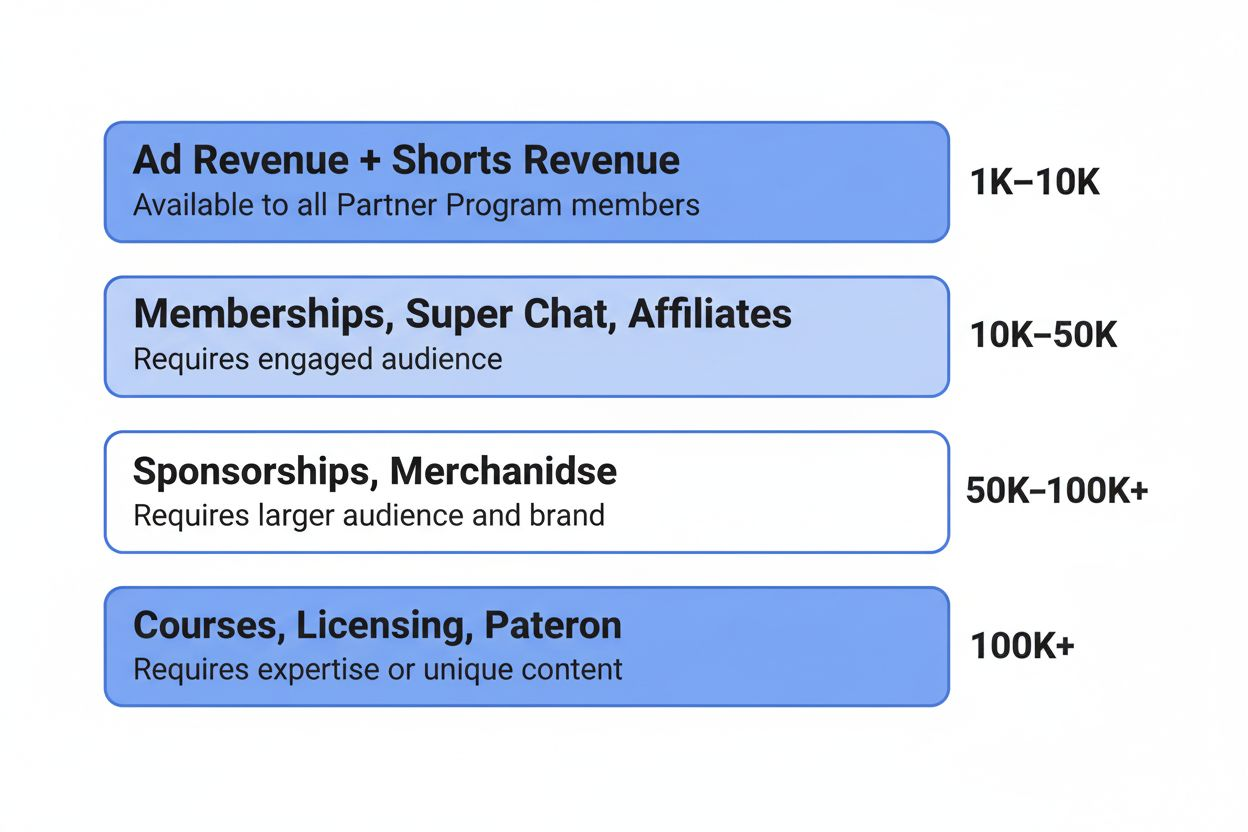
The path typically follows this sequence:
- Build to 1,000 subscribers and join Partner Program (ad revenue)
- Add affiliate links to descriptions (affiliate marketing)
- Reach 10,000 subscribers, add merch shelf (merchandise)
- Land first sponsorships around 50,000 subscribers (sponsorships)
- Launch memberships or Patreon for super fans (recurring revenue)
- Create digital products based on audience needs (courses, templates)
Each new revenue stream compounds with the others. Your sponsored video also generates ad revenue and drives affiliate sales. Your course promotion video earns ad revenue while selling the course. Your merchandise announcement reaches members who are most likely to buy.
The Real Timeline: When Each Revenue Stream Becomes Viable
Understanding when each monetization method becomes realistic helps you plan your channel growth strategy.
Months 0-12: Building Foundation Focus on content quality and consistency. Most creators are not monetized yet. If you hit 1,000 subscribers and 4,000 watch hours, enable ads immediately. Start adding affiliate links even before monetization.
Months 12-24: First Revenue According to vidIQ, most creators reach monetization within 12 to 24 months of consistent posting. Early ad revenue might be $50 to $200 monthly. Affiliate commissions might add another $20 to $100.
Months 24-36: Diversification Begins At 10,000 to 30,000 subscribers, you can launch memberships and merchandise. Small sponsorships become possible ($200 to $500 per video). Monthly income might reach $500 to $1,500.
Months 36+: Multiple Strong Streams With 50,000+ subscribers, sponsorships become reliable ($1,000+ per video). Merchandise sales increase. Course launches become viable. Monthly income can reach $3,000 to $10,000+ depending on niche and engagement.
These timelines assume consistent uploads (2-4 videos per month), improving content quality, and active audience engagement. Channels in high-CPM niches or with viral growth can accelerate this timeline significantly.
What Actually Matters More Than Subscriber Count
Subscriber count is visible and easy to compare, but it is not the best predictor of income. These metrics matter more:
Average View Duration: Longer watch time means more ads shown, higher engagement, and better algorithmic promotion. A channel with 50,000 subscribers averaging 8-minute view duration on 12-minute videos will earn more than a channel with 100,000 subscribers averaging 2 minutes on 10-minute videos.
Audience Demographics: Viewers in the United States, Canada, United Kingdom, and Australia generate higher CPMs than viewers in other regions. A channel with 80% US audience will significantly out-earn a channel with 80% global audience, even with identical view counts.
Niche and Content Type: Finance channels earn $20 to $50 CPM. Gaming channels earn $2 to $5 CPM. A finance creator with 10,000 subscribers can earn more than a gaming creator with 100,000 subscribers.
Engagement Rate: Comments, likes, and shares indicate audience investment. High engagement attracts sponsors, converts merchandise buyers, and drives membership signups. A channel with 5% engagement rate (5,000 interactions per 100,000 views) will monetize better than a channel with 0.5% engagement.
Traffic Sources: Videos getting views from search and suggested videos generate more consistent, long-term revenue than videos dependent on homepage or external traffic. Search traffic often indicates high intent, which improves affiliate conversion rates.
Focus on these metrics as you grow. They translate directly into revenue potential across all monetization methods.

Starting Your Monetization Journey Today
You do not need to wait for 1,000 subscribers to start monetizing. Begin with these steps regardless of your current size:
Add affiliate links to every relevant video description. Sign up for Amazon Associates and include links to products you mention. Even 10 sales per month at $30 average order value and 3% commission generates $9. That compounds as your back catalog grows.
Build your email list. Use a free tool like Mailchimp or ConvertKit to collect emails from interested viewers. This audience is yours, independent of YouTube's algorithm. You can promote courses, merchandise, or sponsored content directly.
Create a business email and add it to your About page. Sponsors search YouTube for creators in their niche and reach out via that email. Make yourself easy to find.
Study your analytics weekly. Identify which videos get the longest watch time, highest engagement, and best traffic sources. Make more content like that.
Engage with every comment in your first 100 videos. This builds community, improves engagement metrics, and helps you understand what your audience wants. That understanding informs which monetization methods will work best.
The creators earning six figures from YouTube did not start with massive audiences or special advantages. They started by uploading consistently, improving gradually, and adding revenue streams as opportunities appeared. The platform provides the infrastructure. Your job is to create content people value enough to watch, share, and eventually support financially.