How to Attract Top-Tier Sponsors with Optimized Video Content
Why Most Creators Never Land the Sponsors They Want
Plenty of video creators have decent subscriber counts, solid engagement, and content they're genuinely proud of. Yet they keep getting ignored by the brands they pitch, or worse, they attract only low-paying sponsors who undervalue their audience.
The gap between creators who land meaningful sponsorships and those who don't usually isn't about follower count. It's about how they present their channel, structure their content, and position themselves in the mind of a brand manager who's deciding where to spend a budget.
This article is about closing that gap. Specifically, it's about how to optimize your video content so that sponsors come to you with serious offers, and how to make your pitches land when you go to them.
What Sponsors Actually Look For
Before changing anything about your content, it helps to understand what a brand's marketing team is evaluating when they review a creator's channel.
They are not primarily looking at subscriber count. They are looking at:
- Audience alignment: Do your viewers match the demographic the brand wants to reach?
- Engagement quality: Are people commenting, sharing, and clicking, or just passively watching?
- Content consistency: Does the creator publish regularly, and does the content stay on-topic?
- Brand safety: Is there anything in the back catalog that could embarrass the brand?
- Integration style: Does the creator handle sponsor segments in a way that feels natural, or do viewers tune out?
A channel with 30,000 highly engaged subscribers in a specific niche (personal finance, home brewing, landscape photography) is often more attractive to the right brand than a general entertainment channel with ten times the audience. Research on micro- and nano-influencer trust and interaction finds that smaller creators account for the majority of influencers and outperform larger ones on both user trust and interaction. Specificity is an asset, not a limitation.
The Difference Between Reach and Relevance
Reach is how many people see your content. Relevance is how closely those people match a brand's target customer.
Brands paying for reach alone can buy programmatic advertising at scale. What they cannot easily buy is a trusted voice speaking directly to a specific, engaged community. That's what a well-positioned creator offers, and it's why relevance commands higher rates than raw numbers suggest. As a rule, influencer CPM by audience breadth runs inversely to specificity: the broader the audience, the lower the CPM.
Optimizing Your Video Content for Sponsor Appeal
Getting sponsors isn't just about making a pitch deck. It starts with what your videos actually look like, sound like, and communicate before any brand ever contacts you.
Production Quality as a Signal
Sponsors evaluate production quality not because they're shallow, but because it signals how their brand will be represented. A shaky camera, inconsistent audio, and poorly lit shots tell a brand that their product will appear in a context that looks amateur.
You don't need a broadcast studio. But you do need:
- Consistent, clean audio (a decent USB microphone makes a bigger difference than camera quality)
- Stable framing and reasonable lighting
- Edited content that respects the viewer's time
These aren't just aesthetic choices. They're signals that you take your channel seriously, which tells a brand you'll take their integration seriously too.
Niche Clarity and Content Consistency
If a brand manager visits your channel and can't describe what it's about in one sentence, they'll move on. Channels that cover fitness one week, travel the next, and personal finance the week after create confusion about who the audience actually is.
Pick a lane. Not forever, but for long enough to build an audience that brands can clearly identify and want to reach.
Consistency in publishing schedule matters too. A channel that posts every Tuesday is far easier for a brand to plan around than one that posts whenever inspiration strikes. Brands often want to align sponsor placements with product launches, seasonal campaigns, or specific dates. Predictability makes that possible.
Sponsor Segments That Don't Alienate Viewers
One of the most important things a creator can demonstrate to a prospective sponsor is that their audience tolerates (or even appreciates) sponsor integrations. Brands know that a creator whose viewers immediately skip or complain about ads is a poor investment.
The best sponsor segments share a few characteristics:
- They're placed at a natural break in the content, not jammed in awkwardly
- The creator explains why the product is relevant to their specific audience
- They're honest, including mentioning limitations when appropriate
- They're brief and don't overstay their welcome
When you handle current or past sponsorships well, you're building a portfolio of evidence that future sponsors can review. A brand watching your videos and seeing smooth, well-received integrations is already halfway sold.
Building a Media Kit That Does the Work for You
A media kit is a document (usually a PDF, sometimes a dedicated webpage) that presents your channel's key data and value proposition to a brand. Think of it as a resume for your channel.
A strong media kit includes:
- Channel overview: What your content covers, who it's for, and what makes it distinct
- Audience demographics: Age range, location, gender breakdown, and any relevant psychographic data (your analytics dashboard provides this)
- Key metrics: Average views per video, subscriber count, engagement rate, average watch time
- Past brand work: Screenshots or links to previous integrations, with results if you have them
- Rate card: Your pricing for different placement types (pre-roll, mid-roll, dedicated video, social amplification)
- Contact information: A professional email, not a personal Gmail
The goal is to make it easy for a brand to say yes. If they have to ask you for basic information, you've already created friction.
What to Include When You're Just Starting Out
If you have no prior sponsorships, your media kit still has value. Focus on:
- Audience data (even a small, highly engaged audience is worth presenting clearly)
- Content quality (link to your three best videos)
- Your niche and why your audience is valuable to a specific category of brands
- A willingness to offer a trial integration at a reduced rate in exchange for a testimonial
You don't need a long track record. You need to make the opportunity clear.
Finding and Approaching Sponsors
Identifying the Right Brands
The most productive approach is to target brands whose products you already use or whose category aligns naturally with your content. An audience that trusts you will notice when a sponsorship feels forced, and that erodes both your credibility and the brand's return on investment.
Start by listing every product or service you genuinely use that relates to your content. Then ask: does this company have a marketing budget? Do they work with creators? A quick search for "[brand name] + creator program" or "[brand name] + affiliate program" usually answers both questions.
Beyond brands you already know, look at who is sponsoring creators in your niche. If a software company is sponsoring five channels similar to yours, they have a budget for this category and they understand creator marketing. That makes them a realistic target.
Creator Marketplaces and Sponsor Networks
Several platforms exist specifically to connect creators with brands. These include marketplaces where brands post campaigns and creators apply, as well as networks where you create a profile and brands approach you.
These platforms are useful for building early experience and getting your first few sponsorships on record. The rates tend to be lower than direct deals, and the brand relationships are less personal, but they're a legitimate starting point.
As your channel grows, direct outreach to brands typically yields better rates and more creative control than marketplace deals.
Writing a Pitch That Gets a Response
Most creator pitches fail because they lead with the creator's needs rather than the brand's opportunity.
A pitch that says "I'd love to work with your brand and promote your products to my audience" is about you. A pitch that says "Your product solves a specific problem my audience asks about constantly, and here's how I'd integrate it in a way that drives real results" is about them.
A strong pitch email includes:
- A specific reason why you're reaching out to this brand (not a generic opener)
- A brief, clear description of your audience and why they match the brand's customer
- A concrete integration idea, not just "I'll mention your product"
- Your key metrics, linked to your media kit
- A clear call to action (a 20-minute call, a reply with questions, etc.)
Keep it short. Brand managers receive many of these. Four tight paragraphs will outperform a detailed essay every time.
Understanding Sponsorship Rates
Rates vary widely based on niche, audience size, engagement, and the type of placement. There's no universal standard, but a few frameworks help creators set reasonable expectations.
The most common pricing model is CPM (cost per thousand views), where you charge based on how many views a video typically receives. Niches with high-value audiences (finance, software, business tools, health) command higher CPMs than general entertainment because the brands in those categories have larger customer lifetime values and can afford to pay more per viewer reached. Good influencer selection criteria prioritize engagement over follower count for exactly this reason: a smaller, focused audience in a premium niche is worth more per viewer than a broad one.
Mid-roll placements typically command higher rates than pre-roll or end-card mentions because they have higher completion rates. Dedicated videos (where the entire video is built around the sponsor's product) command the highest rates of all.
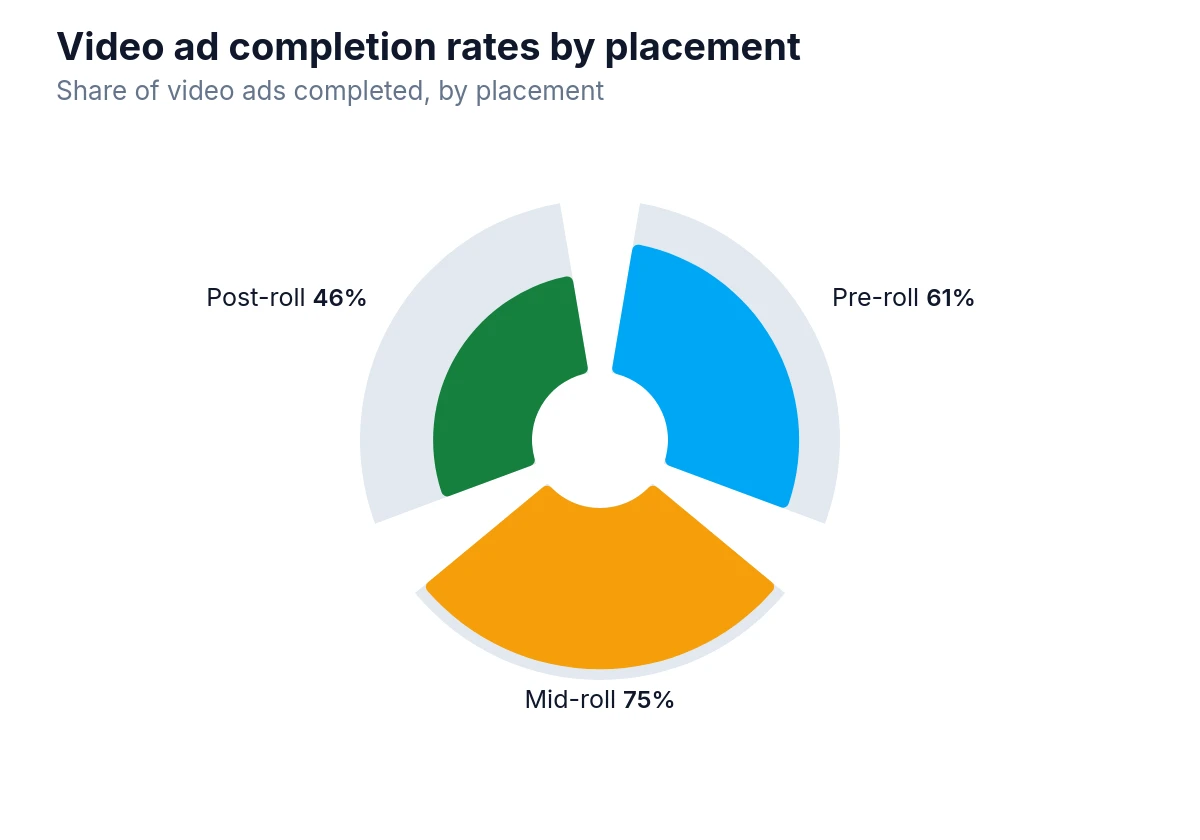
Mid-roll ads have the highest completion rate at 75 percent, while post-roll ads have the lowest at 46 percent.
A few other factors that affect what you can charge:
- Exclusivity: If you agree not to work with competing brands during a campaign period, you can charge more
- Usage rights: If the brand wants to repurpose your content in their own ads, that's an additional fee
- Deliverables: A package that includes a YouTube video plus Instagram posts and a newsletter mention is worth more than a video alone
Don't undercharge because you're nervous. Research what creators with similar metrics in your niche are charging, and price accordingly. Brands expect negotiation, and a rate that's too low can actually signal inexperience.
Retaining Sponsors and Building Long-Term Relationships
A single sponsorship is a transaction. A long-term partnership is a business relationship, and it's worth far more.
Influencer-brand partnerships strengthen consumer-brand identification and build long-term loyalty, which means brands that run repeated campaigns with a creator get better results over time as the audience becomes familiar with the product and trust compounds. For the creator, recurring deals mean predictable income and less time spent on outreach.
To turn a one-off deal into a recurring partnership:
- Deliver what you promised, on time and at the quality level you described
- Send a post-campaign report with actual performance data: views, click-through rates if you have them, audience comments
- Follow up a few weeks after the campaign to share any additional organic performance (views that accumulated after the initial push)
- Suggest a follow-up campaign with a specific idea, not just a vague "let's work together again"
Brands remember creators who make their lives easier. Most brand managers are juggling multiple campaigns and multiple creators. Being organized, communicative, and reliable puts you in a small category of people they'll want to work with again.
Positioning Yourself for Top-Tier Brands
The difference between landing a small, low-budget sponsor and a top-tier brand partnership usually comes down to positioning. Top brands have options. They can work with large agencies, celebrity creators, or established media companies. For them to choose an independent creator, that creator needs to present themselves as a professional partner, not a fan asking for a favor.
A few things that shift your positioning:
- Use a professional email address with your own domain
- Have a clean, updated website or landing page that represents your brand
- Respond to inquiries promptly and professionally
- Know your numbers cold (if a brand asks about your average watch time and you have to look it up, that's a red flag)
- Be selective about which brands you work with publicly; appearing alongside low-quality sponsors signals that you'll work with anyone
The creators who attract the best sponsors aren't always the biggest ones. They're the ones who look like they run a real business, because they do.
Making the Work Pay Off
Sponsorship revenue is one part of a broader creator business, but it's often the part with the highest ceiling. A single well-negotiated deal with the right brand can be worth more than months of ad revenue.
Getting there requires treating your channel as a media property, not a hobby. That means investing in production quality, being consistent, knowing your audience data, and approaching brands with the same professionalism you'd want from a business partner.
The creators who consistently attract top-tier sponsors aren't waiting to be discovered. They've built something specific and valuable, packaged it clearly, and made it easy for the right brands to say yes.