KPIs Every Brand Should Track for Sponsorships
Why Most Sponsorship Reporting Gets It Wrong
Brands spend serious money on sponsorships every year, from stadium naming rights to podcast integrations to local event partnerships. Global corporate sponsorship investment reached $97.4 billion, with projections putting that figure at $189.5 billion by 2030. Yet when it comes time to evaluate whether that money was well spent, many marketing teams fall back on the same shallow metrics: logo impressions, social media mentions, and a rough estimate of how many people attended the event.
These numbers feel like accountability. They are not. A logo appearing on a banner in front of 50,000 people tells you almost nothing about whether your brand benefited. Measuring sponsorships properly requires a different framework, one built around what your brand actually needs to achieve, not what is easiest to count.
This article covers the KPIs that give you a real picture of sponsorship performance, how to structure your measurement approach, and what to watch for when the numbers look good but the results are not.
Start With the Business Goal, Not the Metric
Before tracking anything, you need to answer one question: what is this sponsorship supposed to do for the business?
That sounds obvious, but sponsorship objectives vary more than most people realize. A brand entering a new market wants awareness. A brand defending market share wants loyalty reinforcement. A brand launching a product wants trial and conversion. A B2B company sponsoring an industry conference wants qualified leads and relationship-building with decision-makers.
Each of these goals demands different KPIs. Tracking reach and impressions when your real goal is lead generation is not just unhelpful, it actively misleads you. You will optimize for the wrong thing and conclude a sponsorship worked when it did not, or dismiss one that actually delivered.
A useful rule: pick three to five KPIs per sponsorship. Fewer than three and you are probably missing something important. More than five and you are measuring everything without prioritizing anything. The number should reflect the complexity of the sponsorship and the number of distinct goals it serves, not some arbitrary standard.
Awareness and Reach Metrics
Awareness KPIs are the most common and the most misused. Here is how to make them meaningful.
Audience Reach and Demographic Fit
Raw reach (the total number of people exposed to your brand through the sponsorship) matters less than qualified reach. A music festival with 80,000 attendees is only valuable if those attendees match your target customer profile.
Before signing any sponsorship deal, request detailed audience data from the property: age, income, location, interests, purchase behavior where available. After the event, compare that data against your actual customer profile. The metric you want is not total reach, but the percentage of that reach that falls within your target demographic.
This single adjustment transforms reach from a vanity metric into a useful planning tool.
Brand Recall and Awareness Lift
Brand recall measures whether people who were exposed to your sponsorship actually remember your brand afterward. You measure this through surveys, typically a pre-event survey with a control group and a post-event survey with an exposed group.
The gap between the two groups is your absolute brand lift: the difference in positive survey responses between the people who saw your sponsorship and those who were not exposed to it. A statistically meaningful lift tells you the sponsorship moved the needle. No lift, or a lift that matches your baseline advertising activity, suggests the sponsorship added little.
This requires some investment in research, but for any significant sponsorship spend, it is worth it. Note that sufficient impressions for lift studies are a prerequisite for statistically reliable results, so smaller activations may not generate enough data to draw firm conclusions. Impression counts without recall data are just guesses.
Share of Voice
If you are sponsoring an event or property where competitors are also present, share of voice matters. This measures how much of the total brand conversation in a given context belongs to you versus your competitors.
Track mentions, coverage, and social conversation around the event and calculate your brand's percentage of the total. Research by Binet and Field across 171 campaigns found that market share typically grows by 0.5% for every 10% gain in excess share of voice, so declining share of voice at events you sponsor is a warning sign worth investigating.
Engagement Metrics
Reach tells you how many people could have noticed you. Engagement tells you how many actually did something in response.
Social Media Engagement
Track mentions, hashtag usage, shares, and comments tied to your sponsorship across relevant platforms. But look beyond raw counts. Engagement rate (interactions divided by reach) tells you whether the content resonated. A sponsorship post with 10,000 impressions and 50 likes is performing worse than one with 2,000 impressions and 200 likes.
Also pay attention to sentiment. Positive engagement builds brand equity. Negative engagement, even at high volume, can damage it. Tools that classify sentiment at scale are widely available and worth using for any sponsorship with significant social activity.
Website Traffic and Source Attribution
If your sponsorship includes digital components (a branded landing page, a QR code at an event, a link in a podcast description), you can track direct traffic from those touchpoints. Use UTM parameters on every link so your analytics platform can attribute visits accurately.
Look at not just traffic volume but behavior: how long do visitors from this source stay on your site? What pages do they visit? Do they convert at a higher or lower rate than your average visitor? A sponsorship that drives high-quality traffic with strong conversion behavior is worth more than one that sends large numbers of visitors who bounce immediately.
Content Performance
Many sponsorships now include content creation, co-branded videos, articles, social posts, or live streams. Track the performance of this content separately from general brand metrics. Views, completion rates, click-throughs, and saves all tell you whether the content format and creative approach worked.
Completion rate is particularly useful for video content. If people are watching 20% of a co-branded video before dropping off, the content is not holding attention regardless of how many views it accumulates.
Commercial and Conversion Metrics
These are the KPIs that connect sponsorships to revenue, and they are the ones most often skipped because they are harder to measure. Skip them anyway and you will never know if your sponsorship investment is actually paying off.
Lead Generation and Pipeline Contribution
For B2B brands, sponsorships at trade shows, conferences, and industry events should generate measurable leads. Track the number of leads collected, their quality (job title, company size, fit with your ideal customer profile), and what percentage of them move into your sales pipeline.
Over time, track whether leads sourced through sponsorships convert at different rates or deal sizes than leads from other channels. This tells you whether the sponsorship audience is genuinely valuable to your business or just superficially aligned.
Promotional Code and Offer Redemption
One of the cleanest ways to measure commercial impact is through exclusive offers tied to a sponsorship. A discount code promoted at an event, a special URL for podcast listeners, or a QR code on event materials all create trackable conversion paths.
The promo redemption rate, calculated by dividing redeemed codes by total codes issued, tells you how many people who were exposed to your brand took a commercial action. Even a low redemption rate is useful data: it tells you whether the audience was in a buying mindset and whether your offer was compelling.
Sales Correlation
For larger sponsorships, look at sales data in the markets or segments where the sponsorship had the most exposure. Compare sales trends before and after the sponsorship period, and compare exposed markets against control markets where the sponsorship had no presence.
This is not a perfect attribution method, but it is more honest than assuming impressions translate to revenue. If sales in exposed markets moved meaningfully relative to control markets during and after the sponsorship period, you have evidence of commercial impact.
Brand Health Metrics
Brand health metrics capture changes in how your target audience perceives your brand over time. They are slower-moving than engagement or conversion metrics, but for sponsorships aimed at shifting brand perception, they are essential.
Brand Sentiment
Track how your brand is discussed online and in surveys before and after a sponsorship. Sentiment analysis tools can process large volumes of social mentions and reviews to give you a directional read on whether perception is improving, declining, or holding steady.
For sponsorships with a specific positioning goal (making a brand feel younger, more premium, more community-oriented), sentiment analysis should be focused on the specific attributes you are trying to shift, not just overall positive or negative tone.
Net Promoter Score Among Exposed Audiences
NPS measures how likely customers are to recommend your brand. If you can survey event attendees or viewers who were exposed to your sponsorship and compare their NPS to your general customer base or a control group, you get a direct read on whether the sponsorship strengthened brand advocacy.
This works best when you can follow up with the same group over time. A single post-event NPS score is interesting. Tracking whether that score holds or improves over the following months tells you whether the sponsorship created lasting positive associations.
Purchase Intent
Purchase intent surveys ask respondents how likely they are to buy from your brand in the future. Comparing intent scores between people exposed to your sponsorship and those who were not gives you a leading indicator of commercial impact before actual sales data is available.
This metric is particularly useful for sponsorships in categories with long purchase cycles, automotive, financial services, home improvement, where the gap between brand exposure and actual purchase can be months or years.
Media Value and Cost Efficiency
These metrics help you evaluate whether a sponsorship was a cost-effective way to achieve your goals compared to other marketing channels.
Equivalent Media Value
Equivalent media value (sometimes called earned media value) estimates what the media exposure generated by a sponsorship would have cost if purchased directly through advertising. If your brand received broadcast coverage, social mentions, and press coverage that would have cost a certain amount to buy as paid media, and you paid less than that for the sponsorship, the deal looks efficient on this metric.
Use this metric carefully. AMEC, the global measurement body, notes a clear industry consensus that advertising value equivalents (AVEs) should not be used to measure the value of communications, and the same caution applies to equivalent media value more broadly. It measures exposure, not impact. A brand mention in a broadcast segment is not the same as a targeted ad delivered to someone actively considering your product category. Equivalent media value is a useful sanity check, not a primary measure of success.
Cost Per Meaningful Interaction
Take your total sponsorship cost and divide it by the number of meaningful interactions it generated (qualified leads, content engagements, offer redemptions, or whatever your primary conversion metric is). Compare this to the cost per interaction from your other marketing channels.
If your sponsorship generates qualified leads at a lower cost than paid search or trade advertising, that is a strong argument for renewal. If it is significantly more expensive, you need either a better negotiation on price or a clearer case for the non-commercial value it provides.
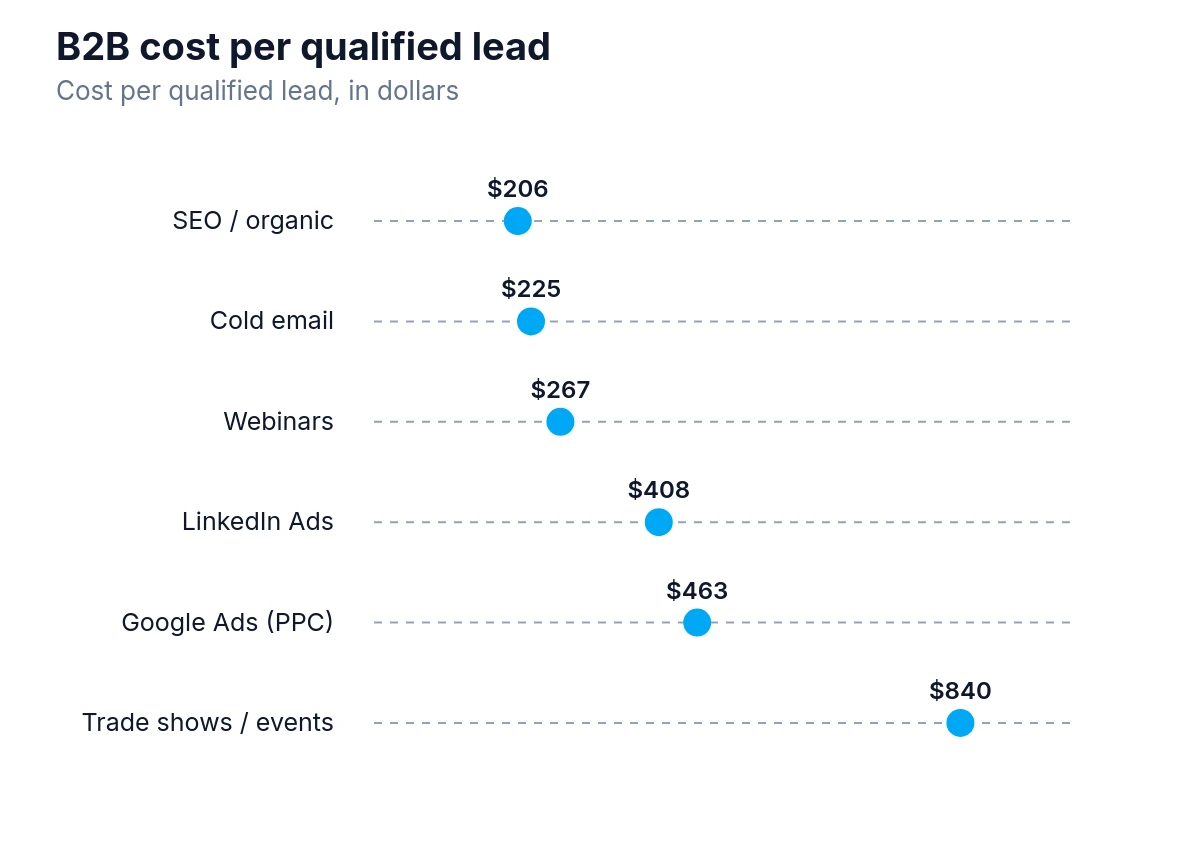
Google Ads and trade shows are the costliest channels—about $463 and $840 per qualified lead—while SEO and cold email are lowest at roughly $206–$225, so a sponsorship that gets leads for less than paid search or events is a strong candidate for renewal.
Building a Measurement System That Lasts
Tracking these KPIs once is useful. Building a consistent measurement system across all your sponsorships is where the real value comes from.
Create a standard reporting template that captures the same metrics for every sponsorship, regardless of size or format. This lets you compare performance across different properties and build benchmarks over time. After a few years, you will know what a good awareness lift looks like for your brand, what conversion rates are realistic for event-sourced leads, and which types of sponsorships consistently outperform others.
Set your measurement plan before the sponsorship activates, not after. Pre-event surveys, UTM parameters, and lead capture systems all need to be in place before the event happens. Trying to reconstruct baseline data after the fact produces unreliable results.
Finally, share your findings with the sponsorship property. Good properties want to help you succeed and will often provide additional data, adjust activation formats, or create new opportunities if you can show them specifically what is and is not working. The brands that treat sponsorships as partnerships rather than media buys consistently get more value from them.
Turning Data Into Better Sponsorship Decisions
The goal of tracking these KPIs is not to produce reports. It is to make better decisions: which sponsorships to renew, which to drop, how to negotiate better terms, and how to structure activations that actually move the metrics you care about.
A sponsorship that scores well on awareness but delivers no commercial signal might be worth keeping if brand building is your primary goal. One that generates strong leads but poor brand recall might need a different activation strategy. One that underperforms on every metric should be cut, regardless of how prestigious the property feels.
The brands that get the most from sponsorships are not necessarily the ones with the biggest budgets. They are the ones that know exactly what they are trying to achieve, measure it honestly, and adjust based on what the data tells them.