The Impact of Short-Form Content on Viewer Engagement

Why Attention Got Shorter Before Platforms Did
Something shifted in how people watch, scroll, and consume media over the past decade. The shift did not start with TikTok or Instagram Reels. It started with behavior. Audiences began skipping, scrubbing, and abandoning content faster than ever, and platforms responded by building formats that matched that impatience rather than fighting it.
Short-form content, generally defined as video or written material running under three minutes, has become the dominant format across social media, news, entertainment, and even corporate communication. The question worth examining is not whether short-form content is popular. That much is obvious. The more interesting question is what it actually does to engagement, and whether that engagement is as valuable as the metrics suggest.
What "Engagement" Actually Means in a Short-Form Context
Engagement is one of the most abused words in digital media. Platforms use it to mean almost anything: a like, a share, a comment, a replay, a swipe-up, a pause. When short-form content reports high engagement rates, it helps to understand what is actually being measured.
Watch Time vs. Completion Rate
Traditional video metrics leaned heavily on watch time, meaning the total number of minutes a viewer spent with a piece of content. Short-form content broke that model. A two-minute video watched to completion represents a very different signal than a twenty-minute video watched halfway through, even if the raw watch time is identical.
Completion rate, which measures the percentage of viewers who watch a video all the way to the end, became a more useful metric for short-form content. Short-video completion rates tell a clear story: videos under 15 seconds average 53.7% completion compared with 29.4% for longer formats. This distinction matters because platforms like TikTok and YouTube Shorts use completion rate as a primary signal for distribution. Videos that hold attention get pushed to more people.
Interaction Depth
Short-form content tends to generate high volumes of surface-level interaction. A fifteen-second clip might rack up thousands of likes and shares within hours. But the depth of that interaction is often shallow. Comments on short videos tend to be brief, reactions rather than responses. Compare that to a long podcast episode or a detailed YouTube documentary, where comment sections often contain extended discussion, debate, and personal stories.
Neither type of engagement is inherently better. They serve different purposes. But brands and creators who optimize purely for short-form metrics can end up with large audiences that have very little actual connection to their work.
How Short-Form Content Changes Viewer Behavior
The effects of short-form content go beyond what happens on the screen. Repeated exposure to rapid, high-stimulation content appears to change how viewers approach all media, not just short clips.
Reduced Tolerance for Slow Starts
Creators working in long-form video have noticed for years that audience drop-off is steepest in the first thirty seconds. That window has compressed further as short-form consumption has grown. Viewers who spend significant time on platforms where content hooks them within two seconds arrive at longer content with the same expectation. If a video does not deliver something compelling immediately, they leave.
This has pushed even long-form creators to front-load their content aggressively, often revealing the conclusion or the most dramatic moment at the very start before circling back to explain it. It is a structural change driven directly by short-form norms bleeding into other formats.
Habitual Scrolling vs. Intentional Viewing
Short-form platforms are largely built around passive discovery. A user does not search for a specific video on TikTok the way they might search YouTube for a tutorial. They open the app and let the algorithm present content. This creates a fundamentally different viewing posture: passive and reactive rather than active and intentional.
Intentional viewing, where someone chooses a piece of content and commits to it, tends to produce stronger recall, deeper emotional response, and more durable brand or creator loyalty. Passive scrolling produces high volume engagement but often leaves viewers unable to recall specific content they watched just hours earlier.
This is not a flaw in short-form content. It is a feature of the format. But it means that the engagement numbers attached to short-form content do not always translate into the outcomes that creators and brands are actually after.
The Algorithm's Role in Amplifying Short-Form Content
No discussion of short-form engagement is complete without addressing how recommendation algorithms shape what gets seen. Platforms do not simply distribute content based on subscriber counts or upload schedules. They test content against real audience behavior and amplify what performs.
Short-form content has a structural advantage in this system. Because clips are brief, a platform can test a new video against many different audience segments quickly. If a fifteen-second video earns strong completion rates and shares in its first hour, the algorithm can confidently push it to a larger audience. A thirty-minute documentary requires a much longer observation window before the algorithm has enough data to make distribution decisions.
This means short-form content can achieve viral scale faster than any other format. It also means the algorithm rewards content that triggers immediate, strong reactions over content that builds slowly toward a meaningful payoff.
The Emotional Trigger Economy
Platforms have learned, through billions of data points, that certain emotional triggers drive the highest engagement. Surprise, humor, outrage, and awe tend to produce the fastest and most reliable responses. Short-form content, with its limited runtime, almost always leads with one of these triggers.
This creates a selection pressure. Content that generates immediate emotional responses gets distributed widely. Content that requires context, nuance, or patience gets filtered out before it reaches a large audience. Over time, this shapes not just what creators make but what viewers expect and seek out.
Short-Form Content Across Different Industries
The impact of short-form content is not uniform. Different industries have experienced its rise in very different ways.
News and Journalism
Short-form video has become a primary news source for younger audiences. More than half of news sources for 18–24-year-olds are now social media, video networks, and AI chatbots, according to Reuters Institute data. The format forces radical compression. A complex geopolitical story gets reduced to sixty seconds.
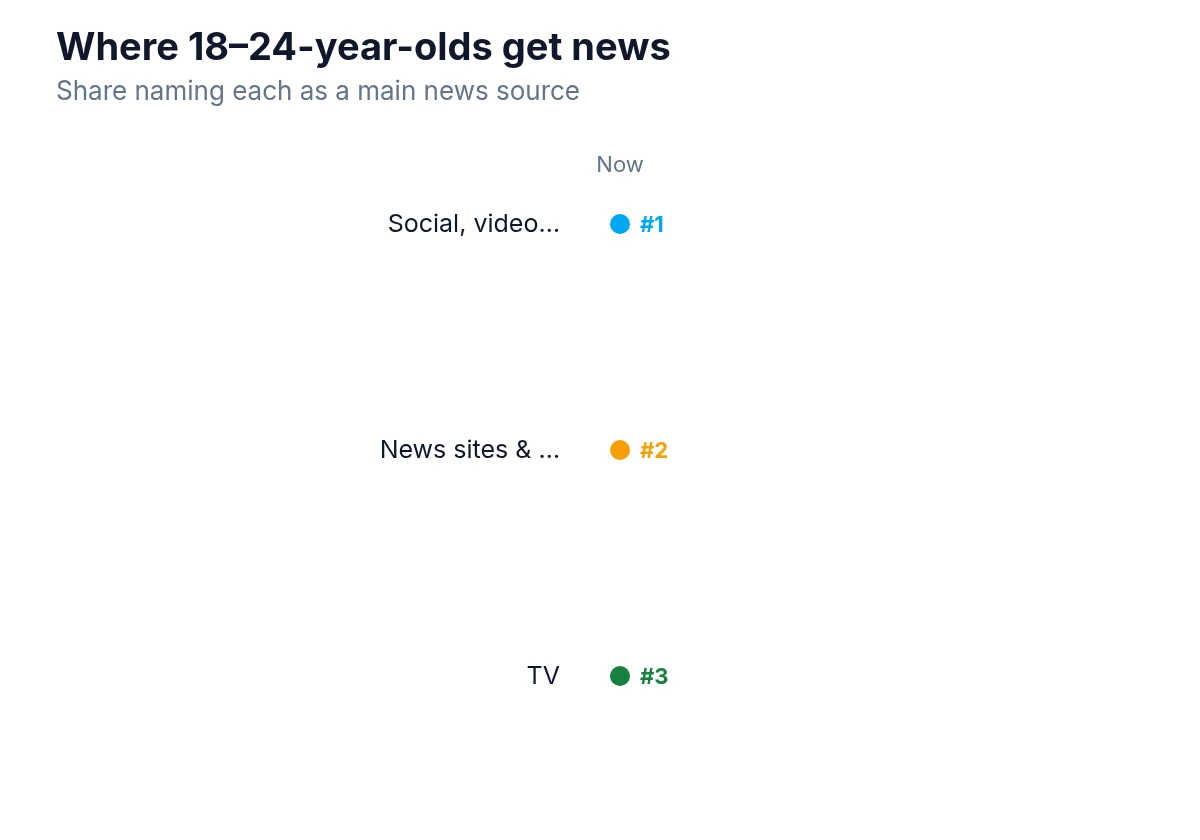
For 18–24-year-olds, social, video and AI are the top main news source, with news sites and apps second and TV third.
This creates real problems. Context gets stripped away. Nuance disappears. Stories that fit neatly into a short clip get covered extensively while stories that require explanation get ignored. Some outlets have responded by using short-form content as a gateway, offering a brief summary and then directing viewers to longer reporting. Others have simply adapted their editorial standards to the format, with mixed results.
Brand Marketing
For marketing, short-form content has been largely positive. Brands can reach large audiences at relatively low cost, test creative concepts quickly, and measure performance in near real-time. The format also lowered the production barrier. A well-shot smartphone video can outperform an expensive studio production on short-form platforms, because authenticity often outperforms polish in the algorithm's eyes.
The challenge for brands is building lasting relationships through a format designed for momentary impact. A viral short-form campaign can generate enormous awareness without producing meaningful purchase intent or brand loyalty. Marketers who understand this use short-form content as the top of a funnel, not the whole funnel.
Education
Short-form educational content, often called "edutainment," has proven genuinely effective for certain types of learning. Concepts that can be demonstrated visually in under two minutes, a chemistry reaction, a historical map, a mathematical trick, translate well to the format. A Wyzowl survey found that 71% of respondents said preferred video length falls between 30 seconds and 2 minutes. Platforms like YouTube Shorts and TikTok host enormous libraries of this material, and much of it is genuinely good.
Where short-form education struggles is with complex, sequential knowledge. Learning to write code, understand constitutional law, or develop a musical skill requires building on prior knowledge over time. Short-form clips can introduce ideas, but they cannot replace structured learning. The risk is that viewers mistake exposure to a concept for understanding of it.
The Creator Economy and Short-Form Pressure
For individual creators, short-form content has been a double-edged development. On one hand, it lowered the barrier to building an audience. Someone with a phone, a good idea, and the right timing can reach millions of people without a production team or a distribution deal.
On the other hand, the economics of short-form content are brutal. Most platforms pay significantly less per view for short-form content than for long-form. YouTube Shorts creator earnings illustrate the gap starkly: Zach King generated 196 million views in the first month of the Shorts revenue share program and took home $2,918. TikTok's creator fund has been widely criticized for paying rates that make it nearly impossible to earn a living wage from views alone.
This pushes creators toward volume. To earn meaningful income, many short-form creators need to post daily or multiple times per day. That pace is exhausting and tends to prioritize quantity over quality. It also means creators are constantly chasing trends rather than building a distinct creative voice.
The Virality Trap
Short-form platforms create a specific psychological dynamic around virality. A video that performs well generates a spike in followers and engagement. The creator then faces pressure to replicate that success. But virality is not a formula. What worked once often does not work twice, and creators who chase their own viral moments frequently produce diminishing returns.
Long-form creators face similar pressures, but the slower feedback loop gives more room for course correction. A short-form creator can post ten videos in a week, watch nine of them underperform, and feel like a failure. The format accelerates both success and the anxiety that follows it.
Does Short-Form Content Hurt Long-Form Engagement?
This is the question that media companies, educators, and researchers have been wrestling with. The concern is intuitive: if people spend hours consuming thirty-second clips, do they lose the capacity or desire for longer content?
The evidence is genuinely mixed. Long-form content is not dying. Podcast listening reach (U.S.) hit all-time highs in 2026, with 58% of Americans aged 12 and older (167 million people) tuning in monthly and 45% (130 million) weekly. Long YouTube videos, documentary series, and serialized fiction continue to attract large, dedicated audiences. The audiences for these formats are not disappearing.
What does seem to be happening is a bifurcation. People consume short-form content in certain contexts, typically mobile, on the go, filling small gaps in the day, and long-form content in others, typically at home, in the evening, with more deliberate attention. The two formats are not necessarily competing for the same attention. They are competing for different slices of the same day.
The more pressing concern is for content that falls in the middle. Mid-length content, a ten-minute explainer, a fifteen-minute documentary short, a detailed written article, faces pressure from both ends. It is too long for passive scrolling and too short to justify the kind of committed viewing that long-form earns. Some of the most substantive content formats live in this middle range, and they are genuinely struggling for attention.
What Creators and Brands Can Do With This Knowledge
Understanding how short-form content affects engagement is only useful if it informs better decisions. A few practical principles follow from everything above.
Match Format to Goal
Short-form content is excellent for awareness, discovery, and emotional connection. It is poor for conveying complex information, building deep loyalty, or driving considered purchases. Creators and brands should be honest about what they are actually trying to accomplish before defaulting to short-form because it is popular.
Use Short-Form as a Gateway
The most effective approach for many creators is to use short-form content to introduce ideas and audiences, then direct interested viewers toward longer, deeper content. A sixty-second clip that raises a compelling question and then points to a full episode or article serves both formats well. It respects the viewer's time while creating a path to more meaningful engagement.
Resist the Volume Trap
Posting constantly to feed an algorithm is a strategy that benefits platforms more than creators. Audiences are generally more forgiving of less frequent posting than creators fear, especially when the content that does appear is genuinely good. Quality retention over time beats viral spikes followed by burnout.
Measure What Actually Matters
Likes and views are easy to count but often tell you little about whether your content is working. More useful signals include: how many viewers follow after watching, how many click through to other content, how many comment with substantive responses, and whether sales, sign-ups, or other downstream actions increase. These metrics are harder to track but far more meaningful.
The Engagement That Lasts
Short-form content changed the media environment permanently. The formats, the algorithms, and the viewer behaviors it created are not going away. But the engagement it generates is specific in character: fast, broad, and often shallow.
That is not a dismissal. Broad reach and fast emotional connection are genuinely valuable. A brand that makes someone laugh in fifteen seconds has done something real. A creator who introduces a viewer to a new idea in sixty seconds has done something worth doing.
The mistake is treating short-form engagement as the whole picture. The creators and organizations that are building something durable are using short-form content as one layer of a larger strategy, not as the strategy itself. They understand that attention is not the same as connection, and that the most valuable audiences are the ones who choose to stay, not just the ones who happened to scroll past.