How Short-Form Content is Changing Sponsorship Strategies
The 60-Second Pitch Has Replaced the 30-Second Spot
Television advertising built its entire model on the assumption that audiences would sit still. Brands paid for time, networks sold attention, and the transaction worked for decades. Then came the scroll.
Short-form video, driven by platforms like TikTok, YouTube Shorts, and Instagram Reels, has dismantled the passive viewing model. People now consume content in bursts, often while doing something else, often with the sound off, almost always with the option to skip in an instant. That shift has not just changed how content gets made. It has fundamentally changed how brands pay for access to audiences.
Sponsorship strategies that worked five years ago look increasingly out of place. The 30-second pre-roll, the banner placement, the logo on a jersey that appears for two seconds before the camera cuts away - these formats assume a captive audience that no longer exists in the same numbers. Brands are adapting, sometimes awkwardly, sometimes brilliantly, to a world where attention is the scarcest resource and the creator is the new broadcaster.
What Short-Form Content Actually Means for Brand Exposure
The mechanics of sponsorship have always been about reach and frequency. Get your brand in front of enough people, often enough, and some percentage will eventually buy. Short-form content complicates both sides of that equation.
Reach Has Changed Shape
A single TikTok video from a mid-size creator can reach more people than a primetime television segment, but the distribution is unpredictable. The algorithm decides who sees what, and virality is not something you can buy directly. Brands used to pay for guaranteed impressions. Now they are often paying for a chance at impressions, with the upside being that organic spread can multiply the initial investment many times over.
This creates a different risk profile for sponsors. Traditional media buys were predictable. You paid for a slot, you got your eyeballs, you measured the result. Short-form sponsorships involve more variables. A creator might have a million followers but only get 50,000 views on a given video. Or a video might blow up and reach five million people who never heard of the creator before. Brands have had to get comfortable with that variance.
Frequency Has Become Harder to Control
In broadcast media, a brand could buy multiple spots across a week and control exactly how many times their message appeared. Short-form content does not work that way. A sponsored post goes up once. The creator might mention the brand again organically, or they might not. The audience might see it once, or they might share it into a loop where it gets seen repeatedly.
Some brands have responded by signing longer-term creator partnerships rather than one-off sponsored posts. Instead of paying for a single video, they pay for six months of content, with the creator weaving the brand into their regular output. This gives brands more consistent presence without the awkward "and now a word from our sponsor" energy that audiences have learned to skip.
The Creator as the Ad Unit
The most significant structural change in sponsorship is that the creator is no longer just a vehicle for the brand's message. The creator is the message.
Traditional advertising separated the content from the commercial. You watched a show, then you watched an ad. The ad was produced by the brand, controlled by the brand, and delivered in a format the brand dictated. The show and the ad existed in different registers.
Short-form creators have collapsed that distinction. When a creator holds up a product and says "I've been using this for three months and here's what I actually think," that is not an ad in the traditional sense. It is a recommendation from someone the audience has chosen to follow. The trust the creator has built over years of content is the thing the brand is actually buying.
This changes the negotiation between brands and creators in important ways.
Creative Control Has Shifted
Brands that try to script short-form creator content usually fail. Audiences can tell when a creator is reading someone else's words. The stilted delivery, the uncharacteristic vocabulary, the sudden appearance of brand talking points - it breaks the illusion that makes creator content valuable in the first place.
Successful brand partnerships in short-form content tend to give creators significant latitude. The brand specifies the product, the key message, and any legal requirements. The creator figures out how to make it feel like their own content. This is uncomfortable for marketing teams used to controlling every word of their brand communication, but the results tend to justify the discomfort.
Authenticity Has Become a Measurable Asset
Audiences have developed sharp instincts for detecting inauthentic sponsorships. A creator who suddenly starts promoting products that have nothing to do with their usual content, or who uses language that sounds nothing like them, will see engagement drop and comments fill with skepticism. That skepticism is visible to everyone, including the brand.
This means creators who maintain consistent, believable partnerships are worth more to sponsors than creators who will promote anything for the right check. The creator's editorial judgment - their ability to say no to brands that do not fit - is part of what makes them valuable to the brands they do say yes to.
How Brands Are Restructuring Their Sponsorship Budgets
The money is moving. Not all of it, and not all at once, but the direction is clear. Brands' influencer-marketing budget allocations have shifted sharply: 34% of brands now put over 40% of their total marketing budget into influencer campaigns, with some in beauty, fashion, and consumer packaged goods dedicating as much as 62% of their digital marketing spend to creator partnerships. The way they structure those deals has changed significantly too, and nearly two-thirds of the increased creator marketing budget has come from reallocation from paid media to creator marketing, as marketers pull funds from traditional digital ads into influencer-led campaigns.
From CPM to Performance
Cost per thousand impressions (CPM) was the standard currency of traditional media buying. You paid based on how many people might see your ad. Short-form sponsorships are increasingly evaluated on performance metrics: clicks, conversions, promo code redemptions, affiliate link clicks. Brands want to know not just how many people saw the content, but how many people did something as a result.
This shift benefits brands in some ways and creators in others. Brands get more accountability for their spend. Creators who drive real results can charge more than their follower count alone would suggest. But it also puts pressure on creators to produce content that converts, which can conflict with the organic, trust-building approach that makes creator content valuable in the first place.
The Rise of Micro and Nano Creators
One of the most significant budget shifts has been away from celebrity and mega-influencer deals toward smaller creators with highly engaged, specific audiences. A creator with 50,000 followers in a niche hobby community might deliver better results for a relevant brand than a creator with five million followers across a general lifestyle audience, and nano-influencer engagement rates rank second highest across all influencer tiers, which helps explain why brands are paying attention to them.
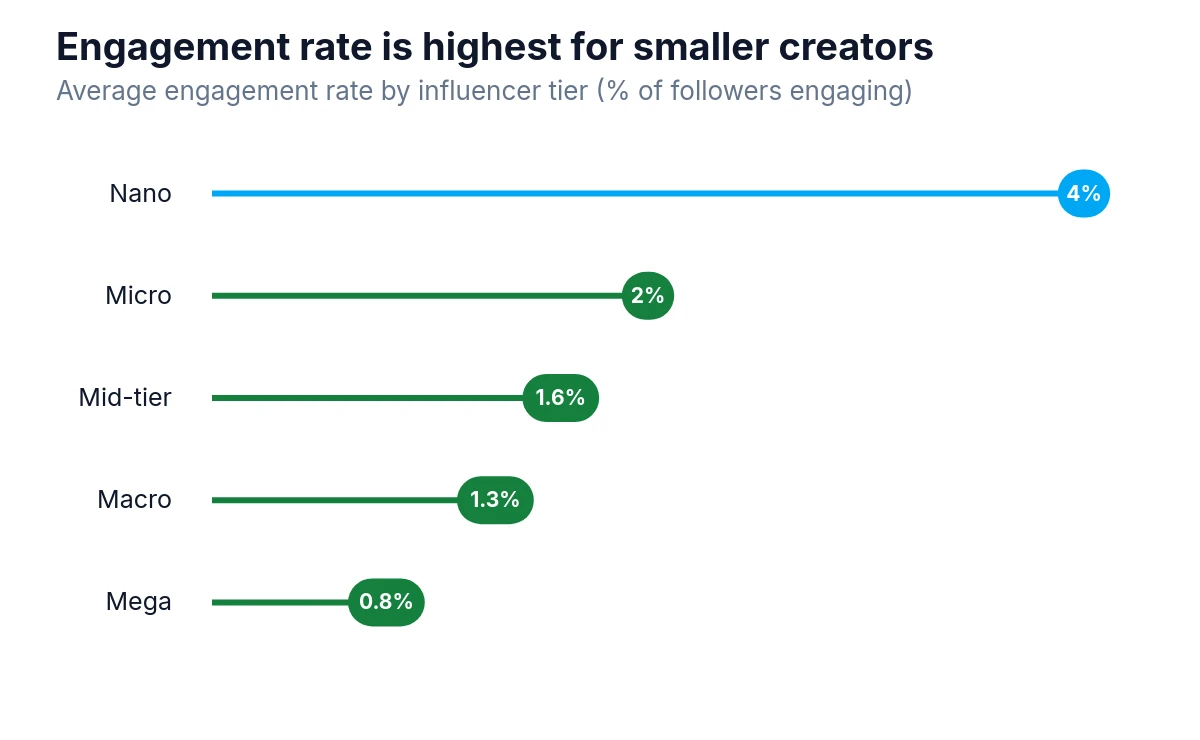
Engagement is highest among smaller creators: Nano influencers average about 4% engagement, declining through micro and mid-tier to about 0.8% for mega influencers.
This has democratized sponsorship in some ways. Brands that could never afford a celebrity endorsement can now work with dozens of smaller creators for a comparable or lower total spend. It has also created a more complex management challenge, since running 50 creator partnerships requires different infrastructure than running one.
Agencies have emerged specifically to handle this complexity, acting as intermediaries between brands and large networks of smaller creators. These agencies handle contracts, content review, payment, and performance tracking at a scale that individual brand teams cannot manage directly.
Long-Term Partnerships vs. One-Off Deals
The one-off sponsored post is losing favor on both sides of the transaction. Brands have found that a single mention rarely moves the needle in a meaningful way. Audiences need repeated exposure to a product before they act, and a single sponsored video rarely provides that.
Creators, meanwhile, have found that one-off deals are disruptive to their content and their audience relationship. Suddenly promoting a brand and then never mentioning it again feels transactional in a way that audiences notice.
Long-term partnerships solve both problems. The brand gets consistent presence in the creator's content over time. The creator can integrate the brand more naturally, mentioning it when it genuinely fits rather than forcing it into an unrelated video. The audience sees the creator using the product repeatedly, which builds the kind of familiarity that drives purchasing decisions.
Platform-Specific Strategies
Short-form content is not monolithic. TikTok, YouTube Shorts, and Instagram Reels have different audiences, different algorithms, and different norms around sponsored content. Brands that treat them as interchangeable are leaving results on the table.
TikTok
TikTok's algorithm is unusually good at surfacing content to non-followers, which means sponsored content has a higher chance of reaching new audiences than on platforms where distribution is more follower-dependent. Brands have found success with content that participates in existing trends rather than creating standalone promotional videos. A product that fits naturally into a trending audio or challenge format can spread far beyond the creator's existing audience.
TikTok also has a higher tolerance for content that is explicitly commercial, partly because the platform has normalized shopping features and in-app purchasing. Audiences are accustomed to seeing products promoted directly.
YouTube Shorts
YouTube Shorts sits within a platform where longer-form content has always dominated, and that context shapes how sponsorships work. Creators often use Shorts as a discovery mechanism, drawing viewers into their longer videos. Brands that sponsor Shorts are sometimes buying access to that funnel rather than the Shorts view itself.
YouTube also has more established norms around disclosure and integration, partly because its creator community has been dealing with sponsorship since the mid-2000s. The "this video is sponsored by" format is well-established and audiences largely accept it when the integration feels genuine.
Instagram Reels
Reels tends to skew toward aspirational content and lifestyle brands. Fashion, beauty, food, and travel brands have found strong traction here. The visual quality expectations are higher than on TikTok, which means production values matter more. Brands working with Reels creators often need to allow more time and budget for content creation.
Instagram's shopping integration also makes it easier to connect sponsored content directly to purchase, which has made it attractive for direct-to-consumer brands that want a short path from awareness to transaction.
The Disclosure Problem
Short-form content has created real friction around advertising disclosure requirements. Most markets require that sponsored content be clearly labeled, but the norms around how to do that vary, and enforcement has been inconsistent.
The challenge is that disclosure can undermine the very thing that makes creator content valuable. A video that opens with "this is a paid partnership" immediately signals to the audience that what follows is an ad, which activates the same skepticism that makes traditional advertising less effective. Creators and brands have sometimes tried to minimize disclosure, which has led to regulatory scrutiny in several markets.
The FTC is specific about the placement of disclosures in video endorsements: the disclosure must appear within the video itself, not just in the uploaded description. The agency also makes clear that U.S. jurisdiction for influencer posts extends to content made abroad whenever it is reasonably foreseeable that the post will affect U.S. consumers.
Audiences have also become more sophisticated. Many viewers understand that creators need to earn money, and they are willing to accept sponsored content as part of the deal, provided the creator is honest about it and the product is genuinely relevant. The backlash tends to come when creators are clearly promoting something they do not actually use or believe in, not simply because they are getting paid.
What Sports and Entertainment Sponsorship Can Learn
Traditional sports and entertainment sponsorship has been slower to adapt, but the pressure is building. Broadcast viewership for major sports has declined among younger demographics, while short-form highlights and creator commentary have grown. Since Q2 2024, online highlights viewership among 16-24-year-olds in Europe has grown by 22%, and leagues and teams that once sold sponsorship primarily through broadcast rights are now having to think about their short-form presence as a distinct sponsorship asset.
Some sports organizations have started treating their own social media channels as creator channels, producing short-form content specifically designed for platform algorithms rather than repurposing broadcast footage. A behind-the-scenes video shot vertically for TikTok is a different product than a highlight clip cut from a broadcast feed, and brands are starting to pay for that difference.
Athletes themselves have become significant short-form creators, often with audiences that rival or exceed the teams they play for. Athlete-direct sponsorships, bypassing the team and league entirely, have grown as a result. This creates complicated territory for traditional sports sponsorship structures, where brands have historically paid for association with teams and leagues rather than individual athletes.
Where Sponsorship Strategy Goes From Here
The brands that are figuring this out fastest share a few characteristics. They have moved decision-making about creator partnerships closer to people who actually understand the platforms. They have built internal processes that can move quickly enough to participate in trends rather than arriving after they have passed. And they have accepted that some degree of creative control has to be surrendered to get the authenticity that makes creator content work.
The brands that are struggling tend to be applying traditional advertising logic to a new medium. They want guaranteed impressions, controlled messaging, and predictable results. Those things are still available in traditional media. Short-form creator sponsorship offers something different: the possibility of genuine connection with an audience that has chosen to pay attention, delivered through a voice that audience already trusts.
That is a more valuable thing than a guaranteed impression. It is also harder to buy, harder to measure, and harder to control. Brands that can make peace with that trade-off are finding that short-form content is not just a new channel for old strategies. It is a fundamentally different relationship between brands, creators, and audiences, and the sponsorship strategies that work within it look almost nothing like what came before.