Building an Email List as a YouTuber: Strategies for Success
Why YouTube Alone Is Not Enough
You have spent months, maybe years, building a YouTube channel. Subscribers are climbing. Views are solid. Then YouTube tweaks its algorithm, demonetizes a video, or changes how it surfaces content to your audience, and suddenly your reach drops by half overnight.
This is the core problem with building entirely on YouTube. You do not own your audience there. YouTube does. The moment a viewer subscribes, they enter YouTube's ecosystem, not yours. YouTube decides when and whether to show them your next video. You have no direct line to them.
An email list changes that. When someone gives you their email address, you have a direct channel to reach them regardless of what any platform decides. No algorithm filters your message. No feed buries it. You send an email, it lands in their inbox, though email inbox placement is never guaranteed: accepted emails can still end up in spam or promotional folders rather than the primary inbox.
For YouTubers specifically, building an email list is one of the most underused growth strategies available. Most creators treat it as an afterthought, if they think about it at all. The ones who build it early tend to have far more stable businesses, stronger product launches, and audiences that actually show up when it matters.
This article covers how to build that list, what to offer people in exchange for signing up, where to promote it, and how to keep subscribers engaged once they are on it.
What to Offer in Exchange for an Email Address
Nobody hands over their email address for nothing. You need to give them a reason, and "subscribe to my newsletter" is rarely enough on its own.
The most effective approach for YouTubers is a lead magnet: something specific and immediately useful that someone gets the moment they sign up. The key word is specific. A vague promise of "exclusive content" does not convert nearly as well as something concrete.
Lead Magnet Ideas That Work for Creators
Checklists and templates are among the highest-converting lead magnets because they save people time on something they are already trying to do. If your channel covers video editing, a "YouTube thumbnail checklist" or a Premiere Pro project file template gives viewers something they can use today.
Mini-courses or email sequences work well if your content is educational. Someone who watches your videos on personal finance might happily sign up for a five-day email series on building a budget from scratch. This type of lead magnet also does something useful: it trains subscribers to open your emails from day one.
Resource libraries are effective for channels with a lot of depth. A collection of your best tools, recommended reading, gear lists, or downloadable guides gives subscribers ongoing value rather than a single-use item.
Early access or exclusive content can work, but only if your audience already trusts you enough to believe the promise. For newer channels, this tends to underperform compared to something tangible.
The best lead magnet is one that connects directly to your most popular video content. Look at which videos get the most comments asking follow-up questions. The answer to those questions, packaged neatly, is your lead magnet.
Where to Promote Your Email List on YouTube
You have multiple touchpoints on YouTube, and most creators use only one or two of them. Using all of them consistently makes a significant difference.
Video Descriptions
Your video description is prime real estate that most viewers scroll past without reading, but a meaningful percentage do check it, especially on educational or tutorial content. Put your signup link near the top, above the fold, with a one-line explanation of what they get. "Download the free checklist I mentioned: [link]" outperforms a generic "Join my newsletter" every time.
End Screens and Cards
End screens appear in the last 20 seconds of your video. Most creators use them to promote other videos or their channel subscription, which makes sense. But if you have a lead magnet that is directly relevant to the video someone just watched, an end screen card pointing to it can convert well. You cannot link directly to external sites from cards (YouTube restricts this), but you can direct people to the description link or mention it verbally.
Pinned Comments
Pin a comment on each video that includes your signup link and a brief reason to click it. Pinned comments sit at the top of the comment section and get seen by a large share of viewers who engage with comments. This is one of the most overlooked spots on YouTube for list building.
Channel Banner and About Section
Your channel banner and About section are often the first things a new viewer sees when they visit your channel page. Include your signup link in both. YouTube allows up to 14 clickable links on YouTube channel profiles, displayed near the Subscribe button, so you have plenty of room to include your email list alongside your other platforms. Use one of those slots for your email list.
Verbal Calls to Action in Videos
Mention your email list in the video itself, not just in the description. The most effective placement is usually around the one-third or two-thirds mark of the video, after you have delivered some value but before the viewer might drop off. Keep it brief and specific: "If you want the template I used to build this, the link is in the description, it takes about 30 seconds to grab."
Avoid the habit of front-loading every call to action at the beginning of a video. Most viewers who are new to your channel have not decided yet whether they trust you enough to give you their email. Earn that trust first, then ask.
Choosing the Right Email Platform
The email platform you choose matters less than actually building the list, but it does matter. A few considerations:
Most creators start with a platform that has a free tier, which makes sense when you are just getting started. As your list grows, you will want features like automation, segmentation, and the ability to tag subscribers based on their behavior.
Automation lets you send a sequence of emails automatically when someone signs up. This is how you deliver a mini-course or a welcome sequence without doing anything manually. A good welcome sequence introduces you, delivers the lead magnet, and sets expectations for what subscribers will receive going forward.
Segmentation becomes important once your list grows beyond a few hundred people. If you make content on multiple topics, being able to send different emails to different segments (people interested in video editing versus people interested in YouTube growth, for example) keeps your emails relevant and reduces unsubscribes.
Popular options among creators include ConvertKit (now rebranded as Kit), Mailchimp, and Beehiiv. Each has different strengths. ConvertKit is built specifically for creators and has strong automation features. Beehiiv has gained traction among newsletter-first creators because of its built-in growth tools. Mailchimp is widely used and has a generous free tier but can feel clunky as you scale.
Pick one, set it up properly, and focus on building the list. Do not spend weeks comparing platforms when you could be creating the lead magnet.
What to Send Once People Are Subscribed
This is where most YouTubers drop the ball. They work hard to get subscribers onto their list, then send nothing for weeks, or send emails so infrequently that subscribers forget who they are.
Consistency matters more than frequency. Sending one email per week that subscribers look forward to is far better than sending three emails in a burst and then going quiet for a month.
The Welcome Sequence
The first email someone receives after signing up should arrive immediately and deliver whatever you promised. After that, a short sequence of two to four emails over the following week or two helps new subscribers understand who you are, what you make, and why they should care.
A simple welcome sequence might look like this:
- Immediate delivery of the lead magnet, plus a brief personal introduction
- Two days later: your best or most popular video, with a sentence explaining why it is worth watching
- Four days later: a behind-the-scenes look at how you make your content, or a question asking what they most want help with
- Seven days later: transition into your regular newsletter cadence
This sequence does two things. It trains subscribers to open your emails, and it gives them enough context to feel like they know you before they start receiving your regular content.
Regular Newsletter Content
Your ongoing emails do not need to be long. Many successful creator newsletters are short: a paragraph or two about something relevant to their niche, a link to their latest video, and maybe one other resource or recommendation.
The goal is to be useful and to show up consistently. Over time, subscribers who regularly open your emails become your most engaged fans. They are the ones who buy your products, share your content, and leave the comments that make the algorithm happy.
A few formats that work well for YouTubers:
- A short essay or take on something happening in your niche, with a link to your latest video at the end
- A "what I learned this week" format that shares one useful insight
- A curated list of resources, tools, or links relevant to your audience
- A behind-the-scenes look at a video you are working on, building anticipation before it publishes
Avoid making every email a pure promotional push for your latest video. Subscribers who feel like they are only being used as a traffic source will unsubscribe. Give them something worth reading even if they never click through to YouTube.
Growing the List Beyond YouTube
YouTube is your primary traffic source, but it should not be your only one. Once you have the basics set up, a few additional channels can accelerate list growth significantly.
Your Website or Blog
If you have a website, every page should have an opportunity to sign up. A popup or slide-in form (timed to appear after someone has been on the page for 30 seconds) tends to convert better than a static form buried in a sidebar. A dedicated landing page for your lead magnet, linked from your YouTube description, gives you a clean place to send traffic with one clear action to take.
Other Social Platforms
If you are active on Instagram, X (formerly Twitter), TikTok, or LinkedIn, mention your email list occasionally. The same principle applies: give people a specific reason to sign up, not just a generic invitation. "I send a weekly email with one tip for growing on YouTube, link in bio" is more compelling than "subscribe to my newsletter."
Collaborations with Other Creators
Guest appearances on other YouTube channels, podcasts, or newsletters can drive a meaningful number of new subscribers if the audience overlaps with yours. When you appear somewhere else, mention your lead magnet specifically. "I put together a free guide on this, you can grab it at [your website]" gives the other creator's audience a reason to seek you out.
Paid Promotion
Once you have a lead magnet that converts well and you understand the lifetime value of a subscriber to your business, paid promotion becomes worth considering. Running ads to a landing page for your lead magnet can scale list growth faster than organic methods alone. This is more relevant once you have something to sell to your list, but it is worth knowing the option exists.
Turning Your List Into Revenue
An email list is not just an audience backup plan. It is a business asset. The creators who build significant income tend to have email lists they can activate when they launch something.
The most direct path is selling your own products: courses, templates, ebooks, coaching, or memberships. Email converts far better than YouTube for direct sales because the relationship is more personal and the message is not competing with other content in a feed.
Sponsorships are another avenue. Some brands specifically want access to email audiences because email readers tend to be more engaged than social media followers. A smaller but highly engaged email list can command meaningful sponsorship rates.
Affiliate marketing also works well through email, particularly if you regularly recommend tools and resources in your niche. A genuine recommendation in an email, from someone a subscriber trusts, converts at a much higher rate than the same link dropped in a YouTube description.
The key is not to treat your list as a place to sell constantly. Build the relationship first. Deliver value consistently. When you do promote something, your subscribers will be far more receptive because they trust you.
Starting Before You Think You Are Ready
The most common mistake YouTubers make with email lists is waiting. Waiting until the channel is bigger. Waiting until they have a better lead magnet idea. Waiting until they understand email marketing better.
The best time to start is when you have your first hundred subscribers. The second best time is now.
Your early list will be small and imperfect. That is fine. You will learn what your audience responds to, refine your lead magnet, and develop a writing voice for email, all while the stakes are low. By the time your channel grows significantly, you will have a system that works and a list that is already building momentum.
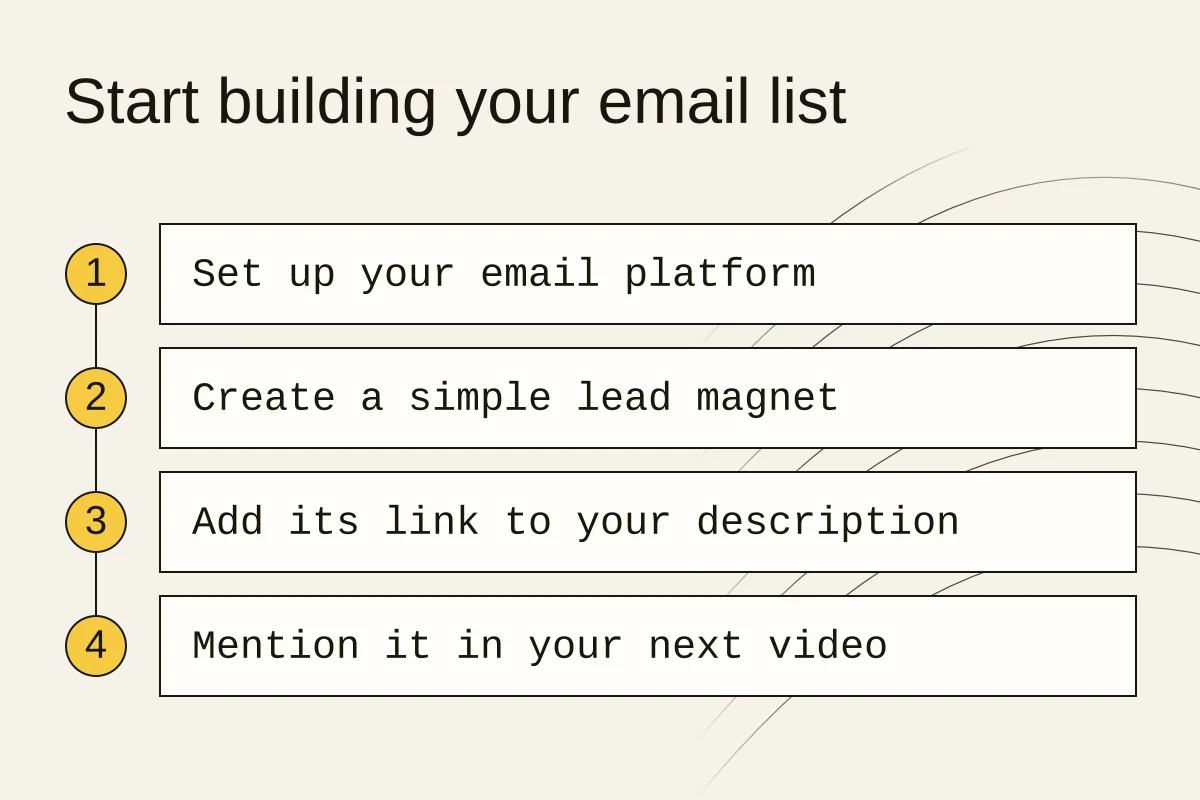
Set up the platform, create a simple lead magnet, add the link to your description, and mention it in your next video. That is the entire starting point. Everything else can be refined as you go.
Building Something That Lasts
YouTube channels rise and fall. Algorithms shift. Platforms change their rules. The creators who build lasting businesses are the ones who invest in assets they actually own, and an email list is the most durable of those assets.
Every subscriber on your list represents someone who raised their hand and said they want to hear from you directly. That is a different kind of relationship than a YouTube subscriber who may or may not see your next video. Treat it accordingly: show up consistently, give more than you ask for, and build the kind of list that subscribers actually look forward to hearing from.
The work of building it is not glamorous. It is writing emails, testing lead magnets, and mentioning a link at the end of videos. But done consistently over months and years, it becomes one of the most valuable things you have built as a creator.