The Evolution of Sponsorships: What's Next for YouTubers?
From Awkward Ad Reads to a Mature Industry
The first wave of YouTube sponsorships was, to put it plainly, a mess. Creators would cut to a jarring mid-video pause, read a script they clearly received 20 minutes before filming, and then snap back to their content like nothing happened. Viewers tolerated it. Brands accepted it. Nobody had a better model yet.
That era is over. What replaced it is a genuinely sophisticated industry with its own norms, pricing structures, performance expectations, and emerging technology. The brands spending money on YouTube today are not doing it as an experiment. They are doing it because it works, and they have the data to prove it: influencer marketing ROI averages $5.78 for every dollar spent.
Understanding where this industry is heading requires understanding how far it has already come, and why the next few years are likely to bring changes that make even the current model look primitive.
How the Sponsorship Model Actually Works
At its core, a YouTube sponsorship is a paid agreement where a brand gives a creator money (or products, or both) in exchange for promotion within their content. But the mechanics underneath that simple description have grown considerably more complex.
The Basic Deal Structure
Most sponsorships fall into a few categories. A dedicated video is exactly what it sounds like: the entire video is about the brand or product. An integrated sponsorship is a segment, usually 60 to 90 seconds, embedded within a longer video on a different topic. Then there are affiliate arrangements, where the creator earns a commission on sales driven through a unique link or discount code, sometimes combined with a flat fee and sometimes replacing it entirely.
The pricing for these deals varies enormously based on channel size, niche, audience demographics, and engagement rate. A creator with 500,000 subscribers in personal finance will typically command higher rates than a creator with twice that audience in general entertainment, because their viewers are more likely to act on financial product recommendations. Brands are not just buying eyeballs. They are buying access to a specific type of person at a specific moment of trust. A finance channel CPM with a 70% US audience, for instance, can reach $55 to $80, well above what general entertainment channels see.
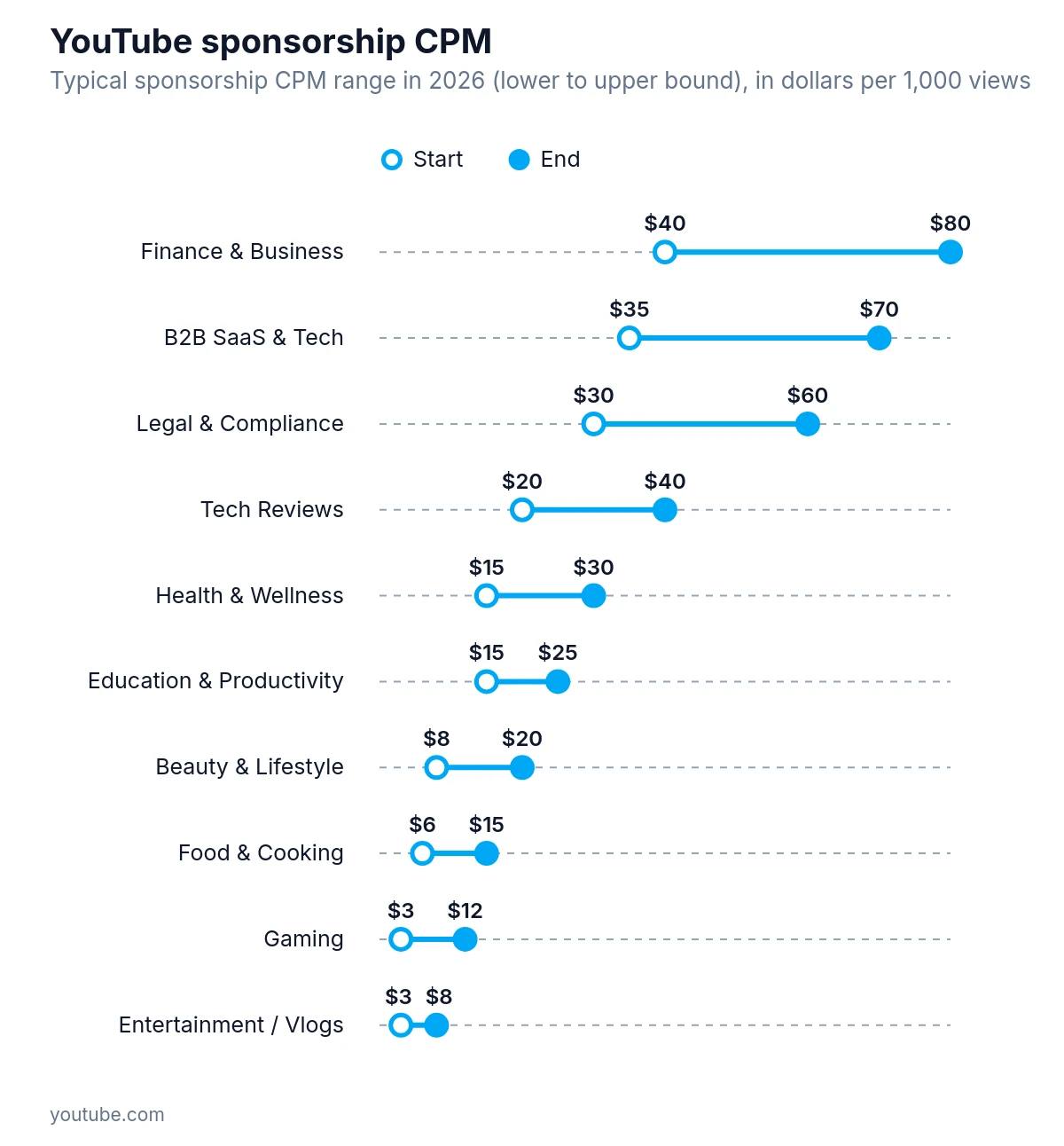
Finance and business channels command the highest typical sponsorship CPMs in 2026—about $40 to $80 per thousand views—while entertainment and vlogs sit at the low end, around $3 to $8.
For channels with around one million subscribers, flat fees for integrated sponsorships commonly range from a few thousand dollars to well over twenty thousand, depending on niche and engagement. Channels with tens of millions of subscribers can negotiate significantly more. But raw subscriber count has become a less reliable pricing signal than it once was, because brands have gotten smarter about what actually drives conversions.
The Role of the Middleman
Most sponsorship deals today do not happen through direct creator-brand contact. Talent agencies, multi-channel networks, and dedicated influencer marketing platforms sit between the two parties. These intermediaries handle negotiation, contracting, compliance, and sometimes campaign performance reporting.
For creators, this means more deal flow and less time spent on business development. For brands, it means access to a vetted roster of creators and standardized campaign management. The tradeoff is that agencies take a cut, typically somewhere between 15 and 30 percent of the deal value, which affects what creators actually receive.
Some creators, particularly those with large audiences and strong personal brands, have moved toward direct brand relationships to avoid this cut. Others prefer the agency layer because it insulates them from uncomfortable negotiations and keeps their audience-facing persona separate from their business operations.
The Metrics That Changed Everything
Early YouTube sponsorships were priced almost entirely on subscriber count and view averages. That made some sense when the platform was younger and the data was thin. But as YouTube's analytics tools matured, and as brands built internal teams with real expertise in creator marketing, the metrics that actually matter shifted.
Engagement Over Reach
Engagement rate, the ratio of likes, comments, and shares relative to views, became a key signal because it separates an active audience from a passive one. A creator with 2 million subscribers and a 1.2 percent engagement rate is often less valuable to a brand than one with 400,000 subscribers and a 6 percent engagement rate, because the smaller creator's audience is clearly more invested. Engagement actions like shares, comments, and favorites tell you that messages are resonating with an audience, which is exactly what brands are trying to measure.
Brands also started paying attention to comment sentiment. Are viewers recommending the product to each other in the comments? Are they asking follow-up questions? Or are they skipping past the sponsored segment and saying so openly? This kind of qualitative signal, which used to require manual reading, is increasingly being processed at scale through automated tools.
Conversion Tracking and Attribution
The biggest shift in how sponsorships are evaluated came from better attribution. When a creator includes a unique discount code or affiliate link, brands can directly measure how many purchases that creator drove. This turned YouTube sponsorships from a brand awareness play into something closer to performance marketing.
The implications were significant. Creators who drove strong conversions could justify higher rates even with smaller audiences. Creators with large audiences but low conversion rates found themselves in a weaker negotiating position. And brands began structuring deals with performance bonuses, paying a base rate plus additional compensation if certain conversion thresholds were hit.
This shift also changed which categories dominate YouTube sponsorships. Products that convert well through creator recommendations, things like software subscriptions, financial tools, health supplements, VPNs, and online learning platforms, became the most common sponsors. These are products where a trusted recommendation from a creator the viewer watches regularly can genuinely move someone from curiosity to purchase.
The Saturation Problem and How Creators Are Responding
By the early 2020s, a real problem had emerged: audiences were getting tired. On some channels, nearly every video carried a sponsorship. Viewers who subscribed for genuine content started feeling like they were watching extended commercials. The signs of ad fatigue are well documented: CTR drop-offs, engagement dips, negative comments, and rising CPAs. Some creators noticed their overall retention metrics dropping as audiences became conditioned to tune out.
The creators who handled this best were the ones who treated sponsorship selection as a content decision, not just a revenue decision. If a tech reviewer only sponsors products they have actually tested and would genuinely recommend, that selectivity itself becomes part of their brand identity. Viewers learn to trust that when this creator mentions a product, it is worth paying attention to.
The ones who struggled were those who took every available deal regardless of relevance. A cooking channel promoting a VPN service is a mismatch that audiences notice immediately, and it erodes the trust that makes creator sponsorships valuable in the first place.
Some creators have responded to saturation by moving toward fewer, deeper brand partnerships. Instead of six different sponsors across six videos in a month, they work with one or two brands over a longer period, integrating them more naturally and giving the relationship time to feel authentic. This approach tends to produce better conversion numbers for brands and less audience friction for creators.
What's Actually Changing Right Now
Several shifts are happening simultaneously that will reshape how YouTube sponsorships work over the next few years.
AI-Assisted Matching and Pricing
Influencer marketing platforms are increasingly using machine learning to match brands with creators based on audience overlap, content category alignment, and predicted conversion probability. This reduces the guesswork on both sides and is making it easier for mid-size creators (those with audiences in the 50,000 to 500,000 range) to access brand deals that previously went only to larger channels.
Automated pricing tools are also becoming more common. Rather than negotiating from scratch, some platforms now generate suggested rates based on channel metrics, historical performance data from similar creators, and current market demand. This is gradually standardizing pricing in a market that has historically been opaque.
Long-Form Content and the Return of Storytelling
YouTube's algorithm has increasingly favored longer videos, and brands have noticed. A 30-minute documentary-style video gives a creator far more room to integrate a sponsor naturally than a 7-minute explainer. Some brands are now funding long-form content directly, essentially acting as production sponsors rather than ad-segment buyers.
This model is closer to how branded content works in traditional media, and it changes the creative dynamic considerably. When a brand is funding an entire video rather than buying a 90-second slot, the conversation about creative control becomes more complicated. The best partnerships in this space are ones where the brand trusts the creator's editorial instincts and the creator genuinely believes in what they are promoting.
Creator-Owned Products and the Shift Away from Third-Party Sponsors
The most significant long-term trend may be creators building their own products and revenue streams rather than relying on brand deals. Beyond sponsored posts, creator revenue sources now include merchandise, courses, memberships, and software tools built directly for their own audiences, representing a fundamentally different economic model.
When a creator sells their own product, they capture the full margin instead of a flat sponsorship fee. They also have complete control over the product experience, which protects their reputation in a way that third-party sponsorships never fully can. A creator who recommends a brand's product is trusting that brand to deliver on the promise. A creator who sells their own product controls every part of that equation.
This shift is already visible across YouTube. Channels that once relied heavily on sponsorships have launched subscription communities, sold out merchandise drops, and built software tools with paying user bases. The sponsorship model is not disappearing, but for the most successful creators, it is becoming one revenue stream among several rather than the primary one.
Regulation and Disclosure Requirements
Advertising regulators in multiple countries have tightened their requirements around sponsored content disclosure. In the United States, the FTC disclosure guidance updated in 2023 states that disclosures in any interactive electronic medium, including social media, should be "unavoidable," and enforcement actions against creators and brands who obscure paid relationships have become more common.
This is pushing the industry toward clearer, more consistent disclosure practices. The verbal "this video is sponsored by" at the start of a segment, combined with a written disclosure in the description, has become the standard. YouTube itself has added a paid promotion checkbox that creators are expected to use.
For viewers, this is straightforwardly positive. For brands, it creates some additional friction but also builds the kind of transparency that sustains audience trust over time. The creators who have always been upfront about their commercial relationships are well-positioned here. Those who tried to blur the line between editorial and paid content are facing more scrutiny.
The Niches That Will Drive Sponsorship Growth
Not all content categories are equally attractive to brands, and the ones that are growing fastest tell an interesting story about where sponsorship money will flow.
Personal finance content has exploded on YouTube, and it attracts sponsors willing to pay premium rates because the audience is actively seeking financial products. The same applies to health and fitness, where supplement brands, fitness equipment companies, and health tracking apps compete for creator attention.
Gaming remains one of the largest categories by volume, though rates have been compressed by the sheer number of gaming creators. The more interesting growth is in gaming-adjacent content: hardware reviews, game development tutorials, and esports analysis, where audiences are smaller but more specialized.
The education category is growing quickly and attracting sponsors from software companies, online learning platforms, and productivity tool makers. A creator teaching data science or video editing has an audience that is actively trying to improve a skill, which makes them receptive to tools that help them do that.
Short-form content through YouTube Shorts is still figuring out its sponsorship model. The format is too brief for traditional integrated segments, and the audience behavior is different from long-form viewing. Some brands are experimenting with Shorts-specific deals, but the economics have not settled yet.
What Creators Should Actually Be Thinking About
For a creator building a channel today, the sponsorship question is not just "how do I get deals?" It is "what kind of commercial relationships support the content I want to make and the audience I want to build?"
Taking early deals from any brand willing to pay is understandable when revenue is thin, but it sets precedents that are hard to undo. An audience that sees a creator promote five unrelated products in their first year of growth will be less trusting of future recommendations than one that saw selective, relevant partnerships from the start.
The creators who will be in the strongest position five years from now are probably the ones who are building direct relationships with their audiences through memberships and owned products, using brand sponsorships selectively to supplement that income, and treating their audience's trust as the actual asset, not their subscriber count.
The Road Ahead for YouTube Sponsorships
The sponsorship market on YouTube is not going to shrink. If anything, it will grow as more brands recognize that creator-driven recommendations outperform traditional digital advertising in certain categories. But the form that growth takes will look different from the current model.
Expect more performance-based pricing, where creators share in the upside when their promotions drive strong results. Expect more long-term brand partnerships that look less like ad placements and more like genuine endorsements. Expect better tooling on both sides, making it easier to match the right brand with the right creator and measure what actually happens afterward.
And expect the most successful creators to be the ones who treat commercial relationships as something that has to earn its place in their content, rather than something they slot in because a check arrived. The audience always knows the difference, and the audience is ultimately what every brand is paying to reach.